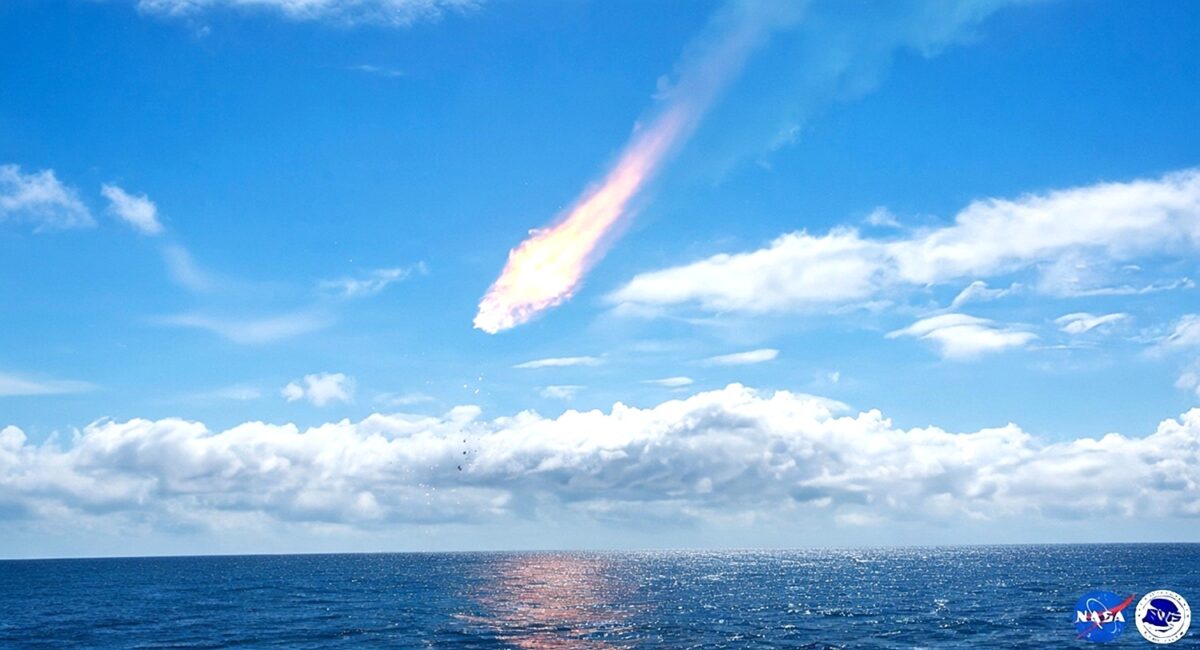
A massive Meteor Cleveland Ohio event on March 17, 2026, has been officially confirmed by NASA as a 6–7 ton asteroid fragment that exploded in Earth’s atmosphere, producing a bright fireball and a powerful sonic boom felt across multiple states.
In simple terms: what residents heard as a loud explosion wasn’t an earthquake or industrial blast—it was a space rock entering Earth’s atmosphere at roughly 45,000 mph, breaking apart high above northern Ohio and releasing energy comparable to hundreds of tons of TNT.
What Happened Over Cleveland, Ohio?
Shortly before 9:00 AM local time, residents across Cleveland and surrounding regions reported:
- A bright streak or fireball in the sky
- A sudden, thunder-like explosion
- Houses shaking and windows rattling
Within hours, scientists confirmed the cause: a daylight fireball meteor entering the atmosphere over Lake Erie and disintegrating mid-air.
This wasn’t subtle. It was visible across multiple states—even in daylight (which is rare for meteors of this type).
Key Facts About the Meteor (Verified Data)
Let’s break down the most critical verified details:
- Size: Around 6 feet (≈2 meters) in diameter
- Weight: Estimated 6–7 tons
- Speed: ~45,000 mph (72,000 km/h)
- Altitude at entry: ~50 miles above Earth
- Travel distance: ~34 miles before fragmentation
- Energy release: Equivalent to ~250 tons of TNT
- Visibility: Seen from Wisconsin to Maryland
- Time: Around 8:56–9:00 AM ET
From my experience covering atmospheric events, anything visible in broad daylight across multiple states is instantly categorized as a high-energy fireball—and this one fits that profile perfectly.
Why Was There a Loud Sonic Boom?
The boom that startled thousands wasn’t an explosion in the traditional sense.
It was a sonic boom.
Here’s what happened:
- The meteor entered Earth’s atmosphere at hypersonic speed
- It compressed air in front of it, forming shockwaves
- When those shockwaves reached the ground → BOOM
The effect was so strong that:
- Homes shook across Northeast Ohio
- Seismic instruments detected minor vibrations
- Emergency services received dozens of calls
This is exactly what happens when an object breaks the sound barrier on a massive scale—only this time, it came from space.
Where Did the Meteor Break Apart?
Data from weather satellites and observers suggests:
- Initial entry: Above Lake Erie
- Explosion (airburst): Near Valley City, Ohio
- Possible debris zone: Medina County region
Scientists believe most of the meteor burned up completely, but small fragments (called meteorites) may have reached the ground.
Was This Dangerous?
Here’s the straight answer:
No immediate danger was reported.
Despite the dramatic explosion:
- No injuries have been confirmed
- No major structural damage reported
- Most energy dissipated high in the atmosphere
That said, if this object had been larger—or entered at a steeper angle—the outcome could have been very different.
(For context, the 2013 Chelyabinsk meteor in Russia injured over 1,000 people—mostly from shattered glass.)
Why This Event Is So Rare
Events like the Meteor Cleveland Ohio fireball sit in a fascinating category:
- Small meteors enter Earth daily (mostly invisible)
- Large fireballs like this occur only a few times per year globally
- Daytime-visible fireballs? Even rarer
According to scientific estimates:
- Around 17,000 meteorites hit Earth annually
- But most are tiny and go unnoticed
This one stood out because of its size, speed, brightness, and timing.
Eyewitness Accounts: What People Saw and Felt
Across Ohio and neighboring states, reports flooded in:
- “It sounded like an explosion above the house”
- “The entire building shook for a few seconds”
- “I saw a bright flash—even in daylight”
More than 100–140 reports were logged with the American Meteor Society.
Some witnesses even captured:
- Dashcam footage
- Doorbell camera flashes
- Sky streaks lasting several seconds
NASA and NWS Confirmation
Both National Weather Service and NASA independently verified the event using:
- Satellite lightning detection systems
- Atmospheric flash sensors
- Eyewitness triangulation
Interestingly, the flash was initially mistaken for lightning—but there were no storms in the region, confirming it as a meteor explosion.
Could Meteor Fragments Be Found?
Possibly—but don’t expect large chunks.
Experts suggest:
- Any surviving pieces would be small, dark, rock-like fragments
- Likely scattered across rural areas
- Difficult to locate without precise tracking
Still, meteorite hunters are already scanning areas around Medina County.
And yes—these fragments can be scientifically valuable (some are older than Earth itself).
Final Analysis: Why This Event Matters
From a scientific and public-awareness perspective, this wasn’t just a “cool sky event.”
It was a reminder.
Earth is constantly interacting with space debris—and occasionally, we get a front-row seat.
The Meteor Cleveland Ohio 2026 event stands out because it combined:
- High energy
- Wide visibility
- Urban impact (psychological, not physical)
- Real-time scientific confirmation
In short: rare, dramatic, and scientifically important.
Conclusion
The March 17, 2026 fireball over Cleveland wasn’t an explosion, attack, or anomaly—it was a natural cosmic event, confirmed by NASA, involving a multi-ton asteroid fragment burning up in Earth’s atmosphere.
No damage. No danger. But definitely unforgettable.
And if there’s one takeaway here—it’s this:
Space isn’t as far away as it feels. Sometimes, it literally knocks on our door.