The Strait of Hormuz has effectively turned into a “parking lot of fire” as the Trump administration shifts from economic pressure to direct kinetic engagement. Under the newly launched “Project Freedom,” the U.S. Navy has begun active combat escorts for commercial vessels stranded in the world’s most critical maritime chokepoint, resulting in a series of high-stakes skirmishes where U.S. forces destroyed seven Iranian fast-attack craft. While the operation initially triggered a 0.8% dip in oil prices due to hopes of restored supply, subsequent Iranian missile strikes on UAE facilities have sent Brent crude surging back toward the $114 per barrel mark, pushing the April 8 ceasefire to the brink of total collapse.
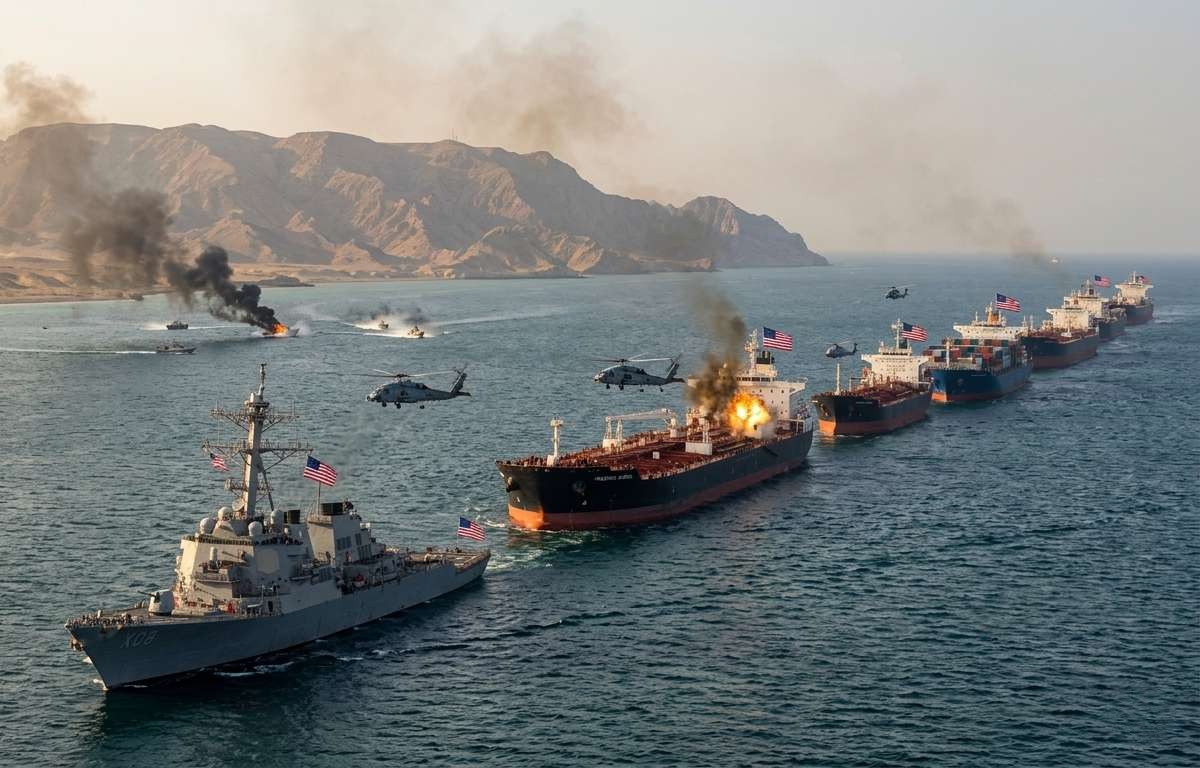
As of May 5, 2026, the U.S. Central Command (CENTCOM) confirms that the USS Truxtun and USS Mason have successfully guided the first wave of neutral merchant ships through the channel, despite a “sustained barrage” of Iranian drones and cruise missiles.
The Mechanics of Project Freedom: Ships, Steel, and Speedboats
From my years covering the Fifth Fleet’s movements in Bahrain, I can tell you this isn’t just “routine patrolling.” This is an aggressive maritime breakout. President Trump’s Project Freedom is a massive logistical undertaking involving over 15,000 service members and a “defensive umbrella” of land-based and carrier-borne aircraft.
The strategy is surgical:
- Tactical Escorts: Guided-missile destroyers are positioned as shields for “innocent bystander” vessels—specifically those running low on food and water after being trapped since February.
- The “Apache” Response: When Iranian Revolutionary Guard (IRGC) speedboats attempted to harass the convoy on Monday, U.S. Apache and Seahawk helicopters engaged immediately. According to Livemint’s regional reports, six Iranian boats were neutralized within 20 minutes of the first provocation.
- Mine Clearing: U.S. forces have reportedly cleared a safe “blue lane” through waters previously seeded with Iranian naval mines.
The Escalation: Iranian Barrage and the “Warning Shot” Fallacy
Tehran’s response has been anything but “symbolic.” While Iranian state television framed their missile launches as “warning shots,” the reality on the ground (and water) is far more lethal.
The United Arab Emirates (UAE) has been the primary collateral victim in the last 24 hours. The Fujairah Oil Industry Zone, the region’s largest storage hub, was struck by an Iranian drone—the first such strike since the ceasefire began. This follows a volley of 12 ballistic missiles and three cruise missiles launched toward UAE territory, highlighting that Iran is willing to burn the neighborhood to maintain its “toll booth” at Hormuz.
“If Iran targets U.S. ships during Project Freedom, they will be blown off the face of the Earth,” Trump told reporters on Monday (a typical piece of high-octane rhetoric that, frankly, leaves very little room for diplomatic face-saving).
Oil Market Whiplash: Why the “Freedom Dip” Didn’t Last
For a brief window on Monday morning, the markets breathed a sigh of relief. As Times of India reported, Brent crude futures dropped by 64 cents on the news of the escort. The logic was simple: more ships moving equals more supply.
However, that “Freedom Dip” was wiped out by Tuesday morning.
- The Insurance Factor: Lloyds of London and other major insurers are reportedly hiking premiums for any vessel entering the Gulf, essentially canceling out the benefit of the U.S. escort.
- The UAE Strikes: The hit on Fujairah sent prices skyrocketing by 6% in a single day, with Brent closing at $114.44.
- The Dual Blockade: We are currently in a bizarre economic stalemate. The U.S. is blockading Iranian exports, while Iran is blockading the entire Persian Gulf.
The Geopolitical Tightrope: Is the Ceasefire Dead?
The Islamabad Talks that led to the April 8 ceasefire are now effectively a dead letter. While Wikipedia’s 2026 Iran War logs still list the status as a “fragile truce,” the kinetic reality suggests otherwise.
Trump’s move to bypass negotiations and “guide” ships out is a direct challenge to Iran’s claim of sovereignty over the Strait. Iran’s top negotiator has warned that the standoff has “not even started,” suggesting that the IRGC may resort to sub-surface assets (submarines) or more extensive mining if Project Freedom continues.
Editorial Conclusion: A Humanitarian Shield or a War Starter?
The Trump administration is framing Project Freedom as a humanitarian mission to rescue 20,000 seafarers caught in a “volatility trap.” In practice, it is the most significant test of American naval power in the 21st century.
From an editorial perspective, the risk is clear: by turning merchant ships into “bait” to force a naval confrontation, the U.S. is betting that Iran will blink before a full-scale regional conflagration erupts. My concern? Iran has already proven it is willing to strike U.S. allies (UAE) to prove its point. The next 72 hours will determine if Project Freedom is a brilliant tactical pivot or the opening salvo of a much larger, darker conflict.