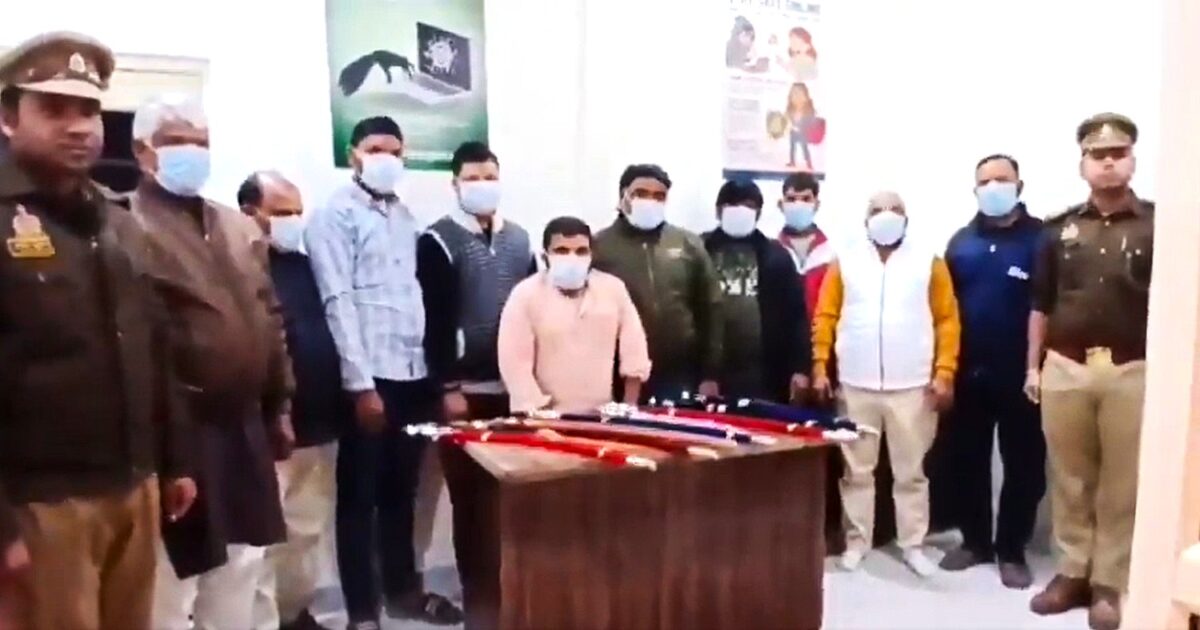
In a startling break from normalcy on December 29–30, 2025, Ghaziabad police arrested 10 members of the Hindu Raksha Dal (HRD) for allegedly distributing swords and other edged weapons in Shalimar Garden Colony, Uttar Pradesh — an act that raised serious law-and-order, communal harmony, and public safety concerns. The country’s attention turned sharply to the region after multiple viral social media videos showed activists handing out weapons and raising charged slogans. The HRD’s national president, Bhupendra Chaudhary — widely known as Pinky Chaudhary — has been named in the FIR but remains absconding as authorities intensify their search.
What Happened? Immediate Facts
Police in Ghaziabad arrested 10 Hindu Raksha Dal members linked to the distribution of swords from the HRD office in Shalimar Garden, registering a FIR against 16 identified and ~25–30 unidentified individuals under sections of the new Bharatiya Nyaya Sanhita relating to rioting, use of deadly weapons, and wrongful confinement. Law enforcement also launched wider raids in search of Pinky Chaudhary, the outfit’s leader, who has evaded arrest and defended the group’s actions as “self-defense” in light of recent violence against Hindus in Bangladesh.
In essence: weapon distribution + political mobilization + communal rhetoric = serious public order breach — prompting immediate police intervention.
1. Scene in Shalimar Garden: What Police and Videos Reveal
Viral Footage and Public Reaction
Multiple videos circulated online showing individuals at a makeshift HRD stall displaying and handing out swords, machetes, and axes to passers-by — unlicensed, unregulated, and in a residential area. The footage further shows participants chanting slogans and parading with weapons.
The public outcry was swift: residents expressed fear and frustration, local politicians condemned the act, and police responded within hours — appearing to treat the event as not merely an assembly but a potential public safety risk and trigger for communal violence.
Police Action and FIR
Ghaziabad’s Shalimar Garden Police Station filed an FIR on December 29, naming 16 individuals and roughly 25–30 unidentified persons. So far:
- 10 HRD members arrested and identified (names include Kapil Kumar, Shyam Prasad, Amit Singh, Amit Arora, Devendra Baghel, Ujala Singh, among others).
- Pinky Chaudhary (Bhupendra Chaudhary), HRD chief, absconding.
- Multiple recovery operations (weapons seized from suspects).
- Police are conducting raids to capture remaining accused.
Cases are registered under:
- Bharatiya Nyaya Sanhita Section 191(2): Rioting
- Section 191(3): Rioting with deadly weapons
- Section 127(2): Wrongful confinement
- Criminal Law (Amendment) Act provisions, further adding weight to charges against alleged incitement.
2. Leader Pinky Chaudhary: Public Defence and Legal Status
Who Is Pinky Chaudhary?
Bhupendra Chaudhary, alias Pinky Chaudhary, is the national president of Hindu Raksha Dal, a fringe Hindutva organisation with a history of controversial actions in the Delhi–NCR region. Earlier episodes include alleged involvement in clashes and protest-related violence.
Chaudhary’s Public Statements
In a video posted while evading arrest, Chaudhary claimed:
- The swords were distributed to help Hindu families defend themselves in a climate of fear triggered by violence against Hindus in Bangladesh — specifically citing reported attacks and deaths.
- He asserted that Hindus must be “well-equipped” to protect themselves.
- He dismissed the act as criminal, framing it as part of a defensive response to perceived threats.
Legal and Enforcement Implications
Chaudhary’s absconding status significantly complicates proceedings. Law enforcement officials have explicitly indicated that they are pursuing legal avenues to:
- Track and arrest him using CCTV footage and digital evidence.
- Add further charges based on ongoing findings.
- Prevent escalation of tensions locally.
3. Context: Why This Sparked National Debate
Ties to Cross-Border Violence
The HRD members defended their actions by referring to an incident in Bangladesh where a Hindu man was allegedly attacked and killed — a sensitive subject that has reverberated across Indian political discourse.
Yet law enforcement and civil society figures caution that weapon distribution in public spaces, especially when tied to communal rhetoric, is neither lawful nor conducive to peace.
Political Fallout
Politicians from opposition parties swiftly criticised not only the HRD but elements of the broader ideological ecosystem:
- Congress MP Manickam Tagore publicly blamed the Rashtriya Swayamsevak Sangh (RSS) for “hate planting” and said such actions are symptomatic of prolonged communal polarisation.
- Others questioned the impact on communal harmony and social stability in a state already sensitive to religious fault lines.
Whether this becomes a larger legislative or judicial case remains to be seen.
4. Legal Framework: Why the Police Acted
Under Indian law:
- Carrying and distributing swords or deadly weapons in public places is regulated and typically requires licensing — especially when done outside controlled training environments.
- Actions perceived as incitement to violence or disrupting public peace fall under serious criminal statutes.
- The Bharatiya Nyaya Sanhita (which replaced the Indian Penal Code in many respects) still has stringent provisions for rioting and unlawful assembly, particularly when weapons and communal slogans are involved.
Police have emphasised they are pursuing charges that match the severity of conduct observed in the videos, not merely possession of weapons.
5. Local Reaction: Residents and Community Impact
Shalimar Garden locals reported alarm at seeing swords and machetes handed out like flyers. Many expressed fear that such acts could unsettle community peace:
- Some said they felt unsafe seeing weapons distributed without regulation.
- Others expressed relief at police action but concern about longer aftershocks on communal relations.
Local leaders and resident groups have demanded heightened patrolling and assurance of no recurrence.
6. What Happens Next? Police and Judicial Path
Ongoing Investigations
Police continue to:
- Track and arrest remaining accused including Chaudhary.
- Analyze video and digital data to establish individual roles.
- Examine whether the hawking of cold weapons extended beyond the immediate group and whether any participants were coerced.
Potential Judicial Proceedings
If apprehended, Chaudhary and others could face multiple charges under the Bharatiya Nyaya Sanhita, with possible implications for bail, evidence presentation, and legal precedents in cases involving weapon distribution for “self-defense.” Evidence extraction will be closely scrutinised in courts given the nuance between intent, action, and public safety risk.
Conclusion: A Dangerous Mix of Rhetoric and Real Weapons
This incident is emblematic of a volatile moment in Indian civic life — where social media visuals, fringe organisation activity, national politics, and communal anxieties converge into a potent mix.
Ghaziabad police acted swiftly, arresting 10 members and opening a comprehensive FIR, yet the real test will be:
- Whether law enforcement can apprehend the absconding leader.
- How courts adjudicate the interplay between self-defense claims and public order breaches.
- What broader impact this incident will have on communal harmony and political rhetoric ahead of future elections.
Local residents, legal experts, and political analysts alike will be watching closely.