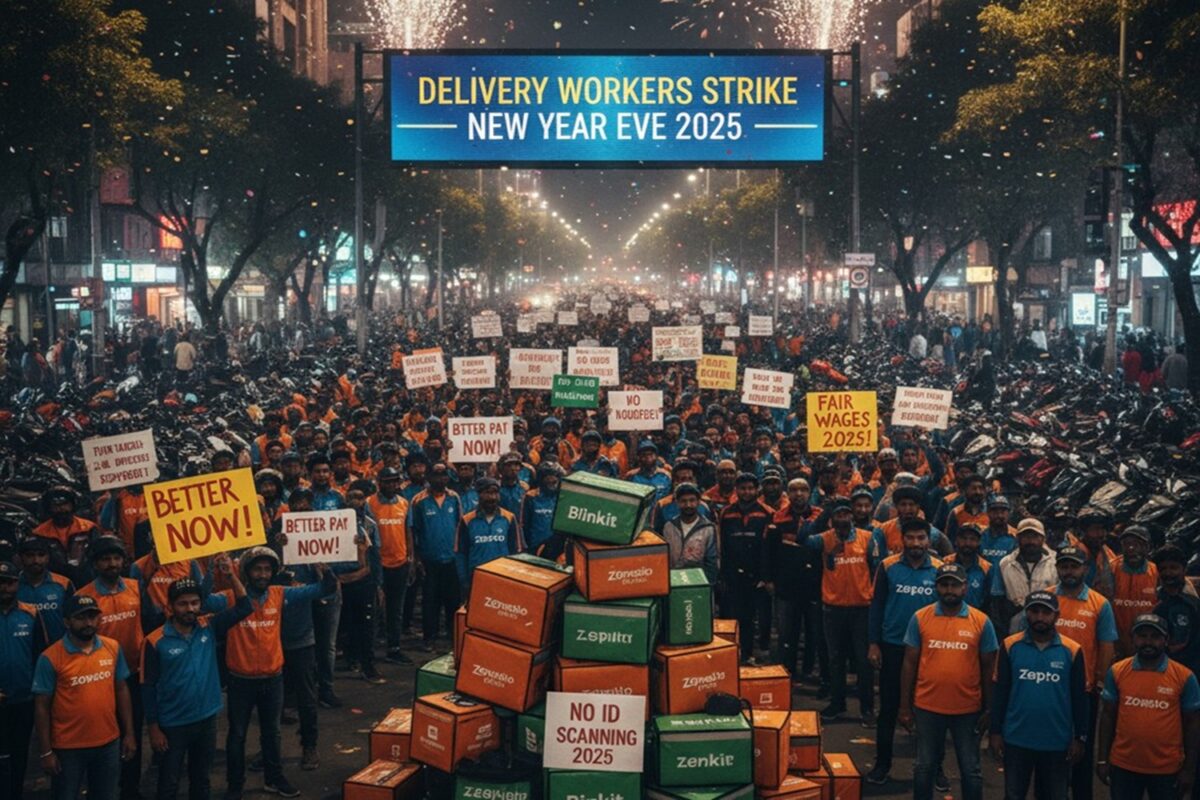
On December 31, 2025, thousands of delivery workers from India’s major food and quick-commerce platforms — including Zomato, Swiggy, Blinkit and Zepto — launched a nationwide strike, logging off their apps or refusing assignments to demand higher pay, safer working conditions, an end to arbitrary ID bans and limits on ultra-tight delivery timelines like “10-minute delivery.” This strike — backed by unions including the Telangana Gig and Platform Workers Union (TGPWU) and the Indian Federation of App-Based Transport Workers (IFAT) — threatens significant disruptions to deliveries on one of the busiest food-and-grocery ordering nights of the year.
Why the Strike Matters on New Year’s Eve
December 31 isn’t just another day for India’s delivery ecosystem — it’s a peak moment when millions rely on food and grocery deliveries to celebrate with family and friends. Yet, long-standing grievances — shrinking per-order pay, unsafe delivery pressures, and lack of basic worker rights or social security protections — boiled over into a coordinated strike that could upend the festive night.
Delivery platforms typically earn massive order volumes on New Year’s Eve, but many workers argue the compensation hasn’t kept pace with rising costs, and algorithm-driven pressures — especially ultra-tight “10-minute” delivery targets baked into apps — are creating unsafe and exploitative work conditions.
How the Strike Unfolded
Who’s Participating
- Thousands of delivery riders and quick-commerce workers across India
- Represented by multiple unions, including TGPWU and IFAT
- Participation reported in major states including Telangana, Karnataka, Maharashtra, Delhi-NCR and West Bengal
What Workers Are Doing
Unlike traditional protests at a site, many workers simply logged out of their delivery apps on New Year’s Eve — effectively halting orders from being accepted or fulfilled. This digital strike — in a sector without classic union structures — leverages the very platform algorithms that workers say exploit them.
In some areas, platforms have reportedly pressed workers to stay logged in, and businesses have warned about potential ID suspensions for non-participation, heightening tensions.
Industry Response
- Zomato and Swiggy announced higher incentives (e.g., ₹120–₹150 per order, peak-hour bonuses and waived penalties) to counter strike impact, a move the companies described as part of their usual year-end operating protocols — but which unions see as antidotal rather than structural.
- Platforms are also advertising higher earning opportunities for delivery partners during this period, including offers of up to ₹10,000 over the New Year’s Eve and New Year’s Day period.
Core Worker Demands
The strike isn’t simply about a one-night income boost — workers have articulated a comprehensive set of demands aimed at restructuring how gig work is managed:
1. Fair Pay and Minimum Rates
- Demand for minimum per-kilometre payment floors (e.g., ₹20 per km)
- Workers want a minimum monthly income guarantee rather than purely commission-based earnings.
2. Safety and Humane Workloads
- Removal of “10-minute delivery” and similar ultra-rapid delivery mandates, which workers say encourage reckless driving and unsafe conditions.
- Limits on mandatory peak hours and excessive working hours.
3. Employment Status & Worker Rights
Gig workers want recognition beyond “platform partners,” seeking:
- Formal recognition under labour law
- Basic protections such as paid leave, insurance, maternity/emergency leave, and grievance redressal with human support rather than automated AI systems.
4. End to Arbitrary Penalties and ID Bans
Workers argue that platforms often block delivery IDs arbitrarily — cutting off access to work — over missed targets or algorithmic ratings, without transparent processes or appeal mechanisms.
Economic and Social Impact
On Consumers
Reports from multiple sources indicate that in many localities, food and grocery deliveries were significantly disrupted on New Year’s Eve — leaving customers without access to apps like Swiggy or Zomato for their celebratory plans.
On Retailers & FMCG Brands
Anticipating disruption, several brands — including PepsiCo, Nestlé, Coca-Cola and Britannia — increased stock in retail outlets and kirana stores to compensate for expected delivery shortfalls.
On the Platforms
Gig platforms are facing a dual challenge:
- Maintain operational continuity on their busiest night of the year
- Respond to mounting systemic pressure for structural reforms — pressure that cannot be eased by temporary bonuses alone.
Broader Context: Gig Work in India’s Digital Economy
India’s gig economy — particularly in delivery and platform services — has grown explosively over the last decade, driven by urbanization, smartphone penetration and on-demand consumption. Estimates suggest millions of workers are active in the sector, though official labour statistics lag behind the actual scale. Many of these workers are classified as independent contractors, not employees, leaving them without standard worker safeguards like minimum wages or social security.
These systemic issues have repeatedly surfaced in strikes and protests earlier in 2025, including actions on December 25, where services were reportedly disrupted in several cities, foreshadowing the larger New Year’s Eve mobilization.
Voices from the Ground
Union leaders and workers have been vocal:
“The December 25 action sent a clear warning… falling earnings, unsafe delivery pressure, and loss of dignity at work… no dialogue from employers.” — Joint statement by TGPWU and IFAT.
Workers also argue that algorithm-driven performance metrics make app-based delivery one of the most stressful and unstable jobs in the modern Indian labour market.
What Happens Next?
Government Engagement
The unions have urged federal and state governments to step in and facilitate tripartite discussions under labour law frameworks — a move that could redefine gig work regulation in India.
Platform Reforms
The strike is pushing platforms to reconsider not just payouts but worker interfaces, safety protocols, deliverable timelines and grievance systems — areas long criticized by workers and consumer advocates.
Consumer Choices
For customers, the strike highlights a moment to think about the human cost of convenience — and whether solidarity with workers’ rights might factor into future ordering decisions.
Conclusion — A Strike with Structural Implications
The nationwide delivery workers’ strike on New Year’s Eve 2025 is more than a temporary protest on a single night. It underscores deep structural tensions in India’s gig economy — between corporate interests in speed and scale, and the basic rights, safety and dignity of the workers who power these services. With widespread participation, clear demands spanning pay and protections, and visible impact on both services and market responses, this strike may reshape how platforms, workers and policymakers interact in the years ahead.