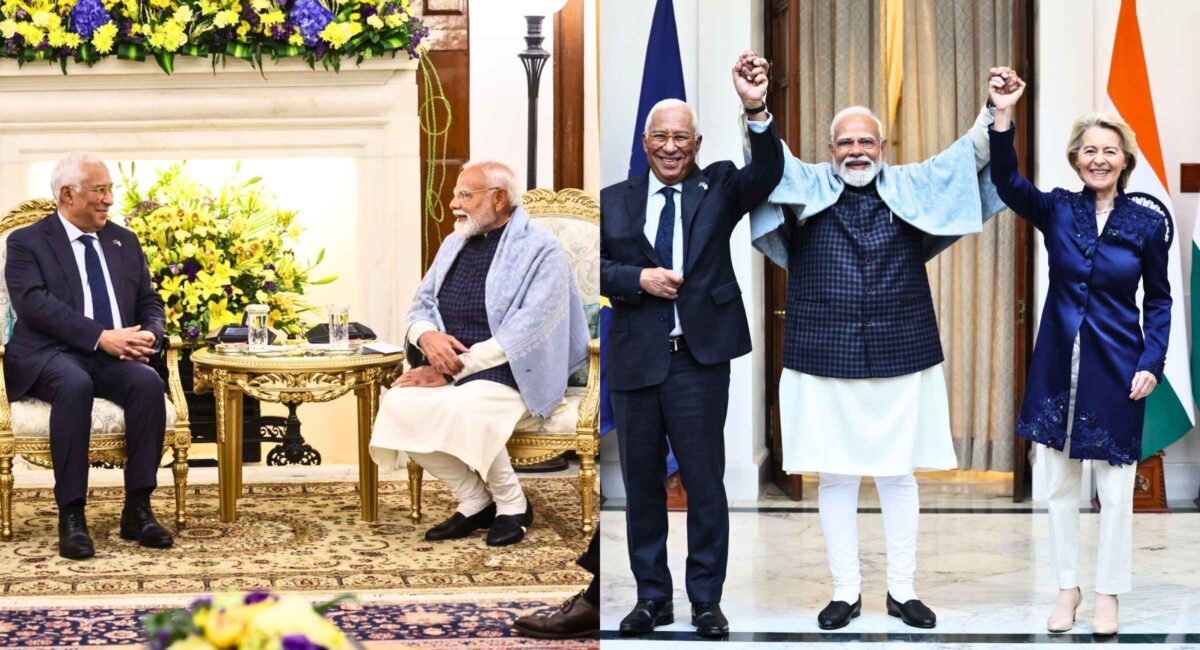
In a landmark breakthrough for global trade, India and the European Union (EU) have formally concluded and signed the long-awaited Free Trade Agreement (FTA) — widely hailed as the “Mother of All Deals” — setting the stage for deep tariff cuts across a massive swath of goods, expanded mobility for skilled professionals and students, and new legal pathways for economic cooperation. This historic pact — after nearly 20 years of negotiations — signals a strategic realignment in global commerce and is expected to reshape trade flows between India and the EU.
Key Takeaways at a Glance
- India and EU sign landmark FTA on 27 January 2026.
- Covers ~99% of Indian exports and 97.5% of EU exports with tariff cuts.
- Major tariff reductions on cars, wines, chemicals, textiles, jewelry.
- Includes services liberalization and mobility for skilled workers and students.
- Expected to be implemented within 2026 post-ratification.
What Is the India EU FTA and Why It Matters
The India-EU FTA (Free Trade Agreement) signed on 27 January 2026 is a comprehensive trade and economic pact that will eliminate or significantly reduce tariffs on over 90% of goods traded between India and the EU, liberalize services trade, facilitate investment, and include frameworks for mobility of skilled workers and students — a rare inclusion for trade agreements of this scale. This deal — set to be implemented within 2026 upon ratification — is expected to link markets representing roughly 2 billion people and about one-third of global GDP, making it one of the most consequential trade deals of the decade.
Why the Deal Is Called the “Mother of All Deals”
Unprecedented Market Access
- India will receive zero-duty access for an estimated 99% of its exports to the EU over time — from textiles and apparel to chemicals, plastics and gems & jewellery — dramatically boosting its export potential.
- The EU will provide duty breaks on 97.5% of its exports to India, covering machinery, electronics, pharmaceutical products and more.
Geopolitical and Economic Scale
- Prime Minister Narendra Modi and EU leaders pointed to the deal’s coverage of about one-third of global trade and 25% of global GDP, underlining its economic heft and geopolitical weight at a time of rising trade tensions globally.
Historic Negotiation Arc
- Talks began under the Broad-based Trade and Investment Agreement (BTIA) framework nearly two decades ago and were stalled multiple times due to disagreements over market access and regulatory standards. The 2026 agreement marks the successful culmination of those efforts.
Major Tariff Cuts and Trade Implications
1. Cars and Automobiles
European cars — traditionally subject to import duties as high as 110% in India — will see phased tariff reductions down toward 10% under quota arrangements over time. This gradual opening is designed to balance domestic industry protection with market access.
Why it’s significant: Lower duties will make premium European brands like Mercedes-Benz, BMW and Audi more accessible in India, potentially reshaping the luxury auto segment and deepening cross-border supply chains.
2. Wine, Spirits and Consumer Goods
Tariffs on products like wine and spirits are being cut substantially — in some brackets from over 150% down to around 20-30% — making EU beverages more competitively priced for Indian consumers.
Impact: This could reshape consumption patterns and boost premium beverage imports from France, Spain and Italy.
3. Textiles, Chemicals, Leather and Jewellery
- Indian textiles, leather goods, sports goods, marine products, gems & jewellery and other labor-intensive sectors will gain zero-tariff access to the EU market, lifting barriers that have long constrained exports.
- Specifically, the gems and jewellery sector — a strategic export industry — is expected to see exports double to around $10 billion over the next few years thanks to tariff elimination and improved margins.
4. Chemicals, Machinery and Industrial Inputs
Tariffs up to 44% on machinery and chemicals will be eliminated in stages, lowering costs for manufacturers on both sides and encouraging cross-border investment.
Trade in Services and Mobility Elements
The pact goes beyond goods to liberalize services trade, including business, transport and professional services. Perhaps most notably:
- Commitments on mobility of skilled workers and post-study work visas for Indian professionals and students were agreed, marking one of the most robust mobility frameworks in any trade deal to date.
This element acknowledges that talent — not just goods — is a cornerstone of modern economic cooperation. Skilled Indian engineers, IT professionals and service experts will have clearer legal pathways to work and study in EU member countries, strengthening people-to-people ties and addressing labor shortages in key sectors.
Strategic Dimensions Beyond Tariffs
Supply Chain Integration
By cutting duties and regulatory barriers, the FTA aims to deepen supply chain integration, particularly for sectors where India and the EU have complementary strengths — like pharmaceuticals, electronics and automotive parts.
From my decade covering trade negotiations, such integration rarely happens without a clear balance: both sides need rules that protect strategic industries while enabling competitive advantage. This deal appears to reflect that balance.
Climate, Standards and Regulatory Chapters
While core agricultural protections (like dairy) remain politically sensitive and largely outside the scope, the agreement incorporates chapters on digital trade, sanitary standards, intellectual property and technical barriers to trade — essential for high-standards commerce in the 21st century.
Economic Forecasts and Market Reactions
Growth Projections
- Bilateral trade — currently around $136 billion — is projected to exceed $200 billion within 3-4 years of implementation.
- Services trade, now estimated at roughly $80-85 billion, may climb toward $125 billion as market access expands.
Stock Market Movement
Indian markets reacted positively to the news, with major indices like the Sensex rallying strongly on expectations of export growth and investment flows.
Political and Global Context
India’s Prime Minister described the deal as a historic achievement that will anchor India’s role in a shifting global order, while EU leaders have spotlighted the pact’s strategic importance amid economic competition with the United States and China.
The agreement also comes as a statement of shared commitment amid geopolitical uncertainties — from supply chain realignments to climate and defense dialogues.
Next Steps: Ratification and Implementation Timeline
While the political signing has taken place, legal scrubbing, translation into 24 EU languages, and ratification by the European Parliament, EU member states, and India’s Parliament are required before enforcement.
Officials have stated hopes to see the agreement enter into force within 2026, with full implementation and tariff schedules rolling out over subsequent years.
Conclusion: A Transformative Trade Architecture
The India-EU FTA 2026 isn’t just another trade agreement. It’s a strategic pact that reshapes commerce, mobility and geopolitical alignment between two major global actors. With tariff cuts spanning cars, wines, chemicals, textiles, and jewelry — and mechanisms to enable skilled mobility and student exchanges — this deal sets a new benchmark for 21st-century trade architecture.
From the corridors of Delhi to Brussels, this pact reflects decades of negotiation — and, more importantly, decades of ambition for deeper economic partnership.
Editorial Opinion: In a world brimming with trade fragmentation, the India-EU FTA stands out not because it eliminates tariffs (other deals have done that) but because it connects economic opportunity with structural cooperation — offering a blueprint for how trade, talent and innovation can move freely without diluting sovereign priorities.