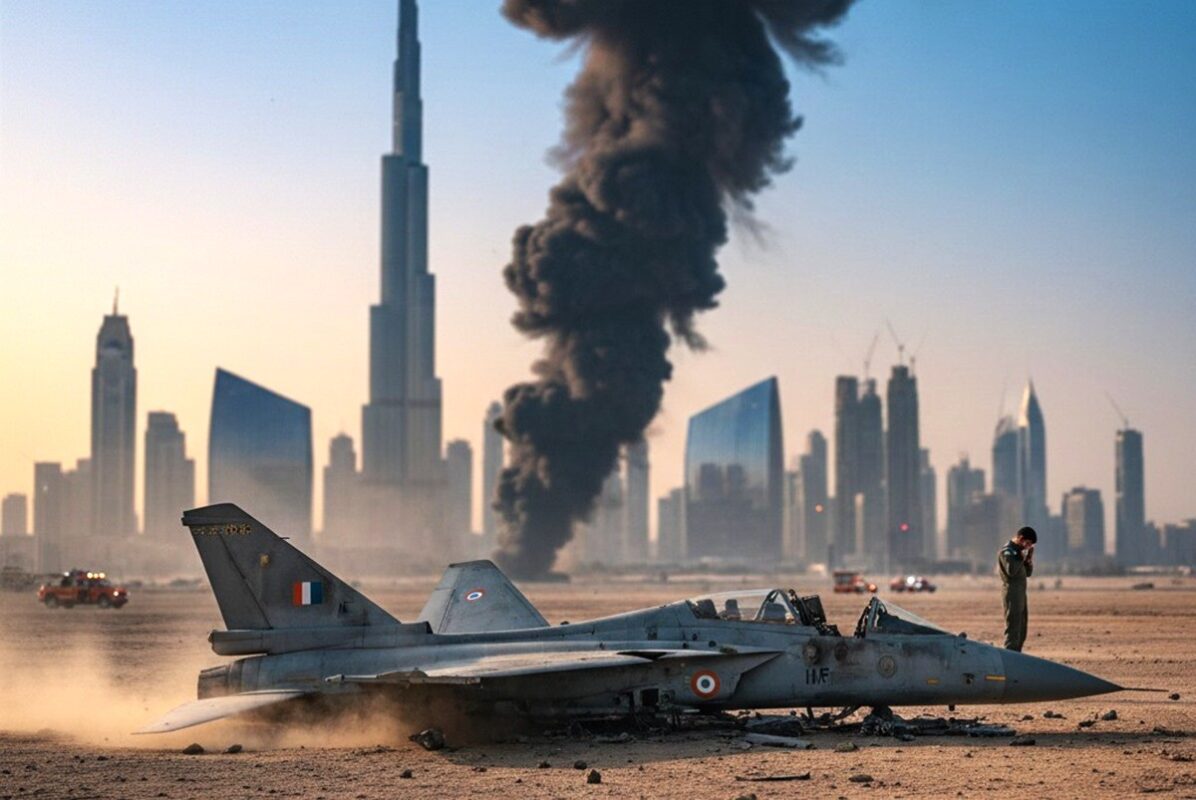
A HAL Tejas light combat aircraft of the Indian Air Force (IAF) crashed in a dramatic and tragic accident during an aerial demonstration at the Dubai Airshow on Friday, killing the pilot, Wing Commander Namansh Syal, the IAF confirmed. The incident has triggered shock across India, prompting a court of inquiry to investigate the cause of the mishap.
The Crash: What Happened
According to the IAF’s statement, the Tejas jet suffered an “accident” during a low-altitude aerobatic display at Al Maktoum International Airport, and the pilot sustained fatal injuries. Eyewitnesses reported that the aircraft, after executing a maneuver, abruptly lost altitude, plunged toward the ground, and burst into flames. Video footage circulating on social media captured a plume of thick black smoke rising from the impact site.
Initial reports from sources close to the investigation suggest that the Tejas may have failed to recover from a “negative-G turn” — a high-risk maneuver at low altitude that leaves very little margin for error. This aligns with accounts from multiple media outlets, though the exact cause is yet to be confirmed.
Who Was Wing Commander Namansh Syal?
The pilot has been identified as Wing Commander Namansh Syal, 34, originally from Kangra district in Himachal Pradesh. A decorated and experienced officer, he belonged to the IAF’s No. 45 Squadron (“Flying Daggers”) based at Sulur Air Base.
Syal joined the IAF in December 2009 and is survived by his wife (also an IAF officer), their six-year-old daughter, and his parents. His death has been widely mourned, with senior leaders and public figures expressing grief. Himachal Pradesh Chief Minister Sukhvinder Singh Sukhu called him “brave, dutiful, and courageous.” Actor-turned-politician Kamal Haasan also offered condolences, calling Syal “India’s pride.”
Why Did the Tejas Crash? Exploring Possible Causes
While the full circumstances are still under investigation, several early hypotheses have emerged:
- Aerobatic Maneuver Risk
According to multiple sources, the jet may have attempted a “negative-G turn” — a difficult manoeuvre that reduces lift and demands precise control, especially at low altitude. If the aircraft failed to pull out in time, there may not have been enough altitude to recover, leading to a catastrophic descent. - Aircraft Limitations or Mechanical Fault
The Tejas is powered by a General Electric F404 engine and has been under scrutiny for its design envelope and safety profile. Some defense experts suggest a mechanical failure — such as engine stall or flight control issue — cannot yet be ruled out. - Pilot Error or Miscalculation
Although Wing Commander Syal was a highly experienced display pilot, it is possible that a miscalculation in speed, angle, or load factor could have contributed, especially in a high-performance, low-altitude demonstration. However, many analysts caution against speculative blame until the inquiry concludes.
Inquiry Launched: Next Steps
In response to the tragedy, the Indian Air Force has constituted a court of inquiry to determine the precise factors behind the crash. The investigation is expected to examine cockpit data, witness statements, and any available telemetry or video evidence.
Hindustan Aeronautics Limited (HAL), the manufacturer of the Tejas, expressed its condolences and said it would fully cooperate with the IAF in the inquiry process.
Senior defense leadership, including the Chief of Defence Staff, also issued statements mourning the loss and affirming institutional support for the investigation and the bereaved family.
How Rare Is a Tejas Crash?
This accident marks only the second publicly known crash involving the Tejas since its induction into service. The first occurred in March 2024 near Jaisalmer, when a pilot safely ejected during a training exercise.
Despite its youth, the Tejas — India’s indigenously developed light combat aircraft — has become central to the IAF’s modernization efforts. Still, this fatal crash raises fresh questions about the aircraft’s safety in high-risk display environments.
The Legacy of Wing Commander Syal
For many in India, Wing Commander Syal’s death is more than a technical tragedy — it is deeply personal. He is being remembered as a humble, committed officer who lived for flying and served his country with distinction.
Social media has been flooded with tributes: on Reddit, dozens of users expressed sorrow and respect. One user wrote,
“Rest in peace warrior … you will be remembered.”
His loss leaves a void not only in his squadron but also in the hearts of fellow officers and citizens who saw in him a symbol of national pride and sacrifice.
What This Means for India’s Air Power
The crash comes at a sensitive moment for India’s defense ambitions. The Tejas plays a critical role in the IAF’s push to reduce dependence on older Soviet-era fighters.
Questions that now demand answers include:
- Is the Tejas safe for future international display deployments?
- What technical or procedural safeguards might need strengthening?
- Will this incident slow down or alter India’s plans for further Tejas procurement and export?
As the court of inquiry unfolds, the IAF and HAL will be under close scrutiny — both to ensure accountability and to reaffirm confidence in India’s homegrown jet.
Closing Thoughts
Wing Commander Namansh Syal’s death is a profound loss. He was a decorated, dedicated pilot representing India on a global stage. The outcome of the inquiry into the Tejas crash Dubai will not only provide technical clarity but also shape the future of India’s indigenous aerospace ambitions.
For now, the nation mourns — and watches closely, hoping that lessons learned will honor his sacrifice and prevent future tragedies.