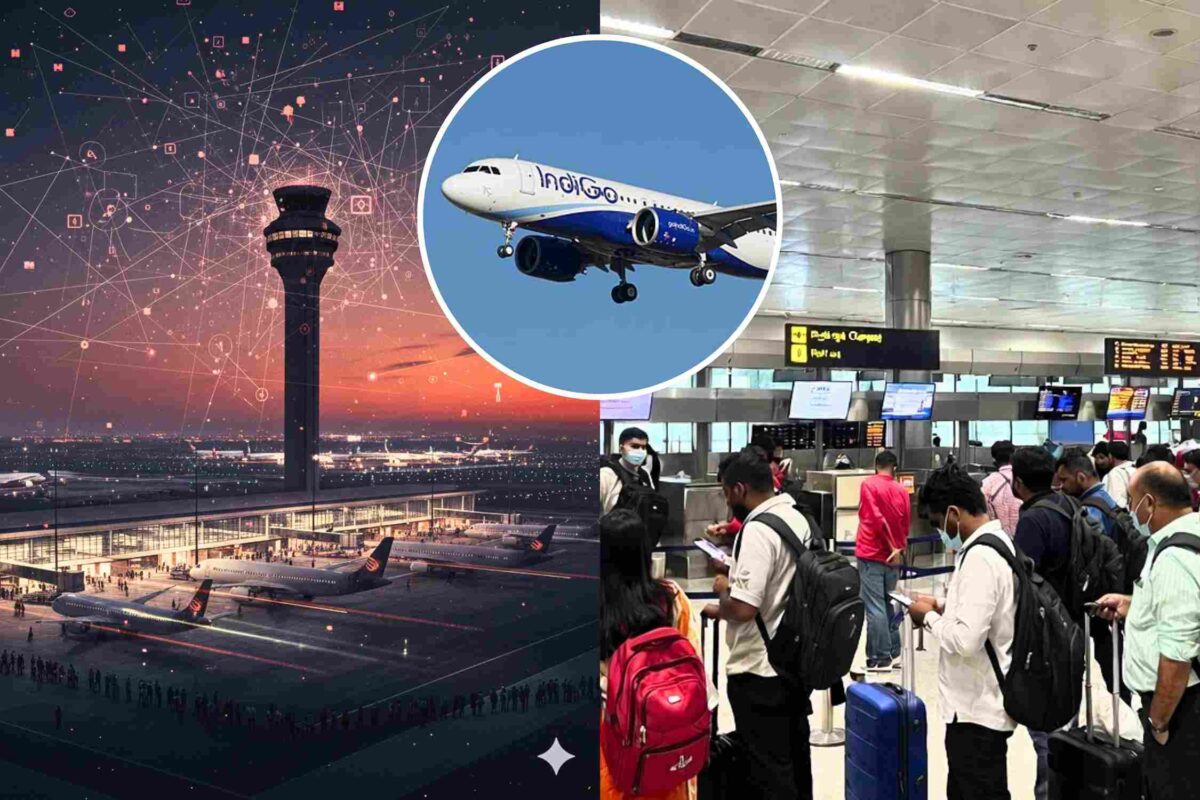
New Delhi, Nov 8, 2025 — A major air-traffic control (ATC) system glitch disrupted flight operations at Indira Gandhi International (IGI) Airport in Delhi on Friday, 7 November 2025, leading to over 800 flight delays and more than 120 cancellations, according to airport and airline officials. Normal operations resumed by Saturday morning, but passengers described scenes of long queues, stranded travelers and overnight waiting inside terminals.
The issue, which began around 10:15 a.m. local time, affected radar and communication links used by Delhi’s ATC center, forcing controllers to manually space takeoffs and landings for nearly five hours — a rare but significant breakdown in India’s busiest airport system.
“An intermittent technical fault occurred in the communication subsystem, leading to reduced runway movements,” a senior Directorate General of Civil Aviation (DGCA) official said, as quoted by Reuters on Friday.
Massive Disruption: Hundreds of Flights Delayed
During the disruption period, domestic carriers such as IndiGo, Air India, Vistara and SpiceJet reported widespread delays across both domestic and international terminals.
According to data from FlightRadar24 and DGCA tracking, by 6 p.m., nearly 820 flights were delayed, while around 125 flights — including both departures and arrivals — were cancelled altogether.
IndiGo, India’s largest airline, reported the highest number of affected flights, accounting for more than 40% of the total delays. Vistara and Air India also faced cascading schedule changes, with aircraft and crew availability heavily impacted through the night.
Airport officials said all three runways remained operational, but movements were slowed due to manual coordination. “No safety compromise occurred at any stage, but throughput was reduced to ensure separation and communication reliability,” the official added.
Cause of the Glitch: Communication System Failure
Preliminary findings suggest that the communication subsystem connecting Delhi’s air-traffic control radar consoles to aircraft was briefly disconnected, possibly due to a software synchronization error in a newly-installed automation system.
The Airports Authority of India (AAI) said in a statement that “a fault was detected in the ATC communication network at Delhi Control Centre,” and that engineers restored full connectivity around 3:20 p.m. using a backup line.
The system is being jointly reviewed by AAI, Bharat Electronics Ltd (BEL), and the Ministry of Civil Aviation.
According to The Times of India, some airlines initially suspected a power surge in the radar subsystem, but AAI confirmed that “the glitch was software-related and not electrical.” Officials ruled out any cyber-attack or security breach.
What Passengers Experienced at Delhi Airport
Passengers took to social media platforms such as X (formerly Twitter) and Instagram to share images of long queues, crowded gates, and screens showing “Delayed” for nearly every major airline.
Many reported being stuck at Terminal 3 for several hours without updates.
“We were inside the aircraft for two hours before takeoff clearance came,” said Shubham Mehra, a traveler bound for Mumbai. “The crew tried to keep everyone calm, but nobody knew when the systems would come back.”
Food courts and lounges remained packed through the day, while some passengers chose to stay overnight at nearby airport hotels when flights were rescheduled past midnight. Airport authorities confirmed that “essential passenger services remained available,” including Wi-Fi, lounges, and rest areas.
Current Status: Operations Normal Again
By Saturday morning, 8 November, Delhi International Airport Limited (DIAL) announced that all flight operations had returned to normal.
In a statement shared with Reuters, DIAL said:
“Normal flight operations have resumed at IGI Airport. The earlier delay was due to an ATC technical glitch that has now been rectified. Airlines are advised to re-synchronize schedules to minimize residual impact.”
Airlines began clearing the backlog by midday Saturday, but residual delays persisted for some international flights connecting through the Gulf, Southeast Asia and Europe.
Which Airlines Were Most Delayed
Based on DGCA data from Friday evening:
- IndiGo: Approx. 360 flights delayed, 45 cancelled
- Air India: 190 delayed, 25 cancelled
- Vistara: 120 delayed, 15 cancelled
- SpiceJet: 80 delayed, 10 cancelled
- Others (Akasa Air, Air Asia India, Go First): 70 delayed, 5 cancelled
The pattern mirrored earlier analyses of punctuality trends: IndiGo, which operates the largest domestic network, often shows the highest volume of delays simply due to scale. However, overall on-time performance (OTP) for all Indian carriers on 7 Nov fell below 40%, compared with the usual 82–85% average, according to DGCA.
What to Do If Your Flight Is Delayed
According to India’s Passenger Charter Regulations, if a domestic flight is delayed more than two hours, passengers are entitled to refreshments or meals and free rescheduling or cancellation.
Airlines including IndiGo and Air India confirmed they were providing vouchers and no-fee rebooking options to affected travelers. For international passengers, the applicable compensation varies by ticket class and destination.
Those with long layovers can stay overnight at Delhi Airport’s Aerocity hotels or at the Transit Hotel inside Terminal 3, which allows stays on an hourly basis. The airport remains open 24 hours, and facilities such as sleeping pods, lounges, and dining areas operate round-the-clock.
Why It Matters: India’s Air Traffic Growth
Delhi’s IGI Airport handles over 1,400 flight movements daily, making it the busiest in India and among the top 10 globally by traffic. Any technical disruption therefore has a cascading impact across the domestic network.
Analysts said the event underscores the urgent need to modernize India’s air-traffic infrastructure, as air travel demand surges post-pandemic.
“Even short outages in automation systems can paralyze major hubs,” said aviation analyst Ajay Singh. “Redundant networks and faster failover mechanisms must become standard at high-density airports.”
The Civil Aviation Ministry said it would conduct a comprehensive technical audit of ATC systems at Delhi, Mumbai, Bengaluru and Hyderabad airports within the next month.
Outlook
As of Saturday evening, flight schedules at IGI Airport have largely normalized, though some long-haul services are still operating with minor delays due to aircraft repositioning. Authorities say a detailed report on the 7 November ATC glitch will be submitted to the government within ten days.
For now, travelers are advised to check flight status updates directly with airlines before heading to the airport.