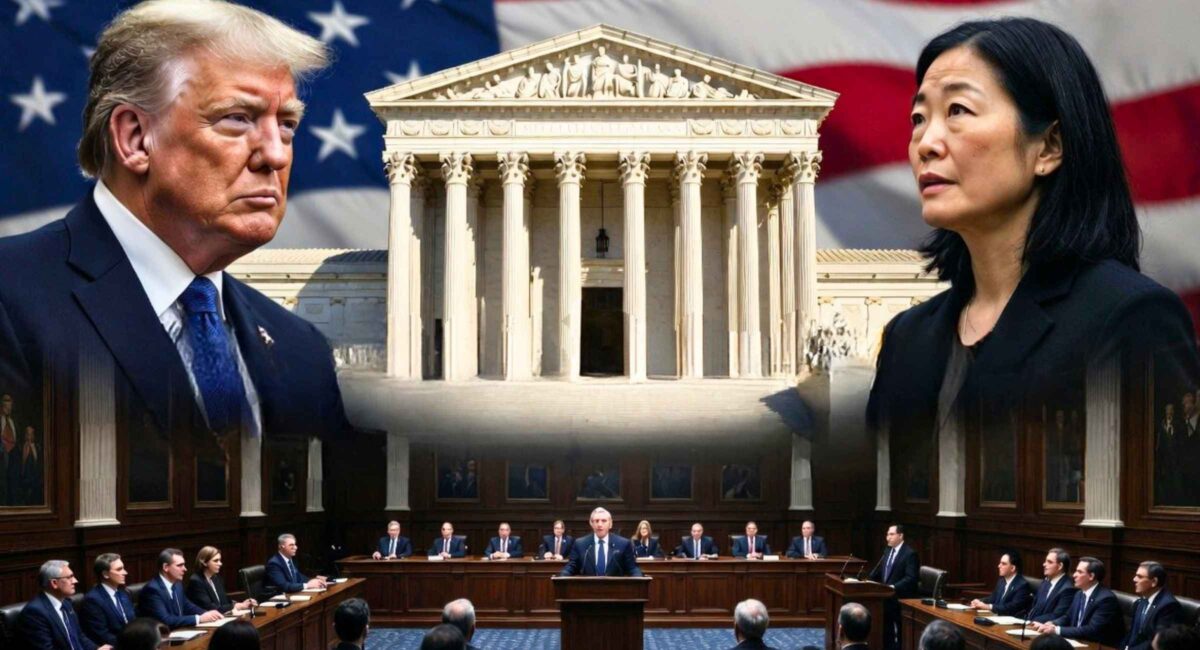
The Supreme Court birthright citizenship case in April 2026 appears to be leaning against Donald Trump’s effort to restrict automatic citizenship. During oral arguments, a majority of justices—including conservatives—expressed clear skepticism toward the administration’s legal theory, raising serious doubts that the policy will survive constitutional scrutiny.
What Happened in the Supreme Court
- Donald Trump personally attended oral arguments—a historic first for a sitting U.S. president
- Solicitor General John Sauer defended the policy restricting birthright citizenship
- Justices—including Amy Coney Barrett and Neil Gorsuch—pressed the government with difficult questions
- The Court appeared inclined to uphold birthright citizenship under the 14th Amendment
In short: the administration faced a tough courtroom—and may face a tough ruling.
Trump’s Unprecedented Move: Sitting Inside the Courtroom
Let’s start with what made this hearing extraordinary.
Donald Trump didn’t just file the case—he showed up.
- He became the first sitting U.S. president to attend Supreme Court oral arguments
- He sat in the front row during the government’s presentation
- He left shortly after his legal team finished arguing
From years of covering legal institutions, I can tell you:
This isn’t normal. Presidents typically keep a distance from the Court to preserve institutional independence.
His presence sent a message—political stakes here are enormous.
The Core Legal Battle: What “Birthright Citizenship” Really Means
At the heart of the case is one sentence from the Constitution:
“All persons born or naturalized in the United States, and subject to the jurisdiction thereof, are citizens…”
That’s the 14th Amendment, ratified in 1868.
The Trump Administration’s Argument
The administration claims:
- The phrase “subject to the jurisdiction thereof” excludes:
- Undocumented immigrants
- Temporary visa holders
- Citizenship should depend on parental “domicile” or allegiance
In practical terms, the policy could deny citizenship to hundreds of thousands of children born annually in the U.S.
The Opposition Argument (ACLU and States)
Argued by Cecilia Wang of the ACLU, the counterpoint is blunt:
- Birthright citizenship has been settled law for over 125 years
- The 1898 case United States v. Wong Kim Ark confirmed it
- Changing it would create a stateless underclass of children
That last point carried weight in the courtroom.
Justices Push Back — Even Conservatives Show Doubt
This is where the hearing took a decisive turn.
Amy Coney Barrett: “Puzzling” Logic
Justice Amy Coney Barrett repeatedly questioned:
- Why the Constitution doesn’t mention bloodline (jus sanguinis) if that’s what it intended
- How the government’s interpretation could be applied consistently
She described parts of the argument as “puzzling”—not a word justices use lightly.
Neil Gorsuch: The “Native Americans” Moment
Justice Neil Gorsuch delivered one of the most revealing exchanges.
He asked:
- Would Native Americans qualify as birthright citizens under the government’s test?
Sauer hesitated and responded:
“I think so.”
Gorsuch’s response—“I’ll take the yes”—highlighted a deeper issue:
The government’s framework wasn’t fully coherent.
Chief Justice John Roberts: “Quirky” and “Idiosyncratic”
Chief Justice John Roberts didn’t hold back either.
He described parts of the administration’s legal reasoning as:
- “Quirky”
- “Idiosyncratic”
That’s judicial language for: this argument doesn’t quite hold together.
Brett Kavanaugh: A Key Question
Justice Brett Kavanaugh pressed a fundamental point:
- Why does the 14th Amendment use different wording than earlier laws?
- If intent was the same, why not say it clearly?
It’s a simple question—but a difficult one to answer convincingly.
Sauer Under Pressure — A Difficult Defense
From a courtroom dynamics perspective, this was tough to watch.
- Sauer faced continuous questioning from both liberal and conservative justices
- At times, his arguments appeared:
- Overly complex
- Historically inconsistent
- Difficult to apply in practice
Even more telling:
Justices repeatedly returned to the same issue—workability.
How would the government:
- Determine parental status at birth?
- Handle disputed cases?
- Avoid bureaucratic chaos?
No clear answers emerged.
Why This Case Matters Far Beyond Immigration
It’s tempting to view this as just another immigration case.
It’s not.
This Is About Constitutional Power
If the Court allows this policy:
- A president could reinterpret constitutional rights via executive order
- Long-standing precedent could be overturned without Congress
That’s a massive shift.
The Risk of a “Stateless Generation”
Legal experts warned that denying birthright citizenship could:
- Leave children without any nationality
- Create a permanent non-citizen class
- Trigger global legal complications
This concern came up repeatedly during arguments.
Public Reaction — Protests and Political Fallout
Outside the Court:
- Protesters gathered in support of birthright citizenship
- Democratic-led states formally opposed the policy
- Trump continued to defend his stance publicly
This isn’t just a legal fight—it’s a political flashpoint.
What Happens Next
The timeline is now clear:
- Oral arguments: April 1, 2026
- Decision expected: by June 2026
Based on courtroom signals:
- A majority of justices appear inclined to reject the policy
- But the final ruling could include:
- Narrow decisions
- Multiple concurring opinions
- Complex legal reasoning
In other words: expect nuance, not simplicity.
Final Analysis: A Defining Test of the Constitution
The Supreme Court birthright citizenship case may become one of the most consequential rulings in decades.
Here’s the bottom line:
- The administration is trying to redefine a core constitutional guarantee
- The Court appears deeply skeptical of that effort
- Even conservative justices are questioning the logic
From an editorial perspective, this feels like a moment of institutional clarity.
The Court isn’t just deciding an immigration policy.
It’s deciding whether 150+ years of constitutional interpretation can be rewritten by executive action.
And right now, the signals suggest:
That’s a very high bar—and one the administration may not clear.