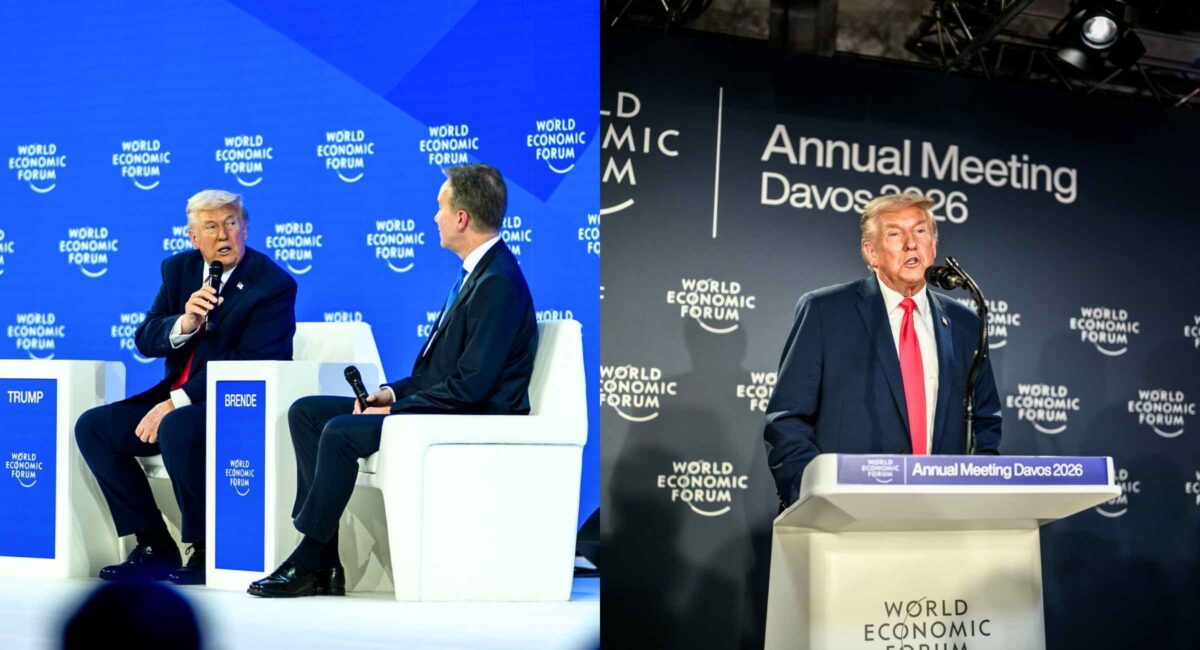
In a dramatic pivot at the World Economic Forum in Davos on January 21, 2026, President Donald Trump announced that he and NATO Secretary-General Mark Rutte have agreed on a “framework of a future deal” concerning Greenland and the broader Arctic region, effectively shelving his threatened tariffs on eight European nations that had rattled transatlantic markets and alliance cohesion. While the framework stops short of transferring sovereignty — Denmark’s red line — it signals a renewed emphasis on Arctic security cooperation and a shift away from coercive trade leverage previously floated by Trump.
What Was Announced at Davos — The Deal Framework
Details from the Trump-Rutte Meeting
At the snowy Swiss gathering of global leaders, Trump took to his social platform to declare that:
“**Based upon a very productive meeting that I have had with the Secretary-General of NATO, Mark Rutte, we have formed the framework of a future deal with respect to Greenland and, in fact, the entire Arctic Region.”’
Importantly:
- Trump withdrew planned tariffs that were to take effect on February 1 against European allies over resistance to U.S. demands related to Greenland.
- He emphasized the framework would be “great for the United States and all NATO Nations.”
- Discussions on the “Golden Dome” missile defense system — a proposed strategic shield — would continue as part of broader Arctic security talks.
But that’s where certainty ends: the exact mechanics, timelines, and obligations within this “framework” remain largely undefined publicly, even as leaders tout it as a breakthrough in de-escalating one of the most unusual diplomatic crises in recent memory.
Why This Matters — Easing Transatlantic Tensions
Just days earlier, Trump’s aggressive posture — including threats to use tariffs as leverage to force European concessions on Greenland — had knocked global markets and alarmed allies in Washington, Brussels, and Copenhagen.
From Tariff Brinkmanship to Diplomacy
The tariff threats targeted nations including Denmark, Norway, Sweden, France, Germany, the UK, the Netherlands and Finland, and were set to hit imports starting February 1. Trump conditioned removal of the tariff threat on progress in talks about U.S. interests in the Arctic, including strategic defense and mineral access.
That approach, rare among U.S. presidents, sparked concern among NATO allies and within markets. But at Davos:
- Trump dialed back escalation by cancelling the tariff threat in public remarks tied to the deal framework.
- He also clarified that military force is not on the table, casting the dispute back into the realm of negotiation rather than confrontation.
For European leaders — particularly in Copenhagen — that was a meaningful, if cautious, relief. While sovereignty over Greenland remains a non-negotiable “red line,” the thaw in rhetoric has opened a door to higher-level discussions on collective Western cooperation in the Arctic.
What the NATO Role Really Is
Strategic Security Not Sovereignty Transfer
NATO’s Mark Rutte emphasized that while there’s a shared interest in Arctic defense, Greenland’s political status with Denmark was not part of the negotiations — and did not come up in detail in his discussions with Trump.
Instead, Rutte portrayed the agreement as a forward-looking plan to bolster allied readiness and cooperation against growing Russian and Chinese activity in the region.
What Rutte didn’t do — and what Denmark has publicly insisted upon — is agree to any change in Greenland’s legal status:
- Danish officials have repeatedly stated Greenland is not for sale and reaffirmed that sovereignty and self-determination are protected under international law.
Thus, the current deal is better understood as a diplomatic bridge — a means of defusing immediate tensions and refocusing on shared security goals, rather than handing over territory or altering NATO’s legal arrangements.
Political Reactions Across Europe and the U.S.
This pivot has drawn a spectrum of responses.
European Allies — Relief and Skepticism
European capitals welcomed the easing of tariff threats and the emphasis on diplomacy, but many remain cautious. Danish foreign officials greeted the framework as an opportunity to “sit down and address security concerns while respecting sovereignty.”
At the same time, critics argue the real details are thin: it’s a concept rather than a signed treaty, and both Danish and Greenlandic representatives have not been central to the negotiations thus far.
U.S. Domestic Politics — Mixed Signals
Domestically, Trump framed the agreement as an affirmation of U.S. influence and alliances, saying the framework would endure and benefit all NATO members. But the episode has also yielded mixed reactions:
- Supporters laud Trump for extracting concessions without losing face.
- Opponents question the vagueness of the framework and criticize Trump’s earlier approach as unnecessarily provocative and destabilizing.
Arctic Security and the Golden Dome
A recurring theme in Trump’s Davos remarks was the strategic importance of Greenland and the Arctic:
- Trump linked the region to the proposed “Golden Dome” missile defense system, a high-profile defense initiative with astronomical budget implications and symbolic importance for national security planners.
- The Arctic’s geopolitical value — sitting astride potential shipping routes, rare earth minerals, and strategic airspace — has long been recognized by defense analysts. The current framework, as described by Trump and Rutte, would allow NATO allies to coordinate defense efforts more closely in the region, without undermining Danish sovereignty.
This aligns with broader Western concerns about Russian and Chinese influence in the High North, where melting sea ice is opening new economic and military access.
What’s Next — Negotiations, Not Headlines
The crucial takeaway from Davos isn’t that Greenland has “changed hands,” nor that NATO has signed a finalized treaty. Rather, what was announced is a framework for future negotiations — a broad outline of cooperation that may include defense, economic, and scientific components, but which must still be hashed out in detailed talks.
Officials on all sides will now likely return to capital discussions:
- Denmark and Greenlandic authorities will seek inclusion in substantive talks.
- NATO will clarify its role and scope.
- European Union members may weigh in on trade and security coordination.
- U.S. legislators and defense planners will interpret the framework through domestic political and budgetary lenses.
Only through these multilayered negotiations will a durable deal — if one is achievable — be realized.
Conclusion — A Turning Point, Not a Treaty
Trump’s Greenland news from Davos represents a pivotal moment in a geopolitical saga that has captivated capitals from Copenhagen to Washington. The withdrawal of tariff threats and the announcement of an Arctic framework with NATO’s chief have eased immediate diplomatic pressure and opened a path toward collaborative security dialogue. Yet the fundamental questions — sovereignty, legal authority, and the balance of power in the Arctic — remain unresolved.
In essence, what emerged from Davos is a strategic framework, not a signed agreement: a recognition that allied cooperation in the Arctic is preferred to unilateral brinkmanship, and that diplomacy — not coercion — will shape the region’s future.