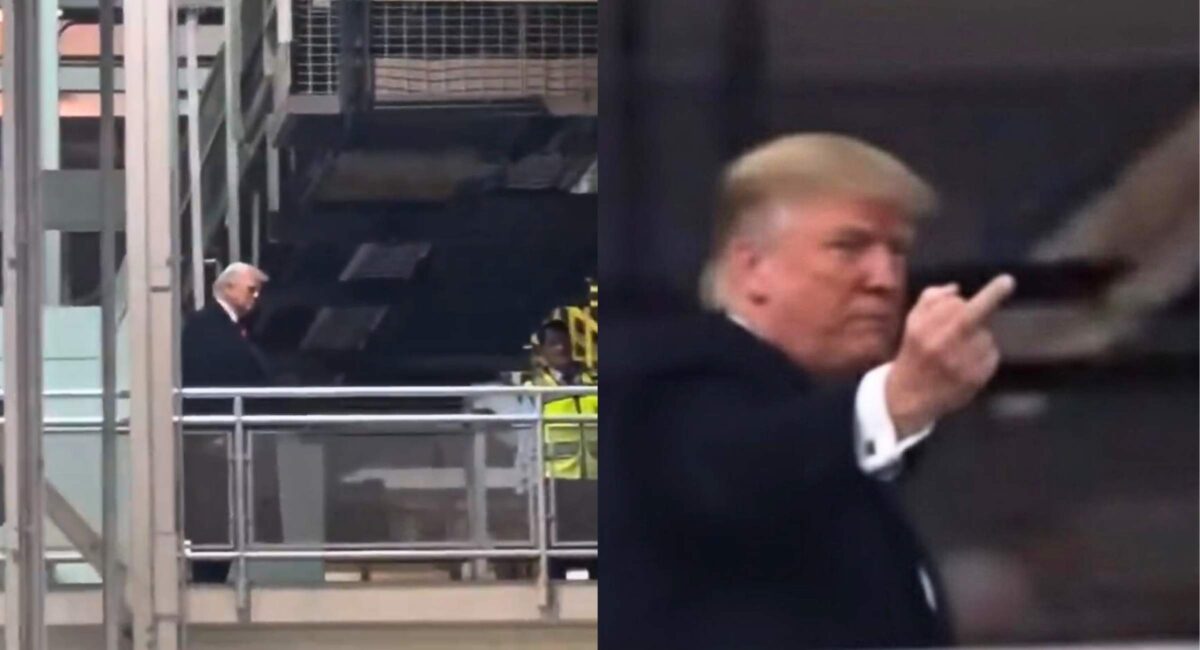
Former President Donald Trump raised his middle finger and mouthed a profanity at a heckling United Auto Workers (UAW) employee — identified as TJ Sabula — during a highly publicized visit to the Ford F-150 assembly plant in Dearborn, Michigan, on Tuesday, January 13, 2026. The exchange was captured in a viral video that quickly spread across social media. Following the confrontation — which pivoted on Sabula shouting a controversial accusation tied to Trump’s handling of the Epstein files — Sabula was suspended from his job pending an internal investigation. Supporters have since launched a GoFundMe campaign that has raised tens of thousands of dollars, while the White House defended Trump’s response as “appropriate” given the circumstances.
During a tour of a Ford factory in Dearborn, Trump responded to a heckler, TJ Sabula, by raising his middle finger and saying “f–k you” after being accused of protecting pedophiles. Sabula, a UAW Local 600 line worker, was suspended from his job pending review. A GoFundMe for Sabula has raised substantial donations, and the White House publicly backed Trump’s reaction, saying the worker’s behavior warranted the response.
Viral Video and What Sparked the Exchange
The confrontation began when Sabula — a 40-year-old line worker at the Dearborn Ford plant — shouted “pedophile protector!” at Trump as he walked along an elevated walkway during the visit. Videos first published by TMZ show Trump briefly turning toward Sabula, mouthing an expletive before raising his middle finger as he continued walking. As the video circulated online, it ignited widespread discussion about presidential conduct and free speech in the workplace.
According to multiple accounts, including Reuters and The Washington Post, the precise wording of Sabula’s remark was difficult to hear in the video, but observers and sources reported it was tied to Trump’s controversial handling of files connected to convicted sex offender Jeffrey Epstein — a topic that has lingered in political debate.
Who Is TJ Sabula and Why He Shouted
Sabula has described himself as a political independent who had never voted for Trump, though he supported other Republican candidates in the past. He told reporters that he intentionally confronted Trump to hold him accountable for his administration’s handling of Epstein-related documents and that he had “no regrets whatsoever” about his outburst — even after being suspended from his job.
“I don’t feel as though fate looks upon you often, and when it does, you better be ready to seize the opportunity,” Sabula said in a statement reported to The Washington Post, elaborating on his choice to speak out. Despite his public stance, he expressed concern that the punishment may be politically motivated — that his suspension was not simply a workplace matter but reprisal for embarrassing the former president in front of company leadership and allies.
Ford’s Response and Workplace Conduct Rules
Ford’s public communications on the incident were measured. A spokesperson emphasized the company’s commitment to respectful conduct within its facilities and confirmed that the company does not condone inappropriate language or actions by employees — but declined to comment on individual personnel decisions. This aligns with typical corporate policy, which can enforce disciplinary action for conduct seen as disruptive or against workplace guidelines, even when political speech is involved.
The UAW has not publicly commented on Sabula’s situation as of this writing, though union members and supporters have discussed the case in online forums and social communities. Whether the union will formally intervene — as some have urged — remains uncertain. (Discussion among supporters on social platforms indicates some are calling for union backing, though this is not yet reflected in official UAW statements.)
White House Defends Trump’s Reaction
In a rare public statement, White House Communications Director Steven Cheung defended Trump’s conduct, describing Sabula as a “lunatic” whose profanity-laced outburst justified the president’s reaction. Cheung described Trump’s gesture as “appropriate and unambiguous,” framing the episode as a response to instigating behavior rather than an unprovoked action.
This defense underscores how the administration viewed the confrontation — not as a breach of decorum, but as a justified pushback against aggressive heckling. Critics, of course, see the gesture as emblematic of a broader erosion of standards for public officials. The polarized reactions reflect the deep political divides shaping U.S. discourse in early 2026.
GoFundMe Campaign: Support From Sympathizers
Amid the fallout, a GoFundMe campaign in support of Sabula has emerged and quickly gained traction. Reports indicate the fundraiser has already raised tens of thousands of dollars, reflecting strong backing from individuals who view Sabula’s action as a stand for free expression or political protest. (Figures reported vary widely on social platforms, with some pointing to amounts above $55,000 or even higher, though precise, verified totals can shift rapidly on crowdfunding pages.)
The campaign’s description encourages supporters to rally behind Sabula for speaking his truth and pushing for broader demands — such as the release of what supporters call “Trump/Epstein files,” a reference to ongoing public scrutiny over related documents.
It is important to note that the GoFundMe page has not been officially verified as authored by Sabula or his family, and donations to crowdfunding efforts should always be approached with careful verification.
Free Speech Versus Workplace Rules: A Legal and Ethical Clash
This incident sits at the intersection of constitutional free speech and private workplace conduct policies. The First Amendment restricts government suppression of speech, but it does not necessarily protect speech in private employment settings like a Ford plant. Companies typically enforce codes of conduct that can include disciplining employees for verbal outbursts that violate policy, even when those are political in nature.
Legal experts caution that while Sabula was expressing a political opinion, his suspension falls within the purview of corporate workplace rules. The legality of that suspension — and any potential appeals — will likely hinge on detailed employment agreements and union protections, not on constitutional free speech law.
Political and Cultural Reactions
The episode has sparked reactions across the political spectrum:
- Supporters of free speech argue Sabula was targeted for political reasons, not only workplace conduct, and have voiced criticism of Ford for the suspension. Online discussions have featured users calling for union intervention and continued support for Sabula.
- Critics of Trump have seized upon the video to highlight what they see as crass or unbecoming conduct by a national leader, particularly in a public relations setting focused on American manufacturing.
- Defenders of Trump and corporate discipline see the gesture as a justified response to aggressive heckling and Sabula’s suspension as a standard application of workplace rules.
This blend of workplace policy, viral social media attention, and partisan interpretation exemplifies how political and labor matters intersect in today’s highly charged environment.
Implications for UAW, Ford, and Broader Politics
Beyond the individual case, the episode highlights broader tensions:
- Union dynamics within the automotive industry remain fraught, with political polarization within labor ranks and between unions and political figures.
- Employer brand risk is evident, as Ford must balance corporate conduct expectations with public sentiment and media scrutiny.
- Political theatre — particularly in a key swing state like Michigan — plays out not just on campaign stages but inside factories that symbolize both union heritage and industrial America.
Sabula’s situation may influence future discussions about worker rights, political expression, and employer discipline, particularly as corporate and political leaders alike navigate a divided social landscape.
What Comes Next
- Investigation: Ford has placed Sabula on suspension pending an internal review; it’s unclear whether this will lead to termination, reinstatement, or another form of resolution.
- Support and Legal Considerations: Sabula and his supporters may pursue legal advice or union support, depending on how the disciplinary process unfolds.
- Public Debate: Conversations about free speech, political protest, and workplace rights will continue to swirl as this case develops — especially if the GoFundMe campaign’s visibility grows or if prominent figures weigh in.
Conclusion
The confrontation between President Trump and UAW worker TJ Sabula at a Ford plant in Michigan — culminating in a middle-finger gesture, suspension, and an emerging GoFundMe campaign — encapsulates the fraught terrain where political expression, workplace conduct, and public leadership collide. The White House’s defense of Trump’s reaction underscores how politically charged moments can quickly become national flashpoints, touching on free speech, corporate policy, and cultural conflict. As the investigation continues and public opinion evolves, this episode will likely remain a talking point in discussions about labor, politics, and the boundaries of protest in modern America.