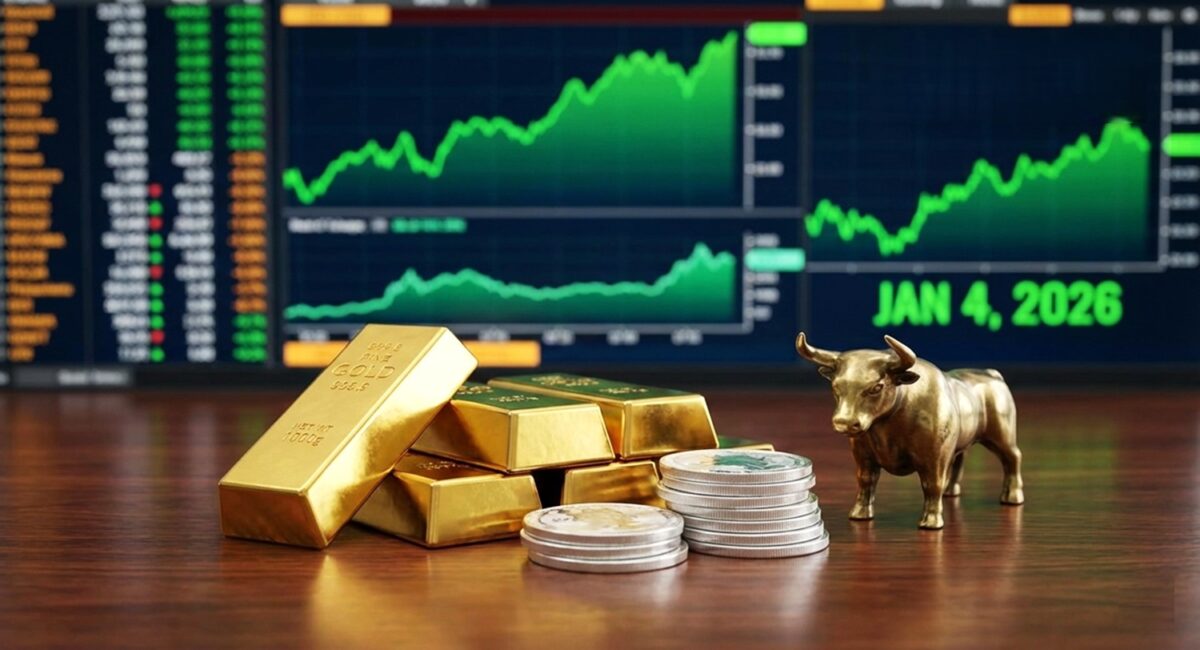
As markets opened on January 4, 2026, the spot gold price today was hovering around $4,344–$4,345 per ounce — a level slightly below late-December highs but still historically elevated — while silver traded near $73.50 per ounce, reflecting robust precious metals demand amid macroeconomic uncertainty and geopolitical tensions. According to live pricing data, gold’s spot price on the U.S. market stands firmly above the $4,300 mark, driven by continued safe-haven interest following global events and expectations of U.S. interest rate cuts that could weaken real yields and support non-yielding assets like bullion.
Over the past week, bullion has displayed resilience after finishing 2025 near record levels — gold saw a remarkable rally throughout the prior year, with annual gains near 60–65% as investors sought refuge from inflation worries and rate-cut expectations. Spot prices surged above $4,400 several times in late December before settling into the current range, where today’s levels continue to reflect sustained investor demand for diversification and protection against volatility in equities and currencies.
Global spot pricing charts show gold relatively stable compared with recent volatility, with daily fluctuations tied closely to U.S. dollar movements, inflation data, and broader risk sentiment. Silver, too, remains elevated, with its price near $73.50 per ounce, supported by both industrial demand and safe-haven positioning — a dynamic that underscores how precious metals markets are responding to both financial and physical market drivers as 2026 begins.
Why Prices Are Elevated and What Analysts Forecast for 2026
The market environment that has pushed gold to these elevated levels is deeply rooted in expectations of easing monetary policy, continued geopolitical stresses, and significant central bank buying. Analysts note that expectations for U.S. Federal Reserve rate cuts in 2026 are a key supportive factor for bullion, as lower real interest rates tend to make non-yielding assets like gold more attractive. Combined with a weakening dollar and persistent inflationary pressures, this environment has bolstered gold’s appeal as both a store of value and an inflation hedge.
Major financial institutions have adjusted their outlooks for gold in the new year. For instance, Goldman Sachs analysts foresee gold approaching nearly $4,900 by late 2026, reflecting a blend of macroeconomic risk primes and continued strong demand from central banks, particularly in emerging markets. Similarly, projections from other global research teams, including J.P. Morgan, suggest that robust demand and safe-haven flows could push the 2026 average price toward the $5,000 per ounce area — a significant psychological and technical milestone if realized.
A Financial Times survey of analysts reflects a wide range of expectations, with some optimists targeting more than $5,400 per ounce under scenarios of heightened geopolitical risk, while more conservative estimates forecast prices in the low-$4,000s if market volatility subsides and demand normalizes. Across the spectrum, the consensus is that gold’s fundamentals remain well supported heading into 2026, even as liquidity and portfolio flows ebb and flow with broader financial conditions.
Silver, Macro Forces, and Risk Drivers
Silver’s price trajectory continues to track closely with gold, driven by both industrial demand and investor allocations to precious metals amid uncertainty. With silver near $73.50 per ounce, the metal has shown significant strength over the past year, though its performance remains more sensitive to economic cycles due to its industrial applications. Analysts have flagged structural supply deficits and strong ETF flows as additional factors underpinning silver’s rise this year.
Geopolitical risks, including conflicts and tensions that roil broader markets, further elevate bullion’s safe-haven status. Markets remain jittery about potential spillover effects from diplomatic crises and economic policy shifts, leading investors to balance traditional risk assets with allocations to hard assets such as gold and silver. Central banks continue to buy gold aggressively, with significant monthly averages projected to persist throughout the year as monetary authorities seek to diversify reserves and hedge against currency risks.
What Investors Should Watch Next
Looking ahead, several key factors will likely shape the gold price outlook throughout 2026. The pace and scale of interest rate cuts by the Federal Reserve will be closely watched, as each adjustment in monetary policy can significantly influence real yields and gold’s relative attractiveness. Equally important are inflation trends, U.S. dollar strength, and global risk sentiment — particularly in emerging markets where political and economic uncertainties can drive incremental demand for precious metals.
Market participants should also monitor central bank reserve activity, ETF flows, and macroeconomic data releases, as these indicators often signal shifts in investor positioning well before broader price moves materialize. With analysts targeting a possible push toward $5,000–$5,500 per ounce by year-end under bullish scenarios, gold’s trajectory in 2026 appears closely tied to a complex interplay of monetary policy, geopolitical risk, and structural demand patterns across global markets.
Spot gold prices are updated regularly throughout trading sessions and may vary from quoted levels based on real-time market conditions.