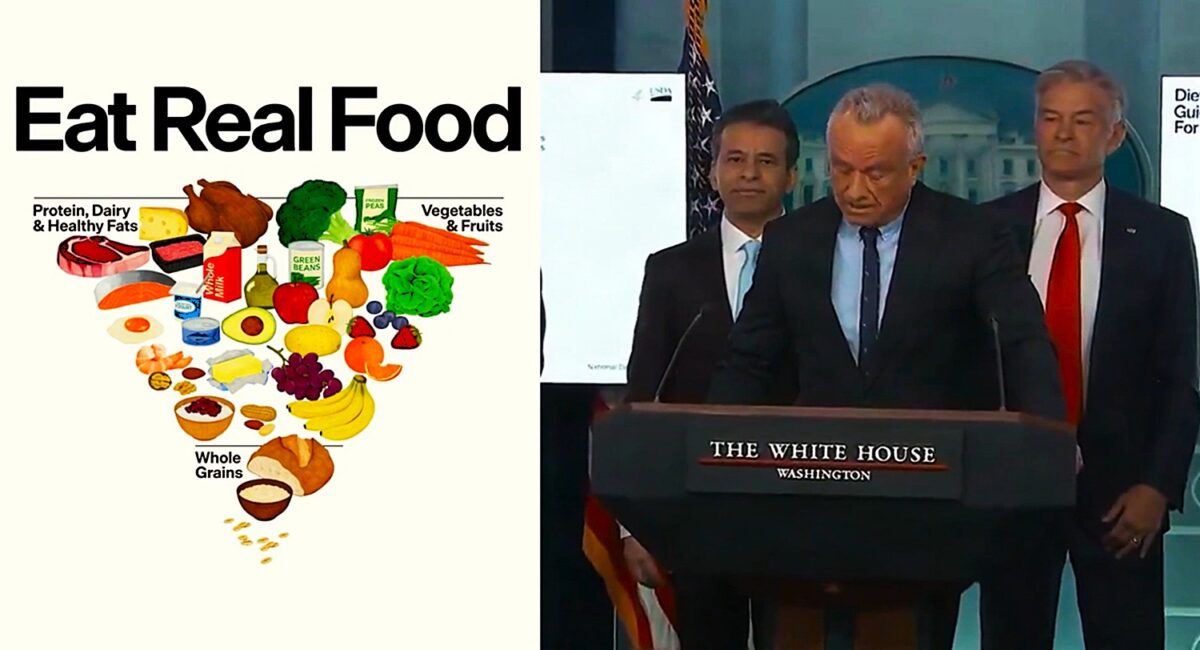
In a move that’s already sparked fierce debate across scientific and public health communities, U.S. Health and Human Services Secretary Robert F. Kennedy Jr. has unveiled a new, inverted food pyramid as part of the Dietary Guidelines for Americans 2025–2030 — effectively reversing decades of federal nutrition policy by placing red meat, full‑fat dairy and healthy fats at the top of the American diet hierarchy. This isn’t a tweak — it’s a policy shift with real consequences for nutrition advice, school lunches, healthcare guidance, and federal food programs.
What the New Food Pyramid Actually Says
The 2026 “RFK food pyramid” flips the traditional pyramid upside down. It now prioritizes high‑quality protein (including red meat), full‑fat dairy and healthy fats above whole grains — a stark contrast to previous guidelines that emphasized grains and restricted saturated fat. The updated framework also strongly discourages processed foods and added sugars, and encourages increased intake of vegetables and fruits.
Why This Matters
This isn’t merely a new graphic — the dietary guidelines influence:
- National School Lunch and Breakfast Programs
- Federal nutrition policy
- Clinical guidelines used by physicians and dietitians
- Food assistance programs (WIC, SNAP, etc.)
In other words, these recommendations shape not just what gets promoted, but what’s purchased and served in schools, healthcare settings, and community programs.
Anatomy of the New Inverted Food Pyramid
In practical terms, this is what the revised structure emphasizes — from most to least foundational:
Top Tier — “Eat Most Often”
- Protein: Red meat (beef, lamb), poultry, seafood, eggs
- Full‑Fat Dairy: Whole milk, cheese, yogurt
- Healthy Fats: Olive oil, butter, beef tallow, nut fats
- Vegetables & Fruits placed prominently alongside protein
👉 This reverses decades of guidance that placed grains and cereals at the base and discouraged saturated fats.
Middle Tier — “Eat Moderately”
- Whole Grains: Brown rice, oats, quinoa — but de‑emphasized relative to protein and fats
- Legumes and Plant Proteins included but not elevated above animal sources
While still included, whole grains no longer dominate the base of the pyramid as they did in prior models.
Bottom Tier — “Limit These”
- Highly Processed Foods (refined flours, snack foods, packaged meals)
- Added Sugars (no sugar is considered optimal)
- Sugary Beverages (sodas, sports drinks)
The guidelines explicitly call for dramatic reduction of ultra‑processed products.
Key Shifts vs. Previous Guidelines
Here’s how this 2026 model breaks with nutrition orthodoxy:
1. Red Meat & Saturated Fat Are Elevated
Previous guidelines had warned about saturated fats and recommended limited red meat intake. Under the new design:
- Red meat is explicitly included as core protein.
- Saturated fats like butter and full‑fat dairy are described as “essential” components.
- Officials framed it as ending the “war on saturated fat.”
Nutrition scientists promptly noted this contradicts decades of data linking excess saturated fats and certain red meats with heart disease risk. Many experts outside the administration have expressed skepticism.
2. Full‑Fat Dairy Comes Back In
For the first time in many years, full‑fat milk, cheese, and yogurt are no longer discouraged:
- Recommendations include 3 servings of dairy per day with whole‑fat options allowed.
- This shifts away from the low‑fat emphasis of past American guidelines.
Some emerging research suggests dairy fats might not be as harmful as once thought — but this remains controversial among cardiologists and dietitians.
3. Whole Grains Are De‑emphasized
Where once grains formed the foundation of U.S. dietary advice, now they sit below protein, fats, fruits and vegetables — a dramatic reinterpretation that has nutrition scientists scratching their heads.
4. Added Sugar Is Declared the Enemy
The new guidelines go further than previous editions by recommending:
- No added sugars are considered “healthy”
- Limit added sugar to under 10 grams per meal
That’s a stricter stance than prior versions, which tolerated some added sugars.
Responses from Science, Medicine and the Public
The announcement has ignited debate:
Support
- Praise for discouraging ultra‑processed foods and added sugars. Many agree that minimizing highly processed meals is beneficial for metabolic health.
Criticism
- *Nutrition experts warn prioritizing red meat and saturated fat> decades of research linking these to cardiovascular disease.
- American Heart Association has cautioned that increased red meat and salt consumption could elevate risk factors.
Broader Reaction
Even among public health professionals, reactions range from curious to alarmed — and many point out that long‑standing science on fiber, whole grains, and plant‑based patterns isn’t being fully reflected in this model.
What This Means for Everyday Americans
Here’s what families and individuals are likely to see:
- School lunches may include more meat and full‑fat dairy
- Dietitians will need to adjust advice (and many may push back)
- Food labeling and marketing may shift toward “real food” messaging
- Healthcare providers may reframe dietary counseling around protein and fats
But it’s worth stressing: evidence on saturated fat and chronic disease is far from settled among experts, and critics argue this policy veers into ideology rather than consensus science.
Conclusion: A Landmark — and Controversial — Reset
The RFK food pyramid of 2026 is far more than a new visual. It reflects a pivot in federal nutrition philosophy — one that embraces whole foods, protein, and healthy fats while pushing back against processed foods and added sugars. For many Americans, this may validate dietary habits many already follow. For nutrition scientists, it raises deep questions about how evidence translates into policy.
Bottom line: This could be the most consequential overhaul of U.S. dietary guidance in decades — with potential benefits and risks — and it will take years for the public health community to fully vet its real‑world effects.