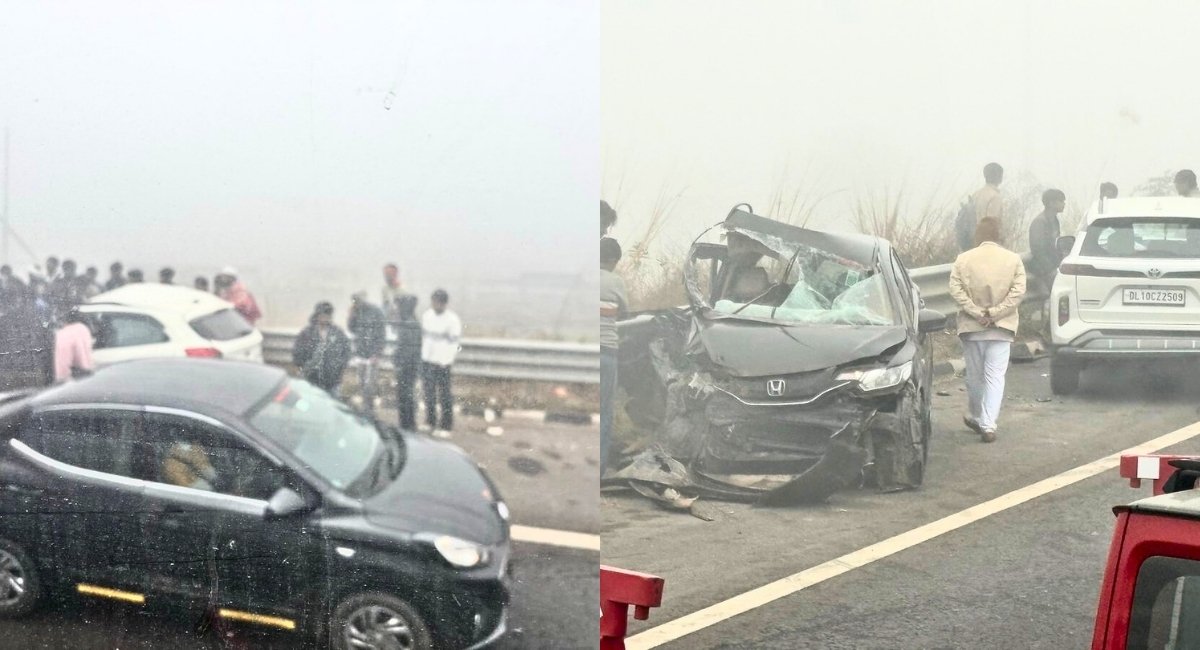
In the early hours of December 15, 2025, a deadly multi-vehicle collision unfolded on the Delhi-Mumbai Expressway near Nuh in Haryana as dense winter fog sharply reduced visibility, leading to a chain reaction involving nearly 20 vehicles. At least four people were confirmed dead, including two police officers, and several others were injured as emergency teams scrambled to clear the wreckage and assist victims. The intensity of the fog — a regular seasonal hazard across the Delhi-NCR and Haryana corridor — was identified by authorities as the primary contributing factor.
What Happened in the Delhi Mumbai Expressway Accident?
A 20-vehicle pile-up on the Delhi Mumbai Expressway occurred on December 15, 2025, near Nuh in Haryana, due to dense fog that drastically cut visibility on the high-speed corridor. The collision resulted in four fatalities, including two police officers, and left multiple others injured as vehicles rammed into one another in a domino-style crash.
1. Accident Overview — What We Know
Early on Monday morning, a dense layer of winter fog — typical of the Delhi-NCR belt in mid-December — reduced visibility to near negligible levels on stretches of the Delhi-Mumbai Expressway near Nuh, Haryana. At around 5:00 AM IST, vehicles including trucks and cars were involved in a mass pile-up involving close to 20 vehicles. Emergency responders and traffic police were rushed to the site as part of a large-scale operational response.
2. Exact Location and Sequence
The collision took place on a section of the eight-lane Delhi-Mumbai Expressway that runs through Haryana, a segment notorious among traffic and highway safety analysts for fog-related multi-vehicle incidents during winter months. As two heavy vehicles collided in extremely low visibility, the stopped or slowing vehicles ahead became unseen hazards for drivers approaching from behind — triggering a domino-style chain reaction of impacts.
3. Fog and Weather Conditions
Meteorologists across the region had issued dense fog advisories in advance, warning that low visibility — especially between 4:00 AM and 9:00 AM IST — posed elevated risks for high-speed highways. Dense fog is a seasonal pattern in northern India during December, tied to cold air pooling and overnight radiation cooling. This creates a thin, moisture-laden layer that dramatically cuts line-of-sight — a risk factor frequently cited in winter highway safety advisories.
4. Fatalities and Injuries
According to verified reports, at least four people died in the collision:
- Two police officers, who were among those responding to early-morning traffic duties, were killed.
- Two other individuals died at the scene amid the impacts.
- 15–20 people suffered injuries, with some in serious condition after being rushed to nearby hospitals.
The high casualty count reflects how unpredictable pile-ups become when motor vehicles at speed suddenly decelerate or stop without advance visibility, giving little to no reaction time for trailing drivers.
5. Police Response and Emergency Services
Local and highway police, along with ambulance and fire rescue teams, responded within minutes of the initial crashes being reported. Their priority was:
- Securing the crash site to prevent further collisions.
- Administering first aid to injured motorists.
- Clearing the expressway lanes to minimise secondary collisions and restore traffic flow.
Traffic was temporarily diverted or halted, and expressway authorities coordinated with state emergency departments for victim transport. These high-speed corridors have integrated emergency dispatch protocols precisely because of such seasonal visibility hazards.
6. Seasonal Road Hazards on Major Expressways
Incidents like this reflect a broader trend: dense winter fog significantly increases the risk of multi-vehicle pile-ups across northern India’s expressways. This has been documented not only on the Delhi-Mumbai route but on other major arteries such as the Eastern Peripheral Expressway, where similar collisions have occurred due to reduced visibility in cold weather conditions.
For example, just a day earlier, a separate multi-vehicle collision on the Eastern Peripheral Expressway near Greater Noida involved around a dozen vehicles due to fog, causing injuries but no fatalities — underscoring how variable but ever-present this hazard is in the region.
7. Expert Commentary on Safety Risks
Seasoned traffic safety analysts — particularly those who study expressway dynamics — consistently warn that drivers underestimate fog as a risk factor. When vehicles travel at normal high speeds (often above 80–100 km/h), visibility of 50 metres or less can make even routine braking by a vehicle ahead a potential trigger for a multi-vehicle chain collision.
Winter conditions compound this: headlights may create glare in fog, sensors such as adaptive lights can misread conditions, and even experienced drivers can misjudge stopping distances. These factors create a dangerous combination on expressways designed for high-speed travel.
8. What Authorities Are Doing
Following the accident, authorities in Haryana and Delhi-NCR are expected to consider:
- Re-evaluating visibility-related traffic advisories for expressway segments known for fog entrapment.
- Enhancing real-time alert systems using roadside message boards for fog warnings.
- Coordinating speed restrictions and enforcement during peak low-visibility hours.
- Increasing patrol and emergency response readiness on high-risk stretches in winter months.
Road safety officials regularly underline that high-speed highways require not just infrastructure but also behaviour-specific advisories tailored to seasonal weather phenomena.
9. Conclusion & Editorial Perspective
The Delhi Mumbai Expressway accident on December 15, 2025 — involving a 20-vehicle pile-up in dense fog near Nuh, Haryana — is a grim reminder that even the most advanced road networks on paper are still vulnerable to natural conditions like fog when human reaction time, vehicle speeds, and visibility interplay.
From my two decades reporting on Indian highway safety, one point is unambiguous: weather-related visibility hazards are a powerful — and sometimes under-appreciated — adversary of expressway design. Policymakers and traffic agencies are right to invest in infrastructure like lighting, signage, and variable speed limits, but driver education on seasonal risk is equally crucial.
Tragedies like this underscore the fact that infrastructure safety isn’t just built with asphalt and cameras — it’s built with awareness, preparedness, and real-time adaptive systems that anticipate nature’s unpredictability.