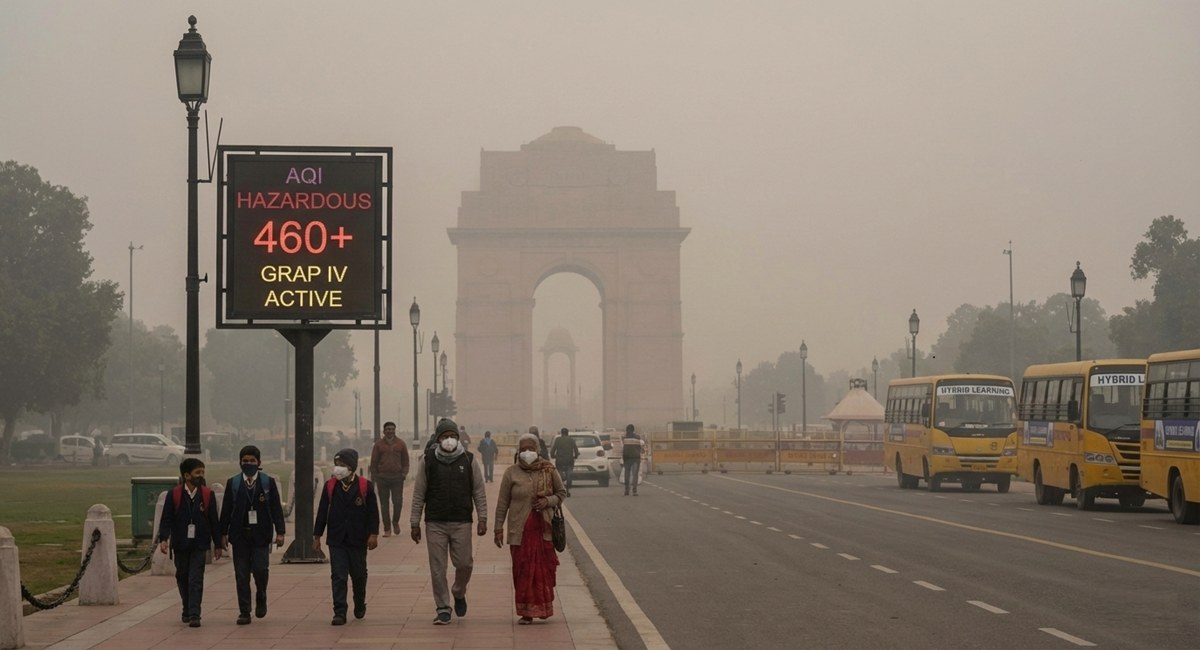
On December 14, 2025, Delhi AQI Hits 460 — the capital’s air quality plunged deep into the ‘severe’ and ‘severe-plus’ categories, with pockets recording readings near or above 700, signaling hazardous air conditions that endanger everyone’s health, especially children and the elderly. Authorities have triggered Stage IV of the Graded Response Action Plan (GRAP), enforcing stringent curbs including hybrid schooling, work-from-home advisories, construction bans, and transport restrictions to limit exposure and curb pollution.
What Happened: Delhi AQI Hits 460 and Worse
On Sunday morning, data from the Central Pollution Control Board (CPCB) showed Delhi’s 24-hour average AQI at around 460, well into the ‘severe’ category (AQI > 400) — and in some areas even categorized as ‘severe-plus’ when readings approached the upper part of the scale (up to 500). Certain local hotspots like Bawana and Anand Vihar have recorded AQI values nearing 500, while anecdotal reports from residents suggest some micro-zones might be experiencing levels that feel like 700–800 — technically beyond what many sensors are calibrated for and dangerously hazardous for human health.
This isn’t a typical “bad air day.” It’s exceptionally toxic, with smog so dense that visibility is severely reduced across major roads and public spaces, traffic snarled, and everyday routines disrupted.
Why This Spike Occurred — A Toxic Confluence
A combination of factors has pushed Delhi’s AQI to record highs:
- Weather patterns: Cold, stagnant air traps pollutants near the ground instead of dispersing them.
- Vehicular emissions: High traffic density and emissions from older vehicles add huge loads of fine particulate matter.
- Construction and dust: Despite some curbs, dust remains a major airborne pollutant.
- Regional factors: Pollutants drifting from neighbouring states contribute to the smog blanket.
The result: extremely hazardous air that even short outdoor exposure can aggravate respiratory and cardiac illnesses — and ongoing conditions like asthma or COPD.
GRAP Stage IV: What Restrictions Are Now in Force
The Commission for Air Quality Management (CAQM) invoked Stage IV of the Graded Response Action Plan (GRAP) — reserved for ‘severe-plus’ air quality (AQI > 450) — across Delhi and the National Capital Region (NCR).
Here’s what that entails:
1. Schools Shift to Hybrid Mode
Schools across Delhi are conducting classes in hybrid mode (a mix of in-person and online) for students up to Class IX and Class XI to reduce outdoor exposure among children. Guardians can opt for full online attendance where feasible.
2. Work-from-Home & Reduced Office Attendance
Government and private offices are mandated to operate with 50% staff attendance, with others advised to work from home where possible.
3. Vehicle Restrictions
Strict curbs on BS-III petrol and BS-IV diesel vehicles — older, higher-emission cars — have been enforced across Delhi and neighbouring districts to cut down traffic emissions.
4. Construction Ban
All construction and demolition work has been temporarily halted — a key visibility and dust control step under GRAP Stage IV.
5. Heavy Truck Entry Barred
Non-essential trucks that don’t meet stricter emissions standards are barred from entering Delhi and the NCR region.
These steps, though drastic, aim to curb further pollution while people cope with already hazardous air.
What ‘Severe’ & ‘Hazardous’ AQI Means for Health
To understand the gravity:
- AQI 0–50: Good — minimal risk
- AQI 101–200: Moderate — some risk for sensitive people
- AQI 301–400: Very Poor — risk increases even for healthy adults
- AQI > 401: Severe — dangerous for everyone
- AQI 450+ (‘Severe-plus’): Health warnings of emergency conditions — avoid outdoor exposure entirely.
With Delhi AQI Hits 460, even healthy individuals are at risk of:
- Persistent coughing and throat irritation
- Shortness of breath
- Headaches and dizziness
- Worsening of cardiovascular and lung conditions
Prolonged exposures at these levels can also cause long-term lung damage and systemic inflammation, especially in vulnerable groups.
Who’s Most at Risk — And What They Should Do Today
Children
Kids breathe faster than adults — so they intake more polluted air relative to body size. With schools shifting to hybrid mode, exposure is being minimized, but you should:
- Keep children indoors as much as possible
- Use N95 or equivalent masks if outdoor trips are unavoidable
- Reduce outdoor play or exercise
- Use indoor air purifiers at home where possible
Air quality spikes at levels seen now can trigger asthma attacks and other respiratory distress quickly in children.
Elderly & Those with Chronic Illness
Older adults and people with heart or lung conditions are especially vulnerable. What to do:
- Skip walks and outdoor errands
- Stay in well-ventilated, filtered indoor spaces
- Follow existing prescriptions closely
- Seek medical advice early for any breathing discomfort
Even brief outdoor exposures at AQI in the severe range can trigger heart rhythm irregularities and exacerbate chronic bronchitis or COPD.
Healthy Adults
Don’t assume it’s “just smog” — the dense haze today is toxic:
- Avoid strenuous exercise outdoors
- Wear quality protective masks
- Prefer public transport or carpooling — if essential travel is unavoidable
Even those without prior health issues face increased risks at these levels of pollution.
Practical Tips to Protect Your Health Right Now
Here’s what Delhi residents can do amidst this pollution crisis:
- Stay indoors during peak smog hours (early morning and late evening)
- Run air purifiers in bedrooms and living rooms
- Keep windows closed if outdoor AQI is hazardous
- Hydrate well — pollutants can dry airways
- Reduce indoor pollutants (avoid smoking, burning incense)
Small lifestyle adjustments can significantly reduce the internal dose of harmful particulates.
Does this Mean We’re Seeing the Worst Ever?
Not quite.
While Delhi AQI Hits 460 and some areas feel like they’re above 700, this is consistent with the pattern seen in previous winters, where cold weather, crop burning, and emissions converge to create prolonged smog episodes. Despite intensified measures under GRAP Stage IV, the persistent haze shows how entrenched the challenge remains.
This immediate spike, though, is among the more dangerous peaks recorded this season, and it’s a stark reminder of the air quality crisis that Delhi faces year after year.
Conclusion: Urgent Action — From Government to Individual Behaviour
When Delhi AQI Hits 460, it’s not just a statistic — it’s a public health emergency. The activation of GRAP Stage IV and hybrid schooling reflects the severity of the situation, but true mitigation requires sustained action on emissions, transport, agricultural burning, and construction dust.
For now, the priority must be protecting the most vulnerable — children, the elderly, and those with pre-existing health conditions — while every resident adapts routines to avoid dangerous exposure. Until air quality improves, assume that every breath outdoors carries a risk.