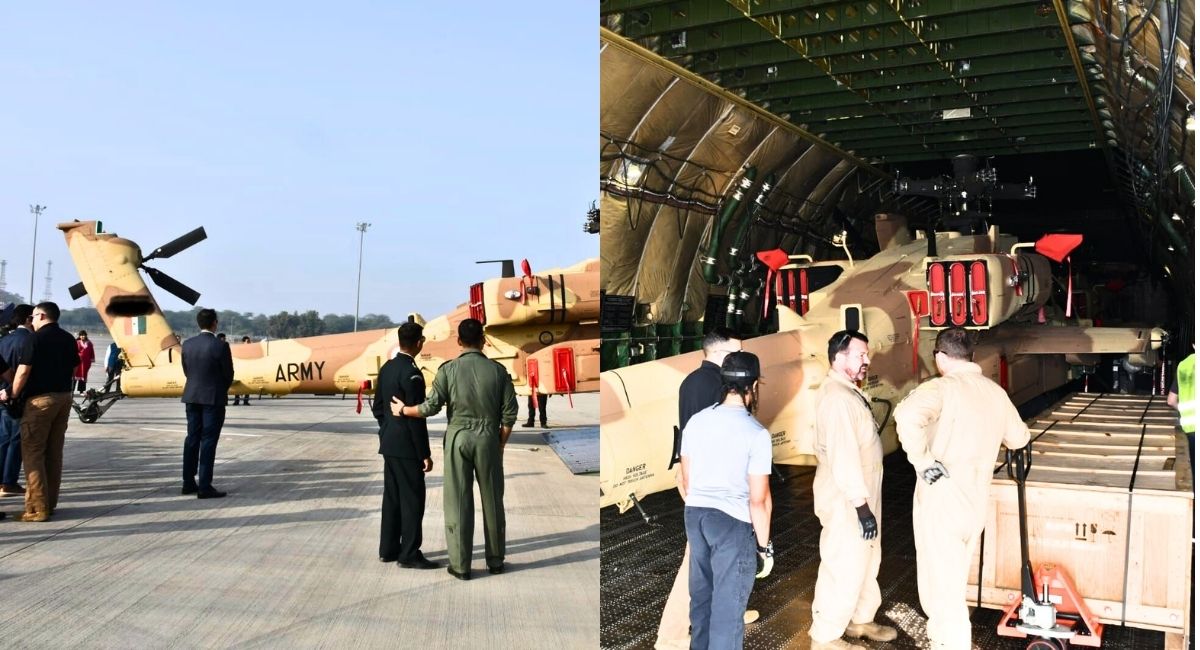
On December 16, 2025, the Indian Army received the final three Boeing AH-64E Apache attack helicopters from the United States, completing its six-aircraft fleet for the 451 Army Aviation Squadron headquartered in Jodhpur, Rajasthan. The aircraft were transported to India aboard a heavy-lift Antonov An-124 cargo aircraft and landed at Hindon Airbase near New Delhi before being prepared and deployed to bolster combat capabilities on the western border.
Why This Delivery Is Momentous
In defence circles, you don’t casually describe an aircraft as a “tank in the air” — but that’s precisely what the AH-64E Apache has earned due to its strike power and survivability. With this final delivery, the Indian Army modernises a critical segment of its attack helicopter fleet, filling a capability gap long identified by planners.
The six Apaches were ordered under a US-India defence agreement signed in 2020 (approx. USD 600 million) intended to provide the Army with heavy attack helicopters configured for anti-armour and deep strike missions.
The Complete Apache Delivery — What Happened
Final Three Arrive in India
On 16 December 2025, an Antonov An-124 cargo aircraft touched down at Hindon Airbase carrying the last three AH-64E helicopters, marking the completion of all six units ordered for the Indian Army.
Before these could enter service, they underwent:
- Unloading and initial assembly at Hindon.
- Joint technical inspections with Boeing and Indian Army personnel.
- Operational checks to qualify them for deployment.
Once cleared, they will join the already stationed three early deliveries to equip 451 Squadron for patrol and offensive missions.
Transport and Logistics
The Antonov An-124 — one of the world’s largest cargo planes — was chosen for its ability to handle oversized military hardware like AH-64Es. Each helicopter had its rotors and appendages temporarily stowed for air transport and is now being reassembled for flight operations post-arrival.
What the Apache Does — Capabilities and Combat Role
The AH-64E Apache represents the most advanced variant of Boeing’s iconic attack helicopter family, combining lethal firepower with cutting-edge battlefield integration:
- Armaments:
- AGM-114 Hellfire anti-tank missiles.
- Hydra 70 2.75-inch rockets.
- 30 mm M230 chain gun.
- Sensors & Systems:
- AN/APG-78 Longbow radar for simultaneous multi-target tracking.
- Night-vision and forward-looking infrared systems.
- Advanced digital communications for real-time battlefield networking.
- Performance: High manoeuvrability, robust survivability, and rapid target engagement make it ideal for both armoured support and suppression of enemy air defences.
These helicopters also integrate emerging technologies like Manned-Unmanned Teaming (MUM-T), enabling them to coordinate with drones for reconnaissance and target acquisition.
Integration Into the Indian Army’s Force Structure
The 451 Army Aviation Squadron
Formally raised in March 2024 at Jodhpur, this unit was established specifically to operate the AH-64E fleet. For more than a year after its raising, however, it awaited actual aircraft amid multiple delays in delivery.
With the arrival of all six Apaches:
- Combat missions can begin in earnest along the western frontier, particularly in desert and semi-mountainous regions.
- The squadron is positioned to provide close air support to mechanised Army units and deep strike options against high-value targets.
Border Security Imperative
India’s western borders — especially along Pakistan — have historically been tense. These Apaches provide rapid offensive reach that indigenous rotorcraft like the HAL-designed Prachand and Rudra series supplement but do not fully replace due to differences in size, payload, and mission profiles.
H2: Why Delivery Was Delayed — A Look Back
Originally, deliveries were expected in May–June 2024 for the first trio and later in 2024 for the second batch, following the 2020 contract. However, supply chain interruptions — especially those affecting avionics and precision components — pushed the timeline repeatedly, with the first batch finally arriving in July 2025.
The reasons for delay included:
- Global post-pandemic production bottlenecks.
- Prioritisation of U.S. Army requirements.
- Aviation-specific certification hurdles.
Despite setbacks, the 2025 deliveries complete the original procurement pact and bring the Army Aviation Corps a long-awaited capability.
H2: Strategic Impact — Beyond Numbers
Force Multiplier on the Ground
From conversations with defence planners, the Apache isn’t just another platform — it’s a force multiplier that shifts how ground commanders think about manoeuvre warfare. Having this capability under direct Army Aviation control (as opposed to the Air Force) cuts down coordination times and enables more responsive fire support.
Complementing Indigenous Efforts
India’s home-grown attack helicopter, the HAL Prachand, excels in mountain theatre and counter-insurgency, but lacks the heavy weapons payload and long-range targeting systems of the Apache. Together, these systems create layered capabilities across different combat scenarios.
A Global Comparison — Why the AH-64E Stands Out
Globally, more than 400 AH-64E helicopters have been delivered to various militaries, and the type has logged millions of flight hours in combat zones and training environments.
Compared with peers:
- Eurocopter Tiger: Advanced but lighter payload.
- Mi-28 Havoc: Comparable firepower but less networked operations.
- Kamov Ka-52: Excellent agility but fewer Western avionics integrations.
The Apache’s blend of lethality, survivability, and digital networking keeps it among the most sought-after attack helicopter platforms worldwide.
Conclusion — A New Dawn for Army Aviation
The receipt of the final three AH-64E Apache helicopters marks not just the end of a long procurement process, but the beginning of a new operational chapter for the Indian Army Aviation Corps. These helicopters bring world-class strike capability to the western front, giving commanders eyes and firepower deep into the battlefield’s critical zones.
From extended waits and supply chain frustrations to final deployment preparations — the journey reflects the growing complexity of modern defence acquisitions. Yet, with this fleet now complete, the Army stands better poised to deter adversaries, execute precision engagements, and support ground manoeuvre forces with unmatched aerial punch.
In an era where battlefield dominance often hinges on information superiority and rapid response, the AH-64E’s arrival is a tangible upgrade to India’s strategic posture and a clear signal to both allies and adversaries about India’s commitment to modern defence readiness.