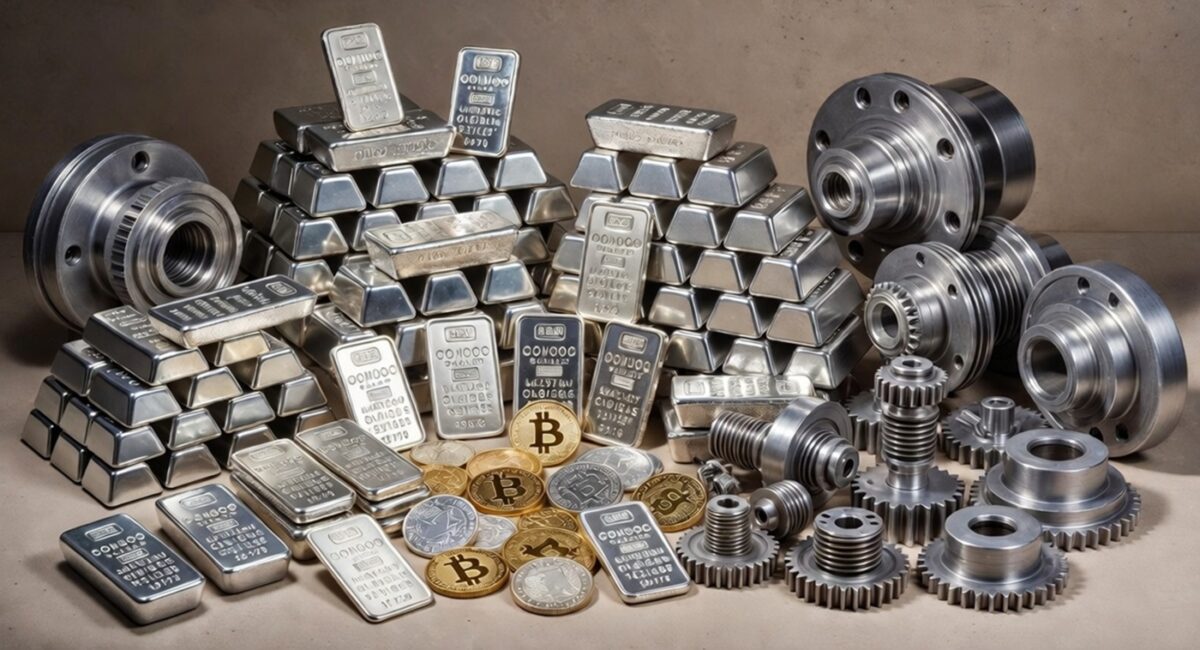
Silver’s price surged to an all-time high near $69 per ounce in December 2025, propelled by a rare convergence of soaring industrial demand, persistent supply shortages, aggressive investment flows, and macroeconomic forces such as expected U.S. rate cuts and geopolitical uncertainty — factors that have driven it up approximately 138% year-to-date (YTD), far outperforming gold and Bitcoin as both a precious metal hedge and an industrial commodity.
Let’s unpack why this isn’t just a headline number — but a signal of shifting market dynamics that investors, industrial users, and policymakers cannot ignore.
1. Record Price Confirmed: Silver Hits $69
On December 22, 2025, spot silver climbed to about $69.23 per ounce, establishing a new all-time high. This tops previous peaks and firmly beats the metal’s long-standing all-time numbers.
Markets showed an upward acceleration late in the year, with silver’s price climbing over 130% YTD by mid-December, reflecting one of the most explosive rallies among major assets in 2025.
2. The Macro Backdrop: Interest Rates, Geopolitics & Dollar Moves
To understand why an industrial metal rallied like a speculative asset, you have to look at the broader macroeconomic context:
U.S. Federal Reserve & Interest Rate Expectations
In 2025, markets began pricing in multiple rate cuts by the Federal Reserve for 2026 — a shift from the prior tightening cycle that had dominated since 2022. Lower interest rates tend to weaken the U.S. dollar and boost the appeal of non-yielding assets like precious metals.
Geopolitical Tensions
Escalating global political risks near year-end — from Middle East instability to supply chain concerns — pushed investors toward traditional safe havens (while also spiking demand for metals with industrial utility).
A Softer U.S. Dollar
A depreciating dollar (down roughly 10% through 2025) made commodities priced in dollars cheaper for foreign buyers, inviting international investment into metals — especially silver.
The combination of these forces strengthened metals broadly, but silver’s unique characteristics pushed it even higher.
3. Industrial Demand Isn’t Just “Nice to Have” — It’s Central
Unlike gold, which is almost entirely an investment/safe-haven asset, silver is dual-purpose:
Industrial Uses
Silver isn’t just jewelry bullion. It’s indispensable in high-growth industrial sectors such as:
- Solar photovoltaic (PV) cells, where silver paste is critical.
- Electric vehicles (EVs) — especially in battery and charging systems.
- Electronics & semiconductors, where silver’s unmatched conductivity is critical.
- Data centers and AI hardware, which require large amounts of silver for high-performance circuitry.
Analysts highlight that growing electrification and renewable energy installations are creating structural demand that mining has struggled to meet.
4. Supply Squeeze: The Hidden Story Behind the Numbers
It’s one thing for demand to rise — but when supply fails to keep pace, prices don’t just climb, they explode.
Persistent Supply Deficits
Physical inventories in major hubs — from London’s bullion markets to Shanghai warehouses — have dropped to decade lows. Some reports suggest that free-floating silver not already tied up in ETFs or funds has shriveled drastically.
Mining Realities
About 70–80% of silver comes as a by-product of lead, zinc, and copper mining, meaning that even high prices can’t magically increase supply. New primary silver mines take years (and billions of dollars) of investment to commission.
This structural deficit — now in its fifth straight year — funnels every additional ounce of demand directly into the price.
5. Silver vs. Gold vs. Bitcoin: Performance Breakdown
In 2025:
- Silver: ~+138% YTD
- Gold: ~+67% YTD
- Bitcoin: Far less compelling gains than precious metals (Bitcoin’s year-end slump vs earlier peaks was notable)
That means silver’s rally has more than doubled gold’s gains and left crypto rivals significantly behind. This is not typical; precious metals and cryptocurrencies usually perform independently.
Even when comparing returns in terms of relative performance (e.g., silver vs Bitcoin ratios), silver has markedly outpaced gold and crypto assets in 2025.
6. Is Silver a Hedge, an Industrial Play, or Both?
Here’s the deeper nuance most headlines miss:
Safe-Haven Hedge
Macro stress — inflation concerns, geopolitical risk, and rate uncertainty — drove investors toward metals traditionally perceived as hedges against currency risk and economic instability.
But silver’s appeal in 2025 wasn’t only safe-haven buying. Its price performance far exceeded what typical hedge flows alone could justify.
Industrial Demand as a Multiplier
Silver’s utility in technology and energy infrastructure gives its price tangible real-world backing. That’s why some traders in 2025 started treating it less like a pure precious metal and more like a hybrid safe-haven + industrial commodity.
In effect — silver became a barometer not just of fear, but of economic transformation.
7. Risks, Volatility & Profit-Taking
Even with these bullish drivers, analysts caution:
- Seasonality: Precious metals often spike toward year-end.
- Profit-Taking: Extremely high short-term gains can invite sell-offs.
- Volatility: Silver’s dual role makes it more volatile than gold — since industrial demand is more cyclical than pure safe-haven demand.
So while the trend looks strong, sharp swings remain possible.
8. Looking Ahead: Will Silver Keep Running in 2026?
Most forecasts — including major brokerage outlooks — suggest that silver’s rally isn’t finished, but gains may normalize:
- Some analysts see 20% or more upside potential into early 2026, driven by continued supply squeeze and robust ETF flows.
- Others warn that if rate cuts fail to materialize or demand weakens, prices could plateau.
Either way, silver’s role as an industrial hedge with strong safe-haven characteristics is now firmly entrenched.
9. Conclusion: A New Era for Silver
From my years covering commodities markets, 2025 stands out as a rare turning point: a metal traditionally viewed as a secondary precious asset has leapfrogged gold and outpaced most risk assets (including Bitcoin). That’s not happenstance — it’s a reflection of the intersection between real-world industrial demand and evolving macroeconomic unease.
When silver hits $69 and doubles in a year, that’s not just a price flash — that’s a signal. It tells us:
- Investors are hedging with a purpose.
- Industrial fundamentals are tightening.
- Macro risk is real, not hypothetical.
As we move into 2026, don’t think of silver merely as a precious metal — think of it as a bellwether for global economic and technological demand pressures, with implications for markets far beyond bullion trading desks.
If you’re watching markets — or the real economy — silver’s surge is a clue worth paying attention to.