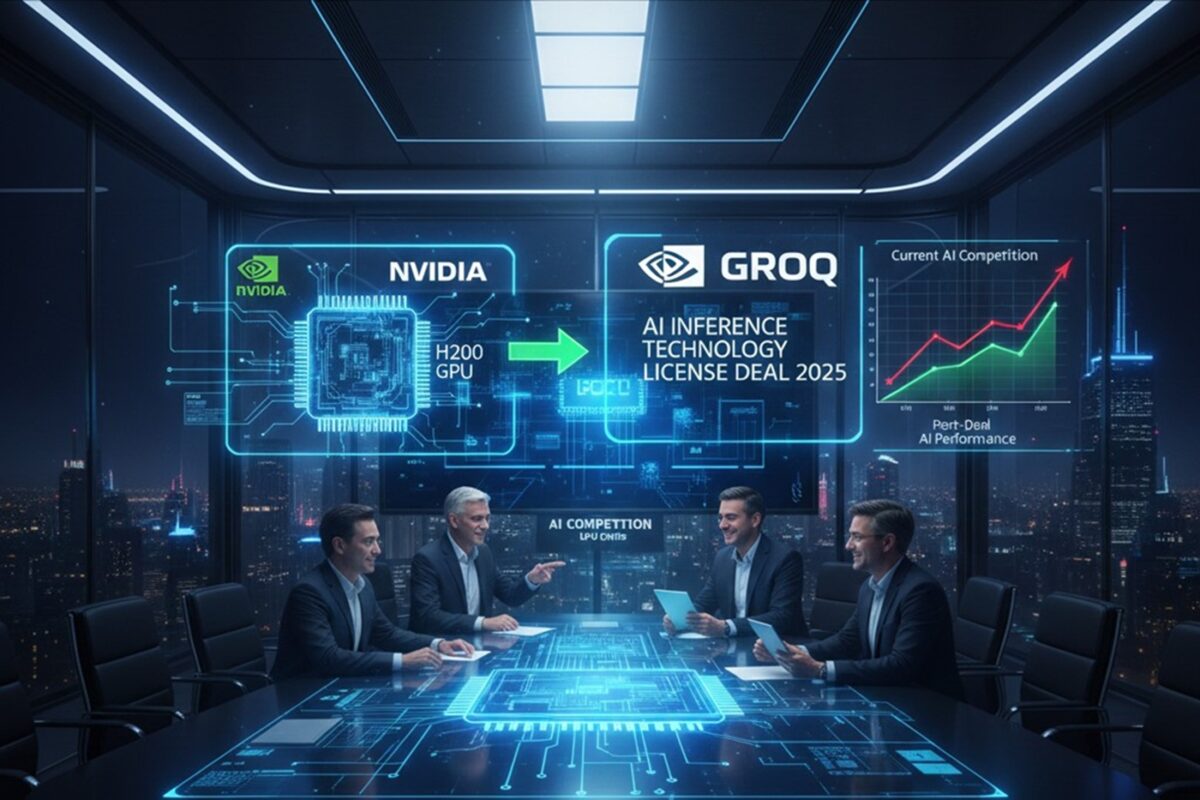
In December 2025, Nvidia struck a non-exclusive licensing agreement with AI chip startup Groq, securing rights to Groq’s inference technology — notably its Language Processing Unit (LPU) architecture — and bringing key Groq leadership into Nvidia while allowing Groq to continue operating independently. This deal signals a strategic acceleration in Nvidia’s push into AI inference performance, intensifies competition in the broader AI chip market, and may fundamentally reshape how real-time model execution is handled across data centers and cloud services.
What the Nvidia–Groq Deal Really Is — Licensing, Not a Full Acquisition
In late December 2025, media and financial markets lit up with reports that Nvidia was acquiring Groq — including claims of a $20 billion transaction that would mark Nvidia’s largest deal ever. But official statements from Groq clarify the situation: the core agreement is a non-exclusive license to use Groq’s high-performance inference technology, not a full corporate acquisition.
Here’s the nuanced part that matters for industry observers:
- Nvidia will license Groq’s inference IP — a foundational set of designs and architectures for executing trained AI models rapidly and efficiently.
- Jonathan Ross (Groq founder) and Sunny Madra (Groq president) — along with other engineering talent — will join Nvidia to help advance and integrate the licensed technology.
- Groq remains an independent company under new CEO Simon Edwards, and its cloud business, GroqCloud, will continue to operate.
Financial specifics weren’t disclosed, though earlier media reports suggested a figure in the $20 billion range — a benchmark if viewed strictly as asset transfer rather than enterprise sale.
Why This Deal Matters — The Strategic Power of LPU Technology
What Is an LPU, and Why It’s Valuable
Groq’s Language Processing Unit (LPU) differs from traditional GPUs in design and purpose: LPUs are specialized inference engines optimized for the rapid execution of already trained AI models — the phase after training when responses need to be delivered to users in real time.
Unlike general-purpose GPU architectures (which were originally designed for parallel computation across many tasks), LPUs can deliver:
- Lower latency — faster response times.
- Higher efficiency per watt — less energy use for the same inference workload.
- Deterministic performance — consistent throughput, which is crucial for scalable real-time services.
This is not just theoretical. Developers reported Groq hardware delivering inference speeds up to 10× faster than some GPU-based systems while using a fraction of the power — a combination that makes LPUs extremely attractive for large-scale AI services.
The Competitive Landscape — Nvidia’s Position and Challenges
Nvidia’s Dominance in Training vs. Inference
For most of the last decade, Nvidia has dominated AI training workloads — the resource-intensive process of building models — thanks to its CUDA ecosystem and extremely parallel GPU architectures. But inference (the delivery of model outputs) has become a major revenue frontier, especially as large language models (LLMs) and real-time AI services proliferate.
Startups like Groq and competitors such as Cerebras have pushed the industry to rethink inference beyond GPUs:
- Groq’s LPU architecture avoids reliance on external high-bandwidth memory, instead using large on-chip SRAM for efficient data access.
- This design can reduce bottlenecks in memory-bound tasks — a pivotal advantage when serving large models in production.
By licensing Groq’s technology and integrating its top talent, Nvidia gains a shortcut to expertise and alternative processor designs that could augment or even transform its existing inference strategy.
What Nvidia Gains — And What Groq Retains
Nvidia’s Gains
- Access to cutting-edge inference IP: Accelerates Nvidia’s development of real-time AI systems.
- Talent infusion: Bringing in Groq’s engineering leadership sharpens Nvidia’s internal skill base — particularly in inference optimization.
- Competitive edge: Strengthens Nvidia’s data center stack across both training and inference.
What Groq Retains
- Independent operations: Groq remains a distinct entity with its cloud offerings intact.
- Non-exclusive licensing: Groq can, in principle, license the same tech to other partners (subject to commercial agreements).
- Brand and product continuity: With new leadership, Groq could still innovate in areas beyond the licensed IP.
This structure — license + talent transfer, not outright acquisition — may also reflect regulatory realities. Antitrust authorities have scrutinized large tech acquisitions in the AI space, and a licensing model allows strategic collaboration without full consolidation.
Implications for the AI Chip Market
Competition and Ecosystem Shifts
The Nvidia–Groq deal highlights a broader tectonic shift in AI hardware:
- Inference workloads are now mission-critical across industries — from conversational agents to autonomous systems.
- Specialized chips like LPUs erode the historical advantage of general-purpose GPUs for inference.
- The licensing relationship could push other chip designers (AMD, Intel, Cerebras) to accelerate their own inference innovations.
Investors and analysts are watching closely — Nvidia’s shares dipped slightly on the news but remained robust overall, indicating confidence in the long-term strategy even if the market processes the structural shift.
What This Means for AI Developers and Users
Broader Impact on Developers
Developers building real-time AI applications — from chatbots to autonomous systems — care about latency, cost, and scalability. Groq’s LPU architecture historically offered compelling performance per dollar for certain models, and Nvidia’s adoption of that technology could:
- Expand access to efficient inference capabilities within the broader Nvidia ecosystem.
- Lower barriers for startups and enterprises seeking high-performance AI deployment pipelines.
Market Access and Choice
Because the licensing is non-exclusive, theoretically, Groq’s technology could still reach other partners, preserving some competitive diversity. How aggressively Groq pursues those options will be an early test of its post-deal strategy.
Conclusion: A Strategic Pivot That Amplifies Nvidia’s Inference Ambitions
The Nvidia–Groq 2025 deal isn’t a straightforward acquisition; it’s a strategic licensing agreement paired with a talent transfer that reshapes Nvidia’s inference roadmap and underscores how crucial fast, efficient AI model execution has become.
Groq’s LPUs — once a small but promising rival to GPU-centric inference — have found new life within Nvidia’s ecosystem, while the startup continues independently. For Nvidia, the move strengthens its dominance in both training and inference, addressing competitive gaps and expanding its technological arsenal. For the wider AI landscape, this deal is a reminder: specialized compute architectures matter, and partnerships — not just acquisitions — will drive the next phase of AI hardware innovation.