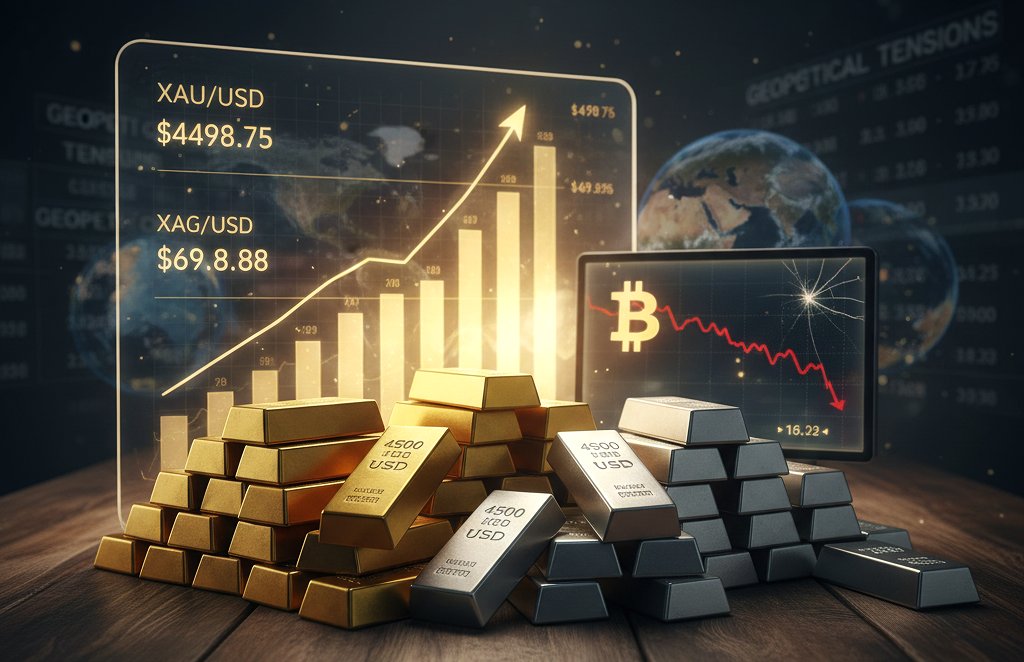
In December 2025, gold prices are trading near $4,500 per ounce and silver is approaching $70 per ounce, driven by escalating geopolitical tensions, safe-haven investor demand, and expectations of U.S. interest-rate cuts — factors that have propelled precious metals ahead of Bitcoin in performance and risk perception.
Why This Matters Now (In 2025)
As markets close out one of the most turbulent years in recent memory, there’s an unusual divergence playing out between traditional safe-haven assets and digital assets:
- Gold and silver are at historic highs — gold flirting with a $4,500 level, silver pushing near $70 — numbers that were once considered improbable just 12 months ago.
- Bitcoin, by contrast, is struggling to break out, trading below key psychological levels and lagging metals that historically rise during fear-driven episodes.
This isn’t a minor market wobble — it’s a structural response to macroeconomic and geopolitical shocks shaping global capital flows.
The December 2025 Precious Metals Rally — Breaking Down the Numbers
Gold: Near $4,500, a Historic Milestone
- Spot gold prices have climbed sharply, with recent trading showing gold near $4,486 per ounce and earlier fleeting highs close to $4,497/oz, underlining one of the most aggressive rallies in decades.
- Year-to-date gains exceed 70%, the strongest performance since the inflation shocks of the late 1970s.
- Central banks remain heavy buyers, and physical gold ETFs are seeing elevated inflows, supporting price resilience.
Gold is no longer just a hedge — it’s participating in a valuation expansion rarely seen outside hyperinflationary regimes.
Silver: On the Cusp of $70 with Industrial Support
- Silver has surged strikingly stronger than gold, with year-to-date gains in the triple digits — outperforming gold’s rally and flirting with the $70 per ounce mark.
- The metal’s dual role as both a monetary metal and an industrial input (from EVs to photovoltaics) is sharpening demand from both investors and manufacturers.
- The gold-to-silver ratio has contracted sharply, a technical signal often associated with broad risk-off flows into precious metals.
Silver’s climb isn’t random — it’s being underpinned by tight physical markets, accelerating industrial demand, and robust investment flows.
Geopolitical Tensions and Flight to Safety
The price action in precious metals has more than one driver — but the most dominant in late 2025 has been geopolitical risk.
Conflicts Fuel Safe-Haven Demand
Several flashpoints are shaping investor psychology:
- U.S.–Venezuela tensions, including oil supply disruptions and naval posturing in the Caribbean, have heightened fears of escalation.
- Ongoing Middle East conflicts and persistent instability in Eastern Europe continue to unsettle markets and reduce risk appetite.
In such conditions, gold and silver aren’t yield-generating assets — they’re insurance policies against systemic risk.
Macro Drivers — Rate Cuts, Dollar Weakness, and Central Bank Buying
Interest-Rate Expectations
Markets are pricing in U.S. Federal Reserve rate cuts in 2026, which reduces real yields on bonds and makes non-yielding assets like gold more competitive.
Lower interest rates often weaken the U.S. dollar, which in turn pushes metal prices higher since they’re priced in dollars:
“Gold price today … surged sharply in early trade … reflecting heightened risk sensitivity across global markets.”
Central Bank Accumulation
Institutional demand isn’t just retail speculation — world central banks have been stockpiling gold aggressively, collectively adding thousands of tonnes to reserves.
This institutional layer of demand fundamentally shifts the supply–demand balance, tightening physical availability and compressing the risk premium required by investors to hold gold.
Bitcoin — Why It’s Not Leading the Rally
It’s tempting to think Bitcoin should be the natural hedge in periods of uncertainty, but 2025 tells a different story:
Bitcoin’s Relative Underperformance
- Bitcoin fell back from its mid-2025 highs, weakening investor confidence.
- While BTC dipped and consolidated below key resistance levels, precious metals surged, shrinking the gold-to-Bitcoin performance gap.
In technical terms: the Bitcoin-to-gold ratio fell sharply, indicating that one Bitcoin now buys significantly fewer ounces of gold than in previous years.
Structural Factors Weighing on Bitcoin
- Risk Assets vs. Safe Havens
Bitcoin remains a risk asset akin to equities in many institutional portfolios, meaning risk-off flows often hit BTC before metals. - Regulatory and Macro Crosswinds
Public policy initiatives — including the U.S. Strategic Bitcoin Reserve concept — are more symbolic than price-supportive, and markets appear cautious. - Crypto Market Liquidity Events
Several forced liquidations and volatility spikes during 2025 eroded investor appetite for Bitcoin as a true store-of-value hedge.
What This Means for Investors in 2026
Precious Metals: Structural Case Still Intact
Analysts continue to forecast bullish long-term trajectories for both gold and silver, with targets above present trading levels due to ongoing structural demand.
Silver, in particular, is entering price-discovery territory, suggesting that further extensions beyond $70 aren’t out of the question.
Bitcoin: Still Volatile but Not Dead
While Bitcoin’s 2025 rally lagged metals, it isn’t structurally broken. Its role continues to evolve, especially as institutional derivatives and ETF products mature.
But in macro-driven sell-offs — like we saw in late 2025 — traditional safe havens still outperform digital ones.
Conclusion: Metals Reclaim the Spotlight in 2025
In an era marked by geopolitical shockwaves and policy uncertainty, gold and silver have reasserted themselves as the pre-eminent hedges against systemic risk:
- Gold’s ascent toward $4,500 reflects broad safe-haven flows.
- Silver’s push toward $70 illustrates both store-of-value and industrial demand convergence.
- Bitcoin’s comparative underperformance highlights the difference between risk assets and traditional hedges in times of heightened fear.
Editorial outlook: If geopolitical tensions persist and monetary policy remains accommodative, metals will likely continue to outperform digital assets in 2026 — not because Bitcoin is worthless, but because gold and silver’s historical roles as crisis anchors still resonate with global capital.