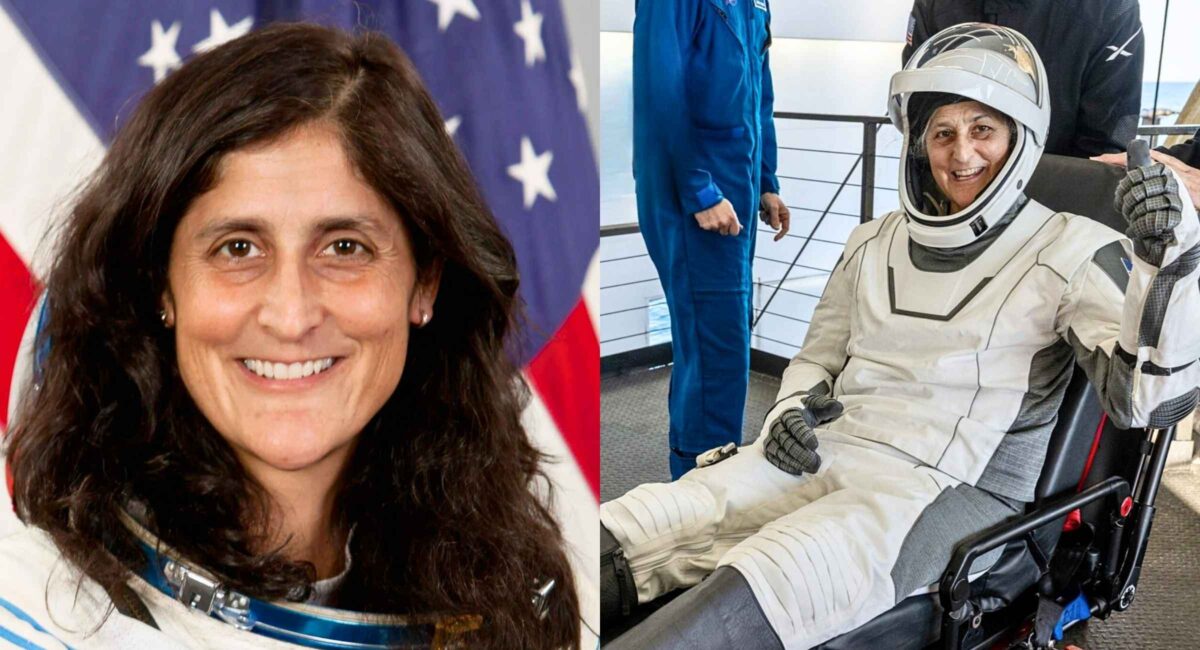
NASA astronaut Sunita “Suni” Williams — a trailblazer in human spaceflight whose career spanned nearly 27 years and included 608 cumulative days in orbit, nine spacewalks (the most ever by a woman), and an extended Starliner mission that evolved into a nine-month ISS stay — has officially retired from NASA, effective December 27, 2025. Her legacy combines historic achievements, leadership aboard the International Space Station (ISS), and a lasting influence on future Moon and Mars missions.
Sunita Williams’ Unforgettable Career — From Discovery to ISS Commander
Early Life and NASA Beginnings
Sunita Lyn Williams was born in 1965 in Euclid, Ohio, and — after earning a BS from the United States Naval Academy and an MS in engineering management from Florida Institute of Technology — she was selected as a NASA astronaut in 1998.
Before she ever reached orbit, Williams was already a seasoned aviator and U.S. Navy captain, logging over 4,000 flight hours in both fixed-wing and helicopter aircraft — a testament to her versatility and leadership under pressure.
The Missions That Made Her a Legend
First Flight — Discovery and Initial Spacewalks
Williams’ first spaceflight came in December 2006 aboard Space Shuttle Discovery (STS-116), where she served as a flight engineer on Expeditions 14 and 15. During this mission, she performed multiple spacewalks, setting the stage for her future record-breaking trajectory.
Expedition Commander — Soyuz Success
Her second trip to space occurred in July 2012, launched aboard a Russian Soyuz spacecraft for Expeditions 32/33. Williams made history by commanding Expedition 33 and played a critical role in repairing station systems while further building her spacewalking expertise.
Boeing Starliner Odyssey — Nine Months in Space
Williams’ third spaceflight, and arguably the one that drew the most global attention, began in June 2024. She and fellow astronaut Barry “Butch” Wilmore launched on the first crewed Boeing Starliner test mission — a flight planned to last roughly eight days. However, **technical problems with the Starliner spacecraft extended their mission far beyond the original timeline, keeping them aboard the International Space Station for over nine months (286 days).
Ultimately, Williams and Wilmore returned safely to Earth in March 2025 aboard a SpaceX Crew-9 Dragon capsule — a dramatic and unprecedented chapter in NASA’s commercial crew era.
Career Records and Achievements
608 Days in Orbit — A Rare Milestone
Over her three ISS missions, Williams logged 608 days, 19 minutes in space — placing her second on NASA’s all-time list for cumulative time in orbit. Only a handful of astronauts have surpassed 600 total days in space, and she stands among the most experienced explorers in the history of human spaceflight.
Most Spacewalk Time by a Woman
Williams also holds the record for the most cumulative spacewalking time by a woman — 62 hours and 6 minutes across nine EVAs (extra-vehicular activities). That accomplishment not only demonstrates her personal endurance and skill but also her technical mastery in some of the most demanding conditions humans can operate in.
First Marathon Run in Space
A fun and inspirational footnote to her career: Williams was the first person to run a marathon in space, completing the distance on the ISS treadmill — a symbolic and literal demonstration of perseverance above Earth.
Leadership and Legacy Beyond Flight
Roles Within NASA
Williams’ influence extended far beyond her missions. Over her career, she served in numerous leadership roles:
- Deputy Chief of the Astronaut Office
- Director of Operations in Star City, Russia, supporting international partnerships
- Instructor and mentor for generations of astronauts training for future missions beyond low Earth orbit
These roles reinforced her impact on NASA culture, particularly as the agency pivoted toward the Artemis programme — aiming to return humans to the Moon and eventually reach Mars.
Inspiration Across Borders
As an Indian-American astronaut with global resonance, Williams became an icon not just in the United States but worldwide. Fans and young space enthusiasts have celebrated her achievements, from her marathon in orbit to commanding critical ISS operations — cementing her role as a global ambassador for space exploration.
Reflections on Starliner’s Challenges and Commercial Spaceflight
The Starliner Mission’s Unexpected Turn
The 2024 Boeing Starliner mission that stretched to nine months offered more than headlines — it underscored the emerging complexities of commercial crewed spaceflight. The mission provided NASA and Boeing with invaluable data, both operational and technical, that will inform future spacecraft design and commercial agreements.
While initially planned as a proof-of-concept for NASA’s new partners, the extended duration of the flight also shone a spotlight on human adaptability, teamwork, and the integration of multiple industry providers into the NASA framework — a dynamic now central to the agency’s strategy for future exploration.
What Williams Said About Her Retirement
Upon announcing her retirement, Williams reflected on how her time in the Astronaut Office and her many missions had shaped her life and inspired others. She stated that:
“It’s been an incredible honor to have served in the Astronaut Office and to have had the opportunity to fly in space three times … I hope the foundation we set has made these bold steps a little easier. I am super excited for NASA and its partner agencies as we take these next steps, and I can’t wait to watch the agency make history.”
Her sentiments capture a lifetime of devotion to science, exploration, and the collaborative spirit that defines NASA’s human spaceflight program — a legacy that continues to influence missions to the Moon, Mars, and beyond.
Historic Context — Women in Space
Williams’ retirement marks the end of an era but also highlights the remarkable progress women have made in human spaceflight. Her achievements — particularly in spacewalks and cumulative time in orbit — continue the work of predecessors like Peggy Whitson and pave a clear path for future explorers.
Her story also reinforces a broader narrative about diversity and opportunity in STEM fields, echoing across classrooms, flight simulators, and international spaceflight programs.
Conclusion — End of a Stellar Era, Foundation for the Future
Sunita Williams’ retirement after 27 years with NASA is more than a personnel milestone — it closes a chapter in human space exploration defined by endurance, leadership, and record-setting achievement. With three spaceflights, 608 days in orbit, nine spacewalks, and a career that traversed shuttle missions, ISS command, and commercial flight testing, her legacy is woven deeply into NASA’s ongoing journey to return humans to the Moon and push onward to Mars.
Her contributions have not only expanded our technical capabilities but also touched hearts and inspired minds everywhere — proving that boundaries in space are meant to be challenged and horizons forever broadened.