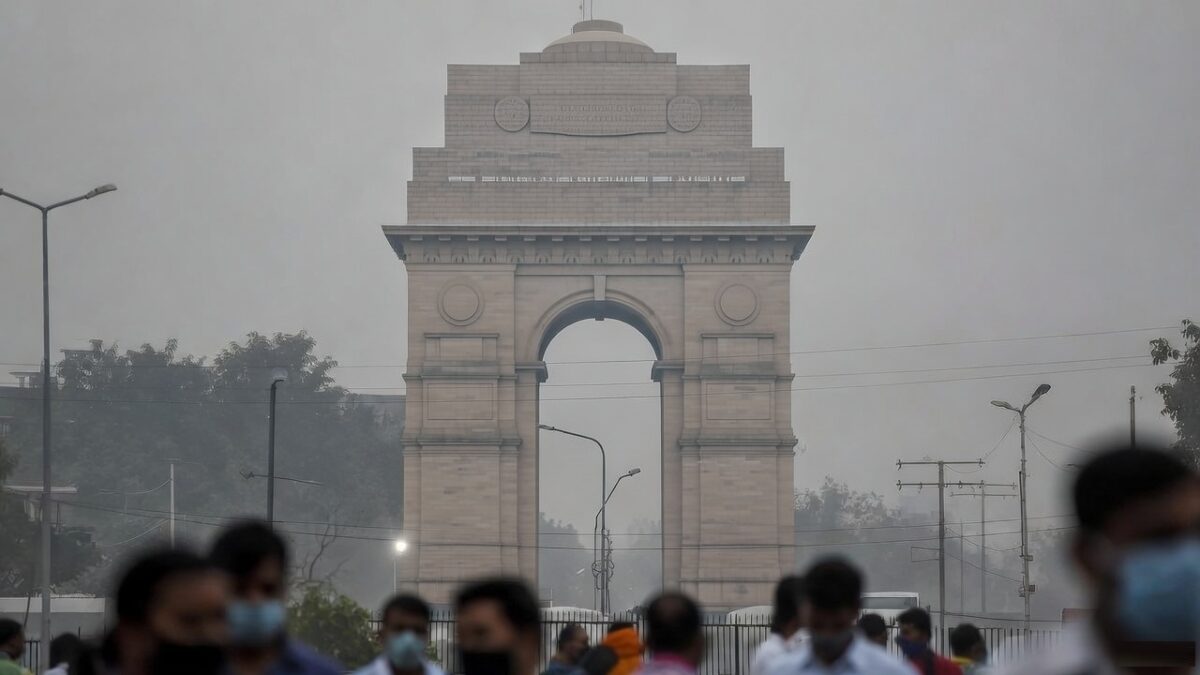
Facing a hazardous air quality spike with AQI readings between ~354–381 (Very Poor to Severe) across major monitoring stations, the Delhi government has activated GRAP Stage IV emergency measures, mandating 50% work-from-home (WFH) for all government and private offices from 18 December 2025 and one-time ₹10,000 compensation for registered construction workers affected by halted activities under the anti-pollution regime — both designed to curb emissions and protect public health amid a severe smog crisis.
What Is GRAP and Why Stage IV Matters
Understanding GRAP (Graded Response Action Plan)
Delhi’s air pollution control framework, GRAP, was instituted by the Commission for Air Quality Management (CAQM) to systematically escalate pollution-cutting actions based on real-time Air Quality Index (AQI) conditions:
- Stage I–II: Moderate responses like odd-even advisory, public awareness campaigns.
- Stage III (Severe): Construction bans, older vehicle restrictions, hybrid schooling.
- Stage IV (Severe+ / Emergency): Most stringent measures — further mobility controls, construction halts, and capacity limits on workplaces.
When pollution stays dangerously high — as Delhi has seen with persistent AQI readings in the 300+ bracket (well above safe levels of 50) this month — authorities escalate to Stage IV to restrict emission sources and reduce exposure risks.
Why the Government Has Enforced 50% Work-from-Home
The Policy
From 18 December 2025, Delhi’s environmental and labour ministries have ordered that:
- All government and private offices must operate with no more than 50% of staff on-site.
- The remaining workforce must work remotely (WFH).
- Essential services — health, police, public transport, electricity — are exempt.
- Non-compliance could invite administrative action or penalties.
This requirement applies regardless of sector, covering large corporates, SMEs, and government departments alike, aiming to significantly reduce daily commuter traffic — a major contributor to Delhi’s particulate load.
The Logic (Based on On-Ground Trends)
Traffic accounts for a substantial share of PM2.5 emissions in the Delhi-NCR region each winter. With meteorological conditions like low wind speeds trapping smog near the surface, reducing vehicular movement through remote work becomes one of the few immediate levers government possesses to lower emissions quickly.
From my experience covering pollution crises in the capital — especially in December — such measures reflect hard lessons from previous years: unless commuter volumes drop, AQIs can breach ‘Severe+’ levels within hours once atmospheric inversion layers set in (a common winter weather event in north India).
₹10,000 One-Time Aid for Construction Workers
Who Gets It?
Labour Minister Kapil Mishra has announced a ₹10,000 aid package for registered construction workers whose livelihoods are affected by the enforced ban on construction and related activities under GRAP Stage III and Stage IV directives.
- The relief is one-time per worker per period that the restrictions remain in force.
- Registration with relevant government labour welfare boards is required to qualify.
- Exemptions apply to essential services that continue operating.
Why It Matters
Construction bans — a backbone of early GRAP measures — are among the most effective ways to cut dust and heavy machinery emissions (a non-vehicular pollution source). But historically, daily-wage workers have felt the economic impact harshly since they lose pay with every day of stoppage. Providing financial relief reflects both environmental urgency and socio-economic consideration, albeit critics argue the amount may be insufficient for extended shutdowns.
On-Ground Air Quality and Public Health
AQI Context (Dec 2025)
Delhi’s AQI has repeatedly hit 354–381 across multiple monitoring stations — in the “very poor” to “severe” range — where even healthy individuals experience irritation and vulnerable groups face heightened risk of respiratory and cardiovascular issues.
While official CPCB data on specific station numbers remains fluid throughout the day, public-facing apps like Sameer and CPCB uploads consistently show readings far above healthy limits throughout mid-December.
Health Advisory Reality
Given such readings:
- Outdoor labour is strongly discouraged.
- Mask use (N95 or higher) is recommended when outdoors.
- Hospitals report high caseloads of respiratory complaints linked to smog exposure — a pattern familiar from previous Delhi winters.
Key Components of Delhi’s Stage IV Enforcement
Below is the snapshot of the larger anti-pollution response that accompanies the WFH and aid measures:
1. Work-from-Home Mandate
50% of office workforce to operate remotely, with essential services exempt.
2. Construction Ban
All construction activities, including private and public projects, halted to eliminate dust and machinery emissions.
3. Vehicle Restrictions
Older diesel vehicles (pre-BS VI) barred; strict PUC (Pollution Under Control) certificate norms enforced on all vehicles.
4. Schools Shift to Hybrid/Online
School classes adopt hybrid or online models to minimize children’s outdoor exposure.
5. Compensation for Workers
₹10,000 for registered construction workers as interim relief.
Frequently Asked Questions
While GRAP rules are executive directives rather than statutory law, Delhi’s government has framed the 50% WFH mandate as a mandatory administrative order — meaning workplaces may face inspections and penalties if compliance is lax.
GRAP stages pivot on real-time AQI. The Stage IV measures remain until air quality sustainably drops to lower GRAP thresholds (usually below ~300). That could be days or weeks during peak smog.
Only registered construction workers whose jobs are directly impacted by the pollution curbs. Registration and verification are underway.
A Necessary Strain
This isn’t just an administrative diktat — it’s a public health emergency response. When AQI breaches very poor or severe ranges for consecutive days, the calculus changes: for millions exposed, the cost of normalcy becomes lung damage and hospitalizations. The GRAP Stage IV measures, despite economic discomfort and implementation challenges, reflect a hard-earned playbook from years of winter smog battles in Delhi.
What happens next — whether these restrictions dramatically lower AQI or merely blunt its worst peaks — depends on weather shifts and compliance across sectors. In the interim, the 50% WFH order and the ₹10,000 relief are among the most tangible, immediate interventions aiming to protect health without paralyzing the city.