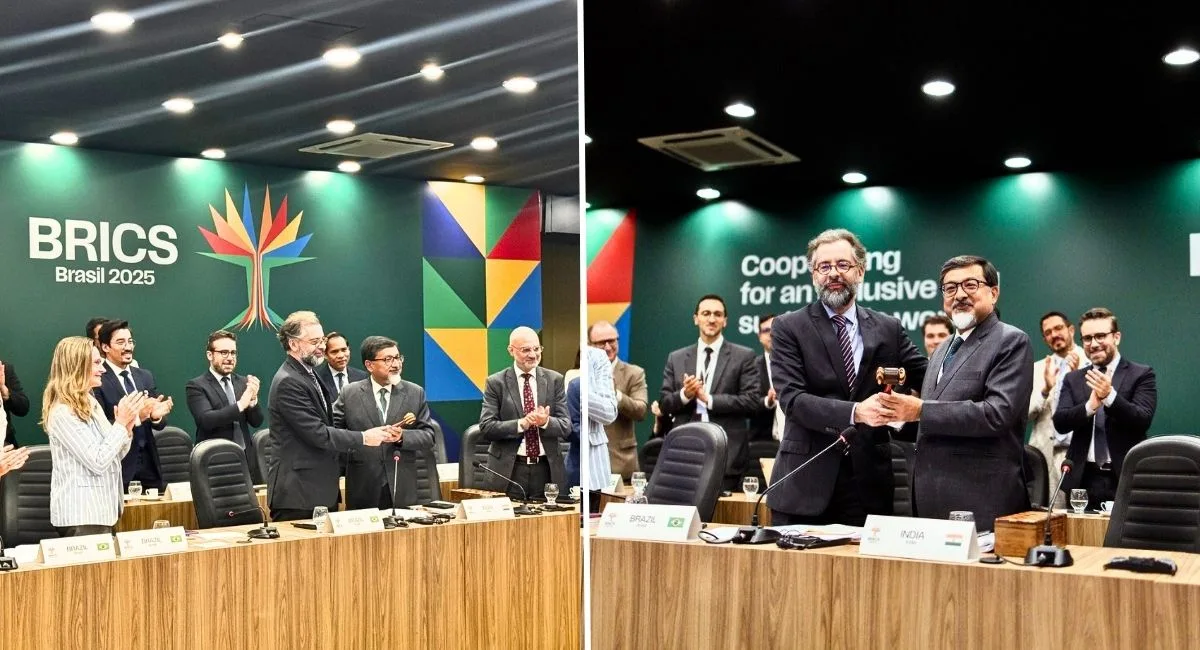
In a pivotal moment for the global South’s most consequential geopolitical forum, Brazil has formally transferred the 2025 BRICS presidency to India — a passing of the baton that sets the stage for an expansive, high-profile Indian leadership of the bloc in 2026. This transfer was confirmed at the BRICS Sherpas meeting in Brasília on December 11–12, 2025, where representatives from all eleven member countries gathered to review the Brazilian year of leadership and chart the path forward under India’s forthcoming chairship.
What Happened at the Handover?
At the final Sherpas meeting under Brazil’s BRICS presidency, hosted at the Itamaraty Palace in Brasília, Brazil completed its leadership cycle and officially passed the BRICS presidency to India, effective January 1, 2026. The two-day gathering brought together political sherpas from Brazil, India, China, Russia, South Africa, Saudi Arabia, Egypt, the UAE, Ethiopia, Indonesia, and Iran to conclude 2025 priorities and introduce India’s agenda for 2026.
Why This Handover Matters
For over a decade, BRICS has been central to alternative multilateral cooperation frameworks — giving voice to emerging economies and shaping policy debates on global governance, finance, technology, and South–South partnerships. Brazil’s leadership in 2025 delivered concrete outputs on trade, health cooperation, climate finance, and institutional dialogue. But the handover to India introduces a new style of presidency — one that will emphasize distributed engagement across India’s states and union territories, reminiscent of India’s G20 playbook.
Brazil’s 2025 Presidency: Achievements and Resilience
Brazil’s tenure as BRICS president — which began January 1, 2025 — was anchored in advancing cooperation across six priority domains, under the guiding motto of “Strengthening Global South Cooperation for More Inclusive and Sustainable Governance.”
1. A Broader BRICS Membership
For the first time, the club operated with eleven full members — including Saudi Arabia, Egypt, UAE, Ethiopia, and Indonesia — reflecting BRICS’ expanding footprint beyond its original five countries and reinforcing its role as a platform for the Global South.
2. Six Strategic Pillars
Brazil’s agenda centered on:
- Global health cooperation — initiatives to expand vaccine access and fight neglected diseases.
- Trade, investment, and finance — advancing diversified currency use and South–South trade.
- Climate action — commitments on climate finance and sustainable development.
- Governance of artificial intelligence — launching frameworks for ethical digital governance.
- Peace and multilateral security — reinforcing peaceful dispute resolution and institutional reform.
- Institutional cohesion — strengthening BRICS mechanisms and internal dialogue.
3. Concrete Results: Declarations and Policies
At the 17th BRICS Leaders’ Summit in Rio de Janeiro, held July 6–7, 2025, leaders reaffirmed commitments on inclusive global governance and issued summit declarations on AI governance, climate finance, and disease elimination — tying strategic direction to measurable outcomes.
4. Civil Society and Parliamentary Engagement
Brazil pushed new ground by elevating civil society voices within BRICS dialogues and deepening parliamentary cooperation — steps that future presidencies can build on for broader societal buy-in and public legitimacy.
India’s 2026 Presidency: Ambition, Resilience, and Nationwide Engagement
As the baton passes, India’s approach to the BRICS presidency marks a clear departure from traditional summit diplomacy — signaling a geo-cultural showcase and distributed engagement strategy that extends well beyond New Delhi’s Lal Qila speeches.
1. Presidency Begins January 1, 2026
India officially takes over the BRICS presidency at the turn of the calendar year, succeeding Brazil’s 2025 leadership.
2. G20-Inspired Nationwide Events
India plans to replicate its G20 presidency’s success model by taking BRICS thematic meetings, ministerial dialogues, sherpa and sous-sherpa tracks, and sector-specific forums to multiple Indian cities across all 28 states and nine union territories. This decentralization aims to integrate regional stakeholders and project Indian leadership on development, innovation, and cultural identity.
- Potential host cities include: Bangalore, Hyderabad, Chennai, Chandigarh, Ahmedabad, Lucknow, and more.
- Cultural showcases: From kite festivals and eco-friendly Diwali installations to drone light shows and themed cultural events.
- Branding campaigns: Embedding the BRICS brand across transportation and public platforms to elevate outreach and resonance.
3. A Broader Policy Menu
India’s presidency intends to:
- Highlight institutional reform within BRICS
- Advance digital governance principles
- Lead discussions on climate finance and sustainable development
- Elevate the Global South’s voice on reforming international economic systems.
What This Transition Signals Geopolitically
Brazil’s handover and India’s strategic blueprint underscore BRICS’ evolving purpose beyond routine leadership rotation:
1. A Shift Toward Distributed Diplomacy
India’s plan to take BRICS engagements into regional cities represents a response to critiques of multilateral forums as elite-centric — pushing a wider public diplomacy footprint that blends local culture with global policy discourse.
2. Resilience in South–South Cooperation
Through both Brazil’s achievements and India’s planned presidency, BRICS is doubling down on resilience — economic, social, and technological — while advancing the institutional capacity of emerging economies to shape global governance.
3. Legitimacy Through Participation
Expanding civil society voices and parliamentary engagement under Brazil’s leadership signals a maturing BRICS — one that India seems ready to institutionalize further with broad-based local engagement across a continental democracy.
Conclusion: A Defining Moment for BRICS and the Global South
The December 2025 Sherpas meeting in Brasília was more than a ceremonial handover — it was a tipping point for BRICS’ future trajectory. Brazil’s presidency delivered measurable progress across economic governance, health, climate, and digital cooperation. India’s forthcoming leadership for 2026 promises to amplify BRICS’ global relevance through nationwide engagement, cultural diplomacy, and strategic policy focus — reflecting a new era of resilient and inclusive multilateralism.
From Brasília to New Delhi and beyond, BRICS is not just changing hands — it’s transforming itself into a platform that’s poised to influence global norms, equity frameworks, and cooperative models for the decades ahead.