Starlink India pricing revealed 2025: ₹8,600/month + ₹34,000 dish — but final rollout still pending government sign-off
Key Takeaways
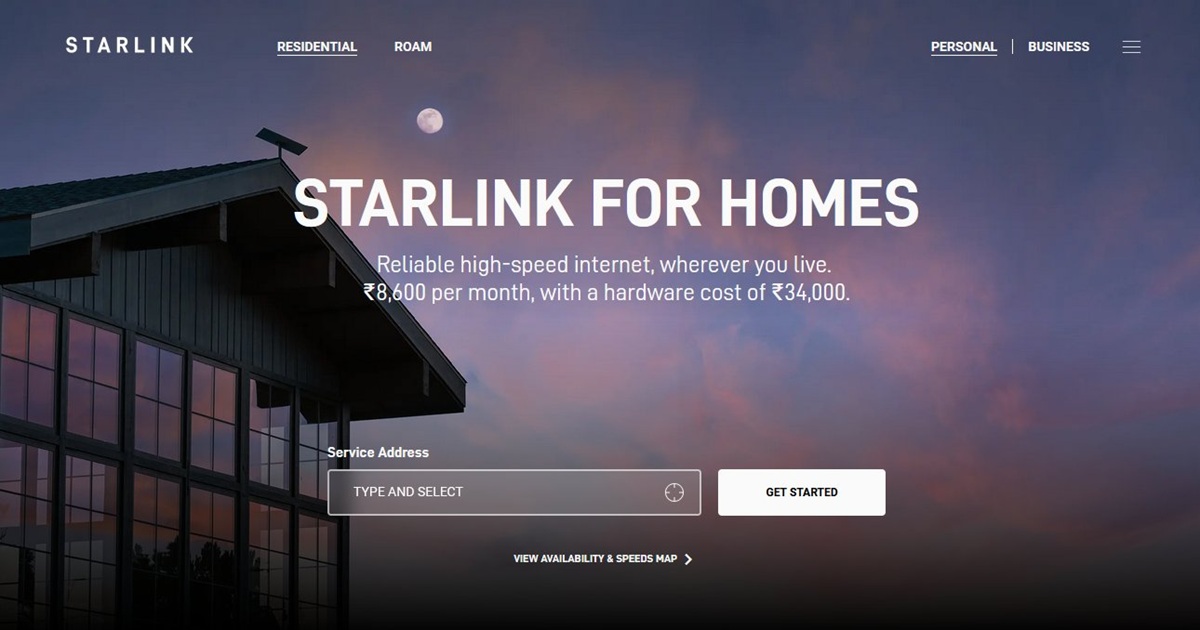
- Starlink has listed its Indian residential plan at ₹8,600 per month, with a one-time hardware kit cost of ₹34,000.
- The plan includes unlimited data, a 30-day trial, and promises 99.9% uptime with a plug-and-play dish + router setup.
- Despite the pricing reveal, Starlink still awaits final regulatory and ground-infrastructure clearance from Indian authorities — service is not active nationwide yet.
- Early expectations (from mid-2025) projected low-cost plans (~₹3,000–₹4,200/month and ₹33,000 device cost), but the announced price is considerably higher — positioning Starlink as a premium satellite broadband option in India.
What Starlink Is Offering — And What’s Changed
Published Plan vs Earlier Forecasts
Initially, analysts and industry watchers expected Starlink to enter India with relatively affordable pricing — roughly ₹3,000–₹4,200 per month and about ₹33,000 for the dish + router kit.
But the version now on Starlink’s official India website tells a different story:
| Component | Price (Published) |
|---|---|
| Monthly subscription (Residential) | ₹8,600 |
| One-time hardware kit (dish + router + mount) | ₹34,000 |
| Data allowance | Unlimited |
| Free trial | 30 days |
| Uptime guarantee | 99.9%, weather-resistant setup |
This is a noticeable premium compared with what many expected. The price bracket now places Starlink closer to high-end wired broadband or premium services — rather than a budget, mass-market alternative.
Why the Price Jump? Possible Reasons
- Global costs & supply constraints. Satellite internet hardware, manufacturing, deployment and maintenance entail high global costs — often not comparable with local wired broadband setups.
- Regulatory overheads. Under Indian rules, satellite operators must maintain domestic gateways, monitoring centres, and buffer zones near borders. Such compliance adds to infrastructure costs, which likely reflect in pricing.
- Targeting a niche segment — not mass market. With this pricing, Starlink seems focused on remote, underserved regions where fibre or 5G/4G may be unavailable — or on users who value reliability, mobility or coverage over cost.
- Market realism after local licence approval. Earlier forecasts (₹3,000–₹4,200) likely assumed aggressive competitive pricing; but after securing approval and reviewing required infrastructure/operational costs, the firm appears to have recalibrated to what analysts call a “premium sat-broadband tier.”
Why It’s Still Not Fully Available
- The published plan is only for residential users. Starlink has not yet disclosed business-tier prices or packages.
- The rollout depends on ground infrastructure, domestic traffic routing, gateway stations and regulatory clearances from agencies such as IN-SPACe.
- On the official sign-up page some users still see “Starlink Residential isn’t available in your region,” indicating that nationwide availability is phased — possibly limited to certain states or regions initially.
Who Gets the Most Value — And Who Probably Doesn’t
Best suited for:
- Households and communities in remote rural or hilly areas where fibre, cable or 4G/5G coverage remains unreliable or absent.
- Users who value consistent connectivity, regardless of weather or terrain — e.g., mountain villages, islands, desert belts, remote farms.
- Businesses or institutions in remote zones — small schools, remote offices, resorts — where consistent internet matters more than cost per Mbps.
Likely not for:
- Urban/suburban users who already get fiber or 5G broadband at ₹700–₹1,500/month, with comparable or higher speeds.
- Price-sensitive customers — ₹8,600/month is several times typical broadband subscription rates.
- Heavy data users expecting gigabit-level speeds — current Starlink performance (50–200 Mbps download, 10–20 Mbps upload) may suffice, but latency and peak throughput remain lower than fibre-optic connections.
What’s Next: What to Watch
- Business-tier pricing — Starlink may soon reveal commercial plans, which could come at different price bands (higher or volume-based).
- Regional rollout schedule — As ground stations and gateways are built, coverage will expand beyond early trial zones.
- Competition with terrestrial players — Local broadband rivals (fiber, 5G) may push back on pricing; adoption will hinge on where satellite access actually adds value.
- Regulatory and compliance updates — Security/licensing rules for satellite operators may affect service availability or data routing models.
FAQ
A: No. ₹8,600 is the monthly subscription fee. The hardware kit (dish, router, mount) costs a one-time ₹34,000.
A: Not necessarily. Starlink’s website still shows the service as “not available in your region” for many areas — nationwide availability depends on phased rollout and ground-station readiness.
A: Early estimates came before regulatory approvals and ground-infrastructure commitments. Actual pricing appears to reflect global hardware costs, compliance overheads, and a market positioning aimed more at premium satellite broadband rather than low-cost rural internet.