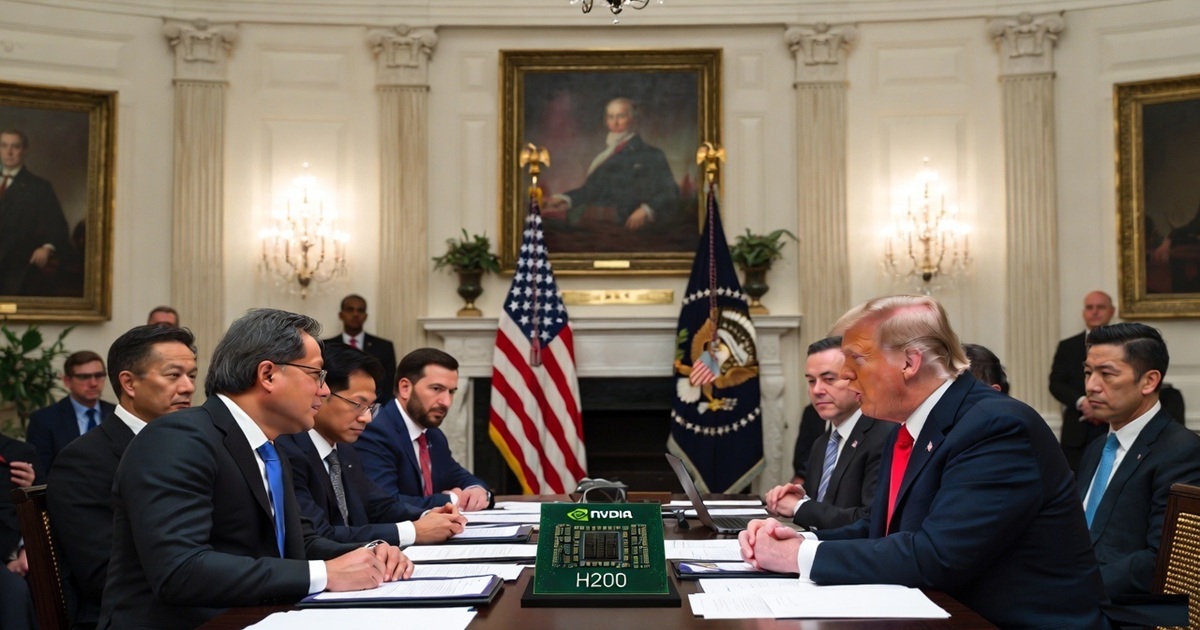
The meeting between Jensen Huang and Donald Trump was real — and it could reshape the trajectory of global AI hardware distribution. Reports confirm that the Nvidia CEO met Trump to discuss export-control policy, particularly whether Nvidia’s H200 chips might soon be eligible for sales to China.
Key Takeaways
- Huang met with President Trump and U.S. lawmakers to press for relaxed export controls that would allow sale of Nvidia’s H200 AI chips to China.
- Immediately after, Huang expressed uncertainty whether China would even accept H200 chips — noting China might reject “degraded” models just to meet export-compliance requirements.
- Congress has so far rejected a proactive export-ban measure, clearing the path for Nvidia to pursue H200 exports — though approval is not yet guaranteed.
- If H200 chips reach China, it represents a significant pivot in the 2025 AI arms race: U.S. firms regain access to the vast AI market in China — potentially accelerating competition in large-scale AI infrastructure.
What Happened — The Essentials First
Trump–Huang Meeting: What We Know
- On December 3, 2025, Jensen Huang met with President Trump and subsequently visited Capitol Hill for closed-door talks with senators and banking-committee members.
- The White House acknowledges the talks but refused to detail the content publicly. A spokesperson said private meetings are not subject to official comment.
- According to Reuters and other outlets, the central topic was potential export-control relaxation for Nvidia’s H200 chips — a generation of AI accelerators currently barred from sale to China.
Immediate Fallout: H200 Sales in Limbo
- After the meeting, Huang told reporters he couldn’t guarantee China would accept H200 chips even if U.S. export controls are lifted — citing customer unwillingness to take “degraded” hardware.
- Still, Congress opted not to include new export-restrictions in a must-pass defense bill — a win for Nvidia.
Why This Matter Doesn’t End with Politics — It Redraws the Global AI Hardware Map
A New Chapter in the AI Arms Race
If H200 chips reach Chinese buyers, a few big shifts follow:
- China’s AI infrastructure ramps up: H200 is far more powerful than what domestic Chinese firms currently produce. A limited export could turbo-charge Chinese data-center and AI-training capacity.
- Global competition heats up: Access to top-tier Western AI hardware could level the playing field. China-based SaaS, LLM providers or AI-driven startups would suddenly have tools roughly on par with U.S. providers.
- Geopolitics and economics collide: Export sales to China would bring Nvidia major revenue — but also raise concerns over technology transfer, surveillance, and military applications. Expect intense scrutiny.
The Risk of “Degraded-Chip” Strategy
Huang’s comment about China rejecting degraded chips reveals a long-term strategic dilemma. If China refuses inferior, export-compliant chips, Nvidia may be forced to negotiate harder, or risk lost market share — but if the U.S. insists on strict compliance, the deal could collapse. That uncertainty might discourage Chinese buyers, slowing any near-term boom.
Where Do Things Go From Here?
| Scenario | Likelihood | Impact on Global AI Landscape |
|---|---|---|
| Full H200 export approval → China builds large-scale data center fleets | Moderate | Rapid escalation of AI capability outside U.S.; intensified tech rivalry. |
| Restricted approval with degraded chips → Limited China uptake | High | Slower growth; Chinese firms seek alternate local or foreign alternatives. |
| No approval → Restrictions remain | Medium | Continues status quo; U.S./allies retain hardware advantage; some Chinese firms shift to domestic chips. |
Much will depend on how export-compliance regulations are written, and how receptive Chinese firms are to “export-safe” chips.
Bigger Picture: What This Says About Today’s AI Geopolitics
The Trump-Huang talks underscore that AI hardware is now a top geopolitical lever — not just a commercial commodity. Tech giants like Nvidia are no longer just making chips. They are shaping global power dynamics, national security debates, and the trajectory of innovation worldwide.
For China, access to H200 could shorten the gap in AI infrastructure. For the U.S., controlling distribution becomes a question of maintaining strategic advantage. And for Nvidia — maximizing profit while staying within geopolitical lines.
This moment captures how AI innovation, global trade policy, and power competition are merging into one.
Frequently Asked Questions (FAQ)
No. As of now, export restrictions remain. Huang and Trump discussed easing them — but approval and Chinese acceptance are not guaranteed.
Because export-compliant chips may be “degraded” in performance. Huang warned that Chinese buyers might reject such hardware rather than settle for sub-par versions.
Not necessarily. Hardware is only one piece. Software ecosystems, talent, regulatory environment, and access to data still favor many U.S. firms — but the hardware gap would narrow, boosting competition.