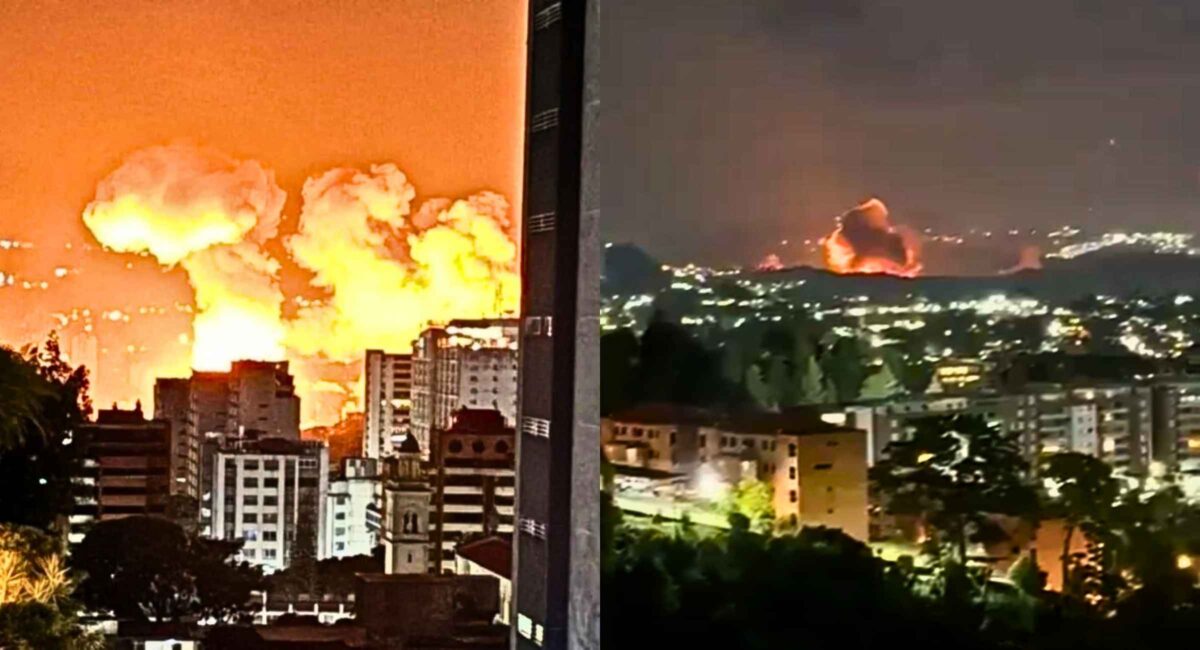
In a dramatic and unprecedented move early January 3, 2026, the United States carried out large-scale military strikes on Venezuela, and President Donald Trump publicly announced that Venezuelan President Nicolás Maduro and his wife, Cilia Flores, had been captured and flown out of the country. The U.S. action—aimed at toppling Maduro’s regime and disrupting alleged narcotics networks—marks one of the most significant escalations in U.S.-Venezuela relations in decades.
What Happened: US Strikes on Venezuela and Capture of Maduro
At approximately 02:00 a.m. (VET) on January 3, U.S. forces launched coordinated strikes on multiple locations across northern Venezuela, including Caracas and surrounding states such as Miranda, Aragua, and La Guaira. Explosions and aircraft activity were widely reported, with residents posting videos showing smoke and loud blasts.
Shortly thereafter, former U.S. President Donald Trump posted on Truth Social that the United States had “successfully carried out a large-scale strike against Venezuela and its leader,” and that Maduro and his wife had been captured and flown out of the country. Trump added the mission was conducted “in conjunction with U.S. law enforcement,” and promised further details at a scheduled press conference.
Venezuelan authorities have not yet independently confirmed Maduro’s capture or current location. Vice President Delcy Rodríguez issued a blunt statement demanding proof of life and clarifying that the government does not know where Maduro and Flores are.
Why the US Attacked Venezuela
Understanding this strike requires context. The U.S.–Venezuela relationship has deteriorated over years:
- Washington has long accused Maduro’s government of corruption, rigged elections, and involvement in drug trafficking networks—claims repeatedly denied by Caracas.
- In 2020, Maduro was indicted in U.S. federal court on narco-terrorism charges.
- Throughout 2025, the U.S. increased military and diplomatic pressure, including sanctions, naval deployments near Venezuelan waters, and strikes against suspected drug smuggling operations.
According to various reports, the January 3 operation falls under a broader campaign (codenamed Operation Southern Spear) targeting the nexus between the Venezuelan government and trafficking groups.
How the Strike Appears to Have Been Executed
While details remain scarce and some claims unverified, multiple credible outlets report:
- Airstrikes and explosions hit both civilian and military infrastructure in the Venezuelan capital and nearby regions.
- Low-flying aircraft were observed over Caracas during the operation.
- Trump’s statement mentions the strike included coordination with U.S. law enforcement, suggesting specialized units may have been involved.
Some reporting indicates elite U.S. special operations forces, potentially Delta Force or equivalent units, played a role in securing Maduro, though formal Department of Defense confirmation is not yet public.
Immediate Aftermath in Venezuela
Within hours of the attack:
- Venezuela declared a national emergency and mobilized its defense forces.
- The government rejected the U.S. action as “military aggression” and called on citizens to protest.
- There were reports of power outages and chaos in Caracas.
- The Federal Aviation Administration (FAA) banned U.S. flights over Venezuelan airspace due to the “hazardous situation.”
International and Regional Reactions
The global reaction has been swift and highly polarized:
- Latin American neighbors are divided. Colombia deployed armed forces to its border expecting a possible refugee surge, while Argentina’s president outwardly supported the U.S. action.
- Russia and Cuba condemned the strike, calling it an act of aggression and violation of Venezuelan sovereignty.
- Spain offered to mediate de-escalation, and Germany organized emergency consultations among EU rivals.
World leaders are now urging a convened United Nations Security Council session to assess the legality and regional impact of the U.S. strike.
Legal and Constitutional Questions in the US
Even within the United States, the action has raised eyebrows:
- Critics argue Congress did not authorize this military intervention, potentially violating the U.S. Constitution’s war powers.
- Supporters claim the operation targeted a narcotics kingpin and counterterrorist objective, though this framing remains contested.
What Happens Next?
At this early stage, many questions remain:
- Where are Maduro and Flores now? Without independent verification, the claims of capture and extradition remain unconfirmed outside Trump’s announcement.
- Who will govern Venezuela? Venezuelan law would typically pass executive duties to the vice president, but chaos could push the nation toward a power vacuum.
- Will this precipitate broader conflict? With regional powers aligning on opposing sides, the risk of wider instability is significant.
Conclusion: An Escalation With Uncertain Outcome
In the early hours of January 3, 2026, the United States’ large-scale military strikes on Venezuela — and the claimed capture and extraction of President Nicolás Maduro and his wife — have thrust the region into a moment of profound uncertainty. What began as tactics aimed at narcotics networks and political pressure has, within hours, transformed into what many analysts are calling the most direct U.S. military intervention in Latin America in decades—rivaling historic actions like the 1989 Panama invasion.
Whether this dramatically reconfigures Venezuelan politics or leads to prolonged conflict depends on verification of the core claims, international diplomacy, and how the Venezuelan people respond in the coming hours and days.