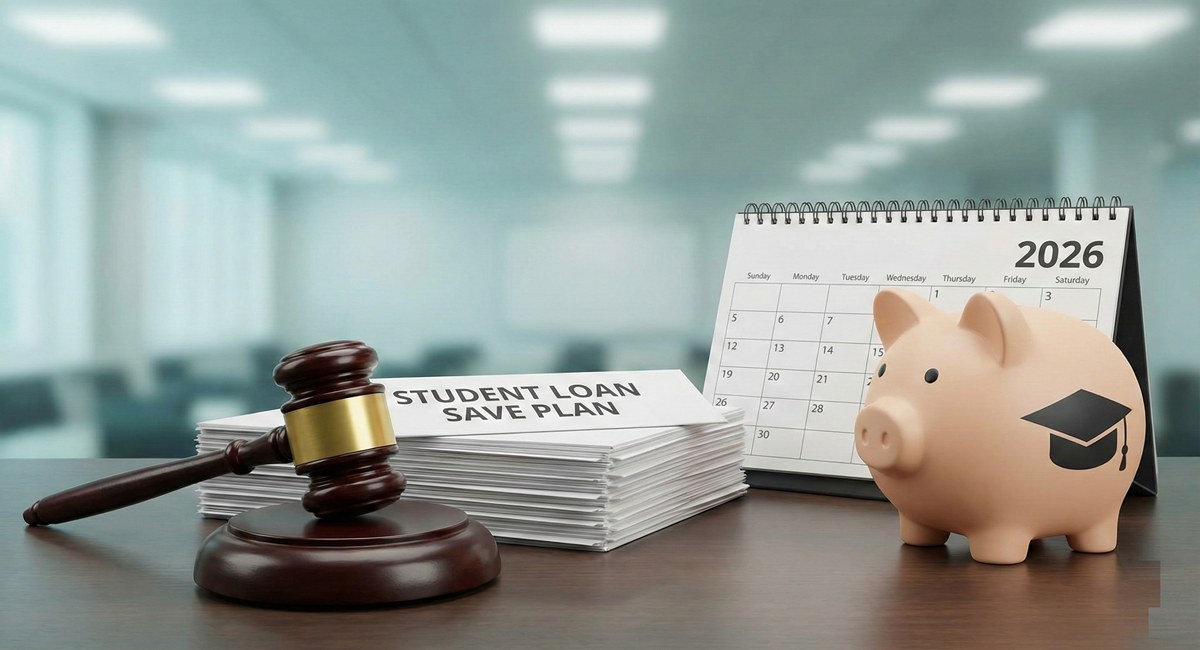
Yes — the SAVE Plan for student loans is ending. Borrowers under SAVE should expect to be moved into different repayment plans sometime in 2026. Here’s what that means — and what to do now.
Key Takeaways
- The U.S. Department of Education (ED) reached a settlement on December 9, 2025, with the state of Missouri and other states to end the SAVE Plan.
- More than 7.6–7.7 million borrowers are enrolled in SAVE and will be required to transition to other repayment plans if the settlement is approved.
- The SAVE forbearance — during which many borrowers had $0 payments — ended accruing interest on August 1, 2025.
- Borrowers must act: they’ll have a limited window to select a new plan (e.g., Income-Based Repayment (IBR), Income-Contingent Repayment (ICR), Pay As You Earn (PAYE), or the upcoming Repayment Assistance Plan (RAP) — or risk being automatically moved.
What Exactly Happened — and Why
The Settlement that Ends SAVE
- On December 9, 2025, the Department of Education announced a proposed settlement with Missouri (joined by six other states) that ends SAVE.
- The government argued SAVE was “illegal,” claiming it lacked proper congressional authorization and unfairly shifted cost to U.S. taxpayers.
- Under the agreement, if a court approves it, the SAVE Plan rule will be vacated — meaning it will be formally removed from federal regulations.
Why This Matters for Borrowers
- SAVE was widely considered the most generous federal student loan repayment plan: monthly payments often as low as $0, and faster forgiveness, especially for borrowers with smaller balances (e.g., loans ≤ $12,000 could be wiped out after 10 years under certain conditions).
- The plan already wiped out certain borrowers’ balances: before the injunction, around 153,000 people — roughly $1.2 billion in student debt — was forgiven under SAVE.
- Now, that path is gone. Borrowers will be forced to use older (and often costlier) repayment plans.
What Public Pensioners, Teachers, and Borrowers Should Do Now
Immediate Steps: Evaluate Your Situation
- Check your inbox and loan servicer account — The Department of Education says borrowers will receive outreach and must choose a new, legal repayment plan.
- Use the official Loan Simulator tool via StudentAid.gov to compare what different repayment plans will cost you with your income and loan balance.
- Apply ASAP for a replacement plan — e.g., IBR, ICR, PAYE (as eligible). These will likely be more expensive than SAVE; securing the lowest payment start may reduce long-term burden.
What You Should Expect in 2026
| Timeline | What Borrowers Should Do / Expect |
|---|---|
| Early 2026 (after court approval) | Department will move SAVE borrowers into other plans; borrowers likely get notice with a “window” to choose. |
| Mid-2026 | Borrowers may begin monthly payments under new plans; balances will include interest accrued since August 2025. |
| July 2026 | New plan option (RAP) is scheduled to be available — but RAP comes with longer repayment terms and likely higher lifetime costs than SAVE. |
Things to Watch Out For
- No more $0-payment or fast forgiveness guarantees. Under new plans, many borrowers will face monthly bills, and forgiveness — if available — will take longer.
- Interest already resumed. Even before formal plan changes, SAVE interest started accruing August 1, 2025. That means your debt has been growing since then.
- Uncertainty remains around timelines. The settlement still needs court approval. No exact date has been posted for when transfers or payment restarts will occur.
Why This Shift Matters Beyond Borrowers
- The decision signals a pivot in federal policy: a move away from aggressive, executive-branch driven loan forgiveness or relief programs toward more traditional repayment.
- It reflects political and legal pressure. GOP-led states argued SAVE lacked congressional authority, and courts repeatedly blocked major components of the plan.
- For taxpayers — especially those without student debt — the government frames this as preventing an estimated $342 billion in cost over a decade.
FAQ — What Borrowers Keep Asking
A: Not yet. The settlement still needs approval from a federal court (U.S. District Court for the Eastern District of Missouri). But if approved, SAVE will be permanently ended.
A: Likely sometime in 2026, after the transition. Interest has already resumed as of August 1, 2025.
A: You can move into older income-driven repayment plans (IBR, ICR, PAYE) or wait for the new Repayment Assistance Plan (RAP) expected in July 2026. Use the official Loan Simulator tool to find what works best.
These are rough estimates based on simple, transparent assumptions (payments = fixed % of AGI). I did this because exact federal formulas require household size, poverty guideline thresholds, loan interest rates, capitalization rules, and servicer timing; modeling those precisely needs more personal details and official calculators.
Assumptions used in the table (explicit):
- SAVE (would-have been) = 5% of AGI annually (simple proxy for the generous SAVE plan).
- PAYE = 10% of AGI annually.
- IBR = 15% of AGI annually.
- RAP (replacement) = 12% of AGI annually.
- Monthly payment = (AGI × rate) / 12. Total paid in 10 years = monthly × 120. Years to repay = balance / (annual payments). Interest and capitalization ignored (so actual times/costs will differ).
The table includes a PSLF note for the public-servant scenario (shows potential forgiveness after 10 qualifying years — independent of plan percentages).
Use StudentAid.gov Loan Simulator rules (more accurate) to model official PAYE / IBR / SAVE / RAP formulas and estimated interest — I’ll need household size and state (or you can ask me to use typical poverty thresholds).