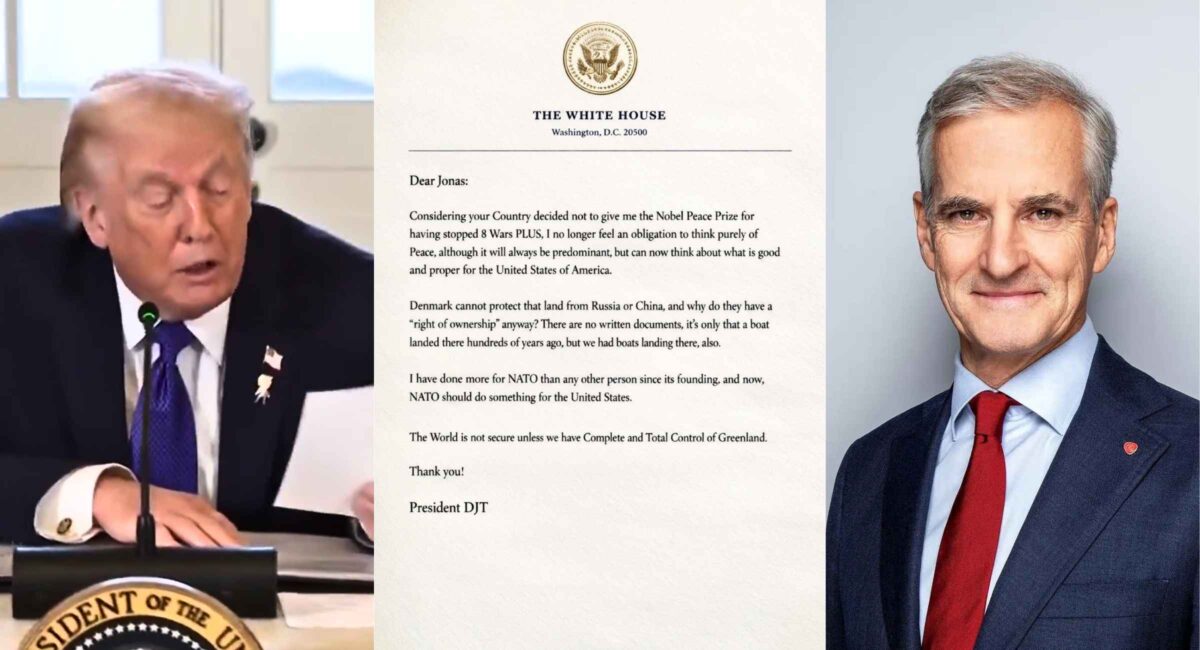
In an unprecedented diplomatic escalation on January 18–19, 2026, U.S. President Donald Trump sent a striking letter to Norway’s Prime Minister Jonas Gahr Støre, asserting that because he was not awarded the Nobel Peace Prize last year, he “no longer feel[s] an obligation to think purely of peace,” and is now focused on securing “Complete and Total Control of Greenland” — a self-governing Danish territory strategically important in the Arctic. The message, first reported by PBS and confirmed by Støre’s office, has sparked growing domestic calls to invoke the 25th Amendment due to concerns about Trump’s fitness for office and foreign policy judgment.
What Trump Wrote in the Letter — Text and Context
On the weekend of January 18, 2026, President Trump sent a personal message to Prime Minister Jonas Gahr Støre of Norway that has stunned allies and sparked political controversy. The text, which was originally obtained by PBS NewsHour reporter Nick Schifrin and later confirmed by Støre’s office, includes the following key passages:
“Considering your Country decided not to give me the Nobel Peace Prize for having stopped 8 Wars PLUS, I no longer feel an obligation to think purely of Peace, although it will always be predominant, but can now think about what is good and proper for the United States of America.”
He continued by questioning Denmark’s sovereignty over Greenland, claiming:
“Denmark cannot protect that land from Russia or China, and why do they have a ‘right of ownership’ anyway? There are no written documents… I have done more for NATO than any other person since its founding, and now NATO should do something for the United States. The world is not secure unless we have Complete and Total Control of Greenland.”
This language dramatically links Trump’s foreign policy objectives — specifically, the long-controversial push to assert U.S. influence, if not control, over Greenland — to a perceived personal slight from not receiving the Nobel Peace Prize.
Why This Letter Is Extraordinary
Nobel Peace Prize Misunderstanding
The Nobel Peace Prize is awarded not by the Norwegian government but by an independent Nobel Committee appointed by the Norwegian Parliament — a distinction Støre reiterated in his response to the letter. Trump’s complaint reflects a misunderstanding (or deliberate reinterpretation) of how the award process works.
Despite this, the president framed his strategic objectives around that perceived rejection — linking his broader geopolitical agenda to award politics in a way few world leaders have done publicly. Critics argue this blurs personal ego with statecraft.
Greenland — A Strategic Flashpoint
The letter reignited tensions over Greenland, a vast Arctic territory under Danish sovereignty with a high degree of autonomy. The island’s strategic position near the Arctic, proximity to Russia, and natural resources have made it a focal point in U.S. strategic thinking since World War II, but any move toward U.S. control would raise major legal, diplomatic, and alliance issues.
Trump has promoted the idea that the U.S. needs Greenland for national security reasons, though allied leaders and experts widely dispute both his rationale and legal basis.
Norwegian and European Reaction
Official Response from Prime Minister Støre
Norwegian Prime Minister Jonas Gahr Støre confirmed he received the message and made clear that Norway does not decide who wins the Nobel Peace Prize — that responsibility lies with the independent Nobel Committee. He also reaffirmed Norway’s support for Denmark’s sovereignty over Greenland.
Støre stated the letter came in response to an earlier message he and Finnish President Alexander Stubb sent to Trump, urging de-escalation and cooperation amid disagreements over tariffs and Arctic policy.
European Union and NATO Concerns
The letter’s publication coincided with rising tensions between the United States and several European allies. In addition to diplomatic unease, EU countries have discussed possible economic retaliation in response to Trump’s tariff threats linked to Greenland — a move that could strain the transatlantic alliance.
European leaders, including Danish, French, and British officials, have publicly defended international law and emphasized that Greenland’s status must be determined through dialogue and respect for sovereignty, not coercion.
Surge in 25th Amendment Calls in the United States
What the 25th Amendment Is
The 25th Amendment to the U.S. Constitution provides mechanisms for removing a sitting president who is unable to fulfill the duties of the office — either because of incapacity or inability to perform the powers and duties of the presidency. It has four sections, but critics typically refer to Section 4, which would allow the Cabinet and a majority of the principal officers of government to declare the president unfit.
Why Calls Are Rising
In the wake of Trump’s Norway letter, voices across the political spectrum — including lawmakers, commentators, and public figures — have amplified calls to invoke the 25th Amendment. These critics argue the content and tone of the foreign correspondence suggest impaired judgment or a departure from established diplomatic norms.
Supporters of the president have dismissed these calls as partisan overreach, noting that controversial statements alone do not meet the legal threshold required for 25th Amendment procedures. Supporters also emphasize national security arguments tied to Arctic strategy and U.S. interests in the region.
The Diplomatic Fallout
U.S.–Norway Relations
While Norway has maintained a commitment to alliance cooperation with the United States, the tone and substance of Trump’s letter could complicate broader diplomatic coordination — particularly in NATO and Arctic security initiatives.
Transatlantic Alliance Strains
The letter arrives at a time when U.S.–European relations are already under strain. Trump’s explicit linkage of personal grievances to policy objectives has fueled concerns among EU leaders about the future of economic and security cooperation.
Analysts suggest that the European Union’s emergency discussions about economic retaliation — including tariffs on billions in U.S. goods — reflects both frustration and a broader worry that traditional channels of negotiation may be bypassed.
Political and Domestic U.S. Reactions
Republican and Democratic Responses
Within the United States, reactions have been sharply divided:
- Some Republican lawmakers have downplayed the letter’s importance or framed it as routine political rhetoric.
- Many Democrats and some centrist Republicans have expressed concern, with a few calling for congressional hearings and public accountability measures.
- Media commentators and constitutional scholars have weighed in on whether Trump’s statements and policy shifts justify a formal fitness review, though legal experts note the bar for invocation of the 25th Amendment is high and requires clear evidence of incapacity.
Why This Letter Will Be Studied for Years
Beyond the immediate political and diplomatic reactions, Trump’s letter to the Norwegian prime minister stands as a rare moment of presidential communication in modern history — one where personal grievances appear intertwined with geopolitical demands that directly confront key alliances, international norms, and constitutional debates. The unusual emphasis on a Nobel Peace Prize snub — an award completely outside formal U.S. policy channels — coupled with an explicit Arctic territorial agenda, positions this event as a defining test of executive conduct in foreign affairs.
Conclusion: A Historic Diplomatic and Constitutional Flashpoint
President Trump’s letter to Norway’s prime minister — linking his Nobel Peace Prize disappointment to renewed threats over Greenland — has pushed global diplomacy into an unforeseen crisis point. Reactions from Norway, EU allies, and U.S. political leaders underscore the seriousness of the moment, and debates around the 25th Amendment reflect deep domestic concern about presidential judgment at a pivotal time for NATO and transatlantic cooperation.
Whether or not this episode leads to constitutional action, it will undoubtedly be etched into the record as an extraordinary intersection of personal grievance, geopolitical ambition, and constitutional debate — one that will shape how future observers understand presidential conduct in crises where personal, national, and international interests collide.