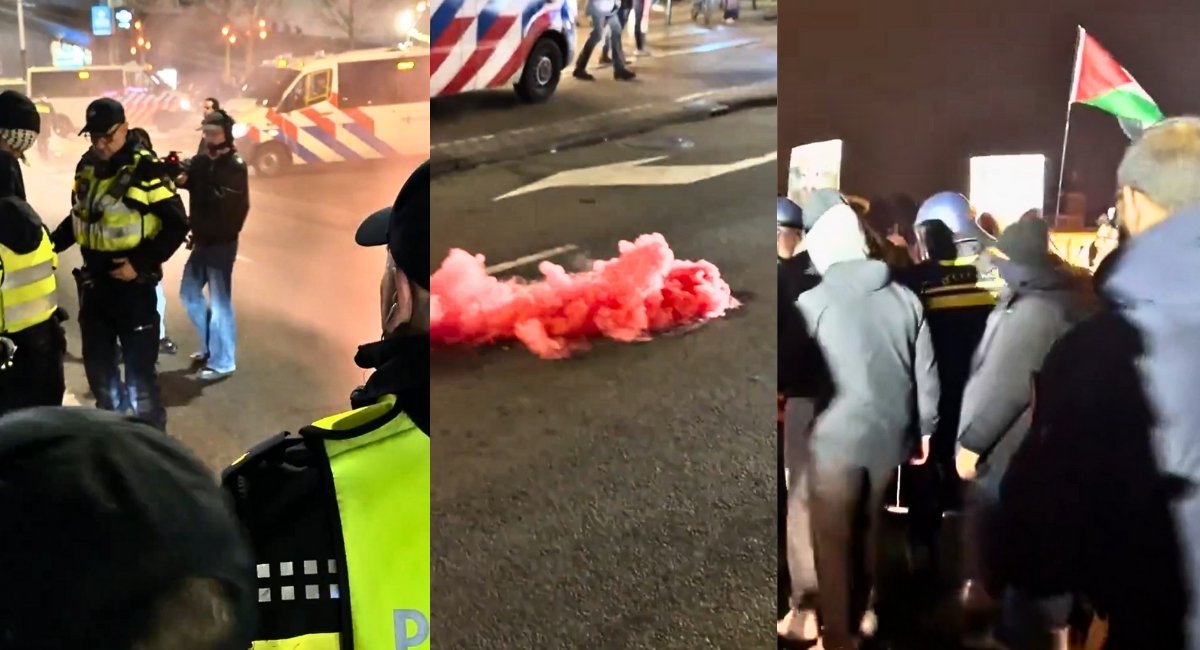
In Amsterdam on December 14, 2025, pro-Palestinian demonstrators clashed with Dutch police outside the historic Concertgebouw during Hanukkah events tied to performances by IDF Chief Cantor Shai Abramson — an Israeli military cantor whose association with the Israel Defense Forces (IDF) drew protests. Dozens of demonstrators threw smoke bombs and briefly blocked entrances, prompting police intervention and multiple arrests. Authorities confirmed that at least 22 people were taken into custody after confronting officers and failing to comply with ordered protest zones.
What Happened at the Concertgebouw Protest?
Pro-Palestinian protesters clashed with law enforcement outside Amsterdam’s Concertgebouw over the appearance of Israeli IDF cantor Shai Abramson at Hanukkah concerts. Smoke bombs were deployed by demonstrators, police moved in to disperse crowds and enforce protest restrictions, and 22 protesters were arrested amid scuffles and attempted blockade of venue entrances.
1. Background — Why Protesters Gathered
The unrest in Amsterdam must be understood in context. The Concertgebouw, one of Europe’s foremost concert halls, had been under pressure over its programming tied to the Israel-Hamas conflict. Local activist groups, including chapters of the Palestinian Community in the Netherlands and the Global Movement to Gaza, framed the protests around objections to the IDF affiliation of Shai Abramson, who serves as the Israeli military’s chief cantor at official ceremonies.
These groups asserted that his performance — even in a cultural and religious setting like a Hanukkah celebration — symbolized political support for the Israeli military’s actions in Gaza and the West Bank. That framing is widely echoed in protest signage and chants heard outside the venue.
2. Concertgebouw Controversy & IDF Cantor Abramson
The events stem from a dispute that dates back weeks. In early November, the Concertgebouw initially canceled its annual Hanukkah concert because organizers had booked Abramson and the venue felt his ties to the IDF were incompatible with its mission to “connect people through music.” That cancellation sparked backlash from Jewish community groups and diplomatic figures.
After negotiations and legal challenge from the Chanukah Concert Foundation, a compromise was reached: a public family concert would proceed without Abramson in the afternoon, and two evening performances restricted to invited guests would feature the cantor.
3. How the Day Unfolded
On Sunday, demonstrators began gathering in the early afternoon outside the Concertgebouw. A court-approved arrangement permitted a limited number of protesters (20 in the early slot and 30 later in the evening) to demonstrate near the venue, while allowing other activist groups to assemble at Museumplein, a larger square nearby.
By late afternoon, crowds expanded. Protesters carried Palestinian flags and shouted slogans condemning Abramson’s participation. Some attempted to move closer to the Concertgebouw entrances. Videos and reporting from Amsterdam indicate a tense atmosphere with demonstrators and counter-protesters on adjacent streets.
4. Police Response and Arrests
Dutch police responded with significant deployments of uniformed officers and riot control units to maintain order and enforce the court’s protest boundaries. According to multiple local sources:
- Smoke bombs were set off by certain demonstrators between the Museumplein area and the Concertgebouw.
- Protesters briefly blocked two entrances to the Concertgebouw, prompting police to intervene.
- Officers moved in to disperse crowds, and 22 arrests were reported among those who refused to comply with police orders or engaged in acts such as smoke bomb deployment and blocking entry.
Police spokespeople did not immediately specify whether arrestees were charged with specific offences but indicated that actions were taken against those breaking demonstrator limits.
5. Protester Tactics: Smoke Bombs & Blockades
The use of smoke bombs — often a tactic to disrupt, draw attention, and create disorder — marked a significant escalation beyond a static demonstration. Such devices are classified under Dutch law as potentially public-order interfering items, and their deployment typically triggers law enforcement intervention.
Blockading entrances to the Concertgebouw was another flashpoint. While peaceful protest is protected under Dutch law, attempts to hinder access to a public performance venue — especially with the presence of families attending a Hanukkah concert — triggered a swift police response under public-safety protocols.
6. Broader Reactions in Amsterdam and the Netherlands
News of the clashes drew attention not only locally but in national headlines and diplomatic commentaries. There are already established patterns of large demonstrations in the Netherlands related to the Middle East conflict — for example, in May hundreds of thousands protested Dutch Israel policy in The Hague earlier in 2025.
Security groups had issued a high-risk warning ahead of the Concertgebouw event, citing strong online engagement and anticipation of demonstrators rallying against Abramson’s appearance.
At the same time, Dutch authorities have acknowledged the balancing act: protecting freedom of expression while also ensuring that public safety is preserved and that cultural events can proceed without violent disruption. The legal limits on protester presence near the venue illustrate this calibrated approach.
7. Security, Free Speech and Public Order in Amsterdam
From a public policy perspective, Amsterdam’s response highlights a common democratic dilemma: how to honour citizens’ right to protest without letting demonstrations spill into unlawful disruption or violence. Dutch policing principles emphasize minimum necessary force but also strict enforcement of court-mandated protest boundaries.
In this case, authorities appear to have relied on pre-set protest zones, staggered time windows, and significant uniformed presence to manage competing interests: cultural celebration, freedom of assembly, and public safety.
Conclusion & Editorial Perspective
What unfolded at the Concertgebouw on December 14 was more than a spontaneous street clash — it was the culmination of weeks of cultural, legal, and political contention over whether a symbolic religious event can be separated from the geopolitics that surround it. Amsterdam’s patchwork of protest rights, court rulings, police strategy, and activist strategy converged in a tense and at times confrontational scene that saw dozens detained and smoke bombs thrown.
From my years covering societal unrest around principled protest movements, this event in Amsterdam mirrors the reality that culture and conflict are increasingly intertwined — especially when global geopolitics resonates within local communities and historic institutions. What remains clear from verified reporting is this: the demonstration drew broader attention to the Concertgebouw’s choices, the role of public spaces in political expression, and the challenges authorities face in safeguarding both civil liberties and public order.