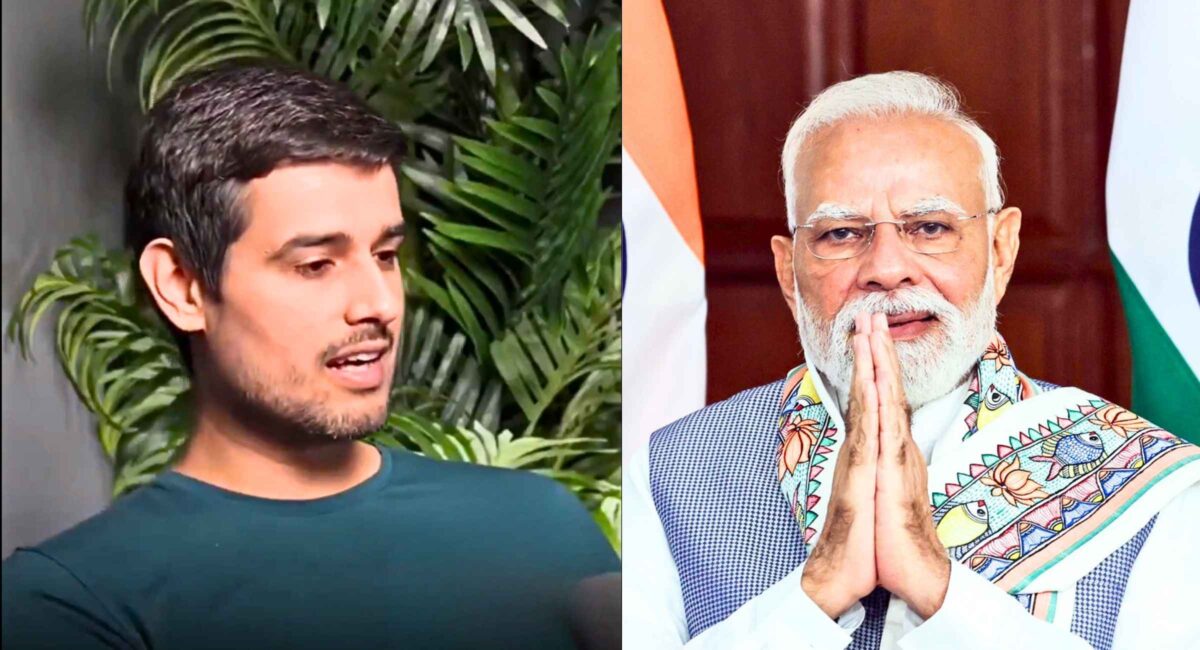
Indian social media commentator Dhruv Rathee has triggered widespread debate and backlash after stating on a recent KK Create podcast that “even a donkey is better than Narendra Modi” — a deliberately provocative critique of the Indian Prime Minister’s performance and governance that quickly spread across digital platforms. Rathee’s assertion, paired with other contentious remarks including comparisons of the Rashtriya Swayamsevak Sangh (RSS) to European paramilitary influences, has drawn sharp reactions from supporters and critics alike. (This article draws on verified reports and direct podcast accounts.)
What Did Dhruv Rathee Actually Say? Context From the Podcast
In a wide-ranging conversation with the KK Create channel, Rathee — known for straight-talk political commentary — weighed in on Indian leadership, partisan politics and institutional norms. When asked about the lack of a credible opposition to Prime Minister Narendra Modi, Rathee responded with a blunt metaphor:
“Nobody has done so much damage to the country than the government under him. Anyone else is better than him. Even an actual donkey is better than Modi because he won’t do anything — and doing nothing is much better than destroying the country like this.”
The line was framed not as personal insult alone but as a rhetorical device. Rathee’s broader critique centered on what he sees as merit-blind political appointments and governance failures that, in his view, have held back India’s institutional progress.
This remark — incendiary by design — immediately circulated on social media and was picked up in coverage by multiple outlets interested in the latest digital politics narratives.
Who Is Dhruv Rathee? Understanding His Platform and Influence
To grasp the fallout from these comments, you have to look at who Rathee is and how he operates:
- Dhruv Rathee is a well-known Indian YouTuber and commentator with a main channel that has nearly 30 million subscribers and billions of views.
- He’s based in Germany, which he has said gives him professional and personal freedom to critique Indian politics without domestic pressure.
- His content spans political commentary, civic analysis and social issues — with a strong emphasis on policy criticism and government accountability.
Rathee’s public persona blends education with pointed political critique. In other contexts, he’s emphasized that his content is backed by internal research teams and independent fact-checking.
Why This Comment Has Resonated and Inflamed
Digital Politics and Polarization
India’s political discourse online is already highly polarized. YouTubers, influencers and commentary channels increasingly shape debate outside traditional media structures. Independent voices like Rathee’s tap into this dynamic, often sparking passionate reactions on both sides of the political spectrum.
Modi’s Polarizing Leadership
Prime Minister Modi himself is one of India’s most consequential political figures in decades, credited by supporters for electoral success, economic reform and international stature — and decried by critics for centralizing power, stifling dissent and sidelining institutional checks. Rathee’s very blunt comparison (even equating inaction with preferable leadership) reflects that polarization and is designed for impact in a digital attention economy.
Criticism, Support and Social Media Reaction
The fallout hasn’t been uniform:
- Critics have seized on the donkey remark as evidence that Rathee’s commentary crosses from analytical critique into personal attack, with some accusing him of feeding anti-national narratives. (Online comments from users on Reddit and X illustrate a broad range of sentiments, from opposition to outright rejection of Rathee’s approach.)
- Supporters argue that dramatic language is part of political commentary and that Rathee’s underlying argument concerns governance outcomes rather than personal animosity. Others observed that India’s digital audience often interprets sharp metaphors differently depending on their political alignment.
There is no shortage of online opinion — ranging from praise for Rathee’s candour to accusations of bias — reflecting the broader fragmentation of India’s social media landscape.
The RSS and Nazi Germany Comparison: Wider Podcast Context
The controversy isn’t limited to the donkey metaphor. In the same interview, Rathee reportedly invoked historical analogies when discussing ideological structures he sees in Indian politics. According to reports, he suggested the RSS’s organizational roots had parallels with 20th-century European paramilitary groups, an analogy that drew gasps from listeners and ire from right-leaning commenters.
Such comparisons — especially when they evoke deeply negative historical associations like Nazi Germany — are highly controversial and rarely go without sharp pushback in Indian political discourse, especially from those aligned with or sympathetic to the RSS and the ruling party.
Legal and Ethical Considerations
Rathee’s speech, while provocative, falls within the broader scope of political expression and commentary. Indian law protects political commentary as free expression, but the boundaries around defamation, hate speech and national insult remain contested in courts and public discourse.
No official legal action has been reported at the time of this writing in response to Rathee’s recent comments — though online fact-checkers and commentators monitor discourse and challenge specific claims when they cross into misinformation.
Editorial Insight: Why This Moment Matters
From my experience covering political commentary trends, a few things stand out:
- Provocation is a tool — not an end. Rathee’s choice of metaphor wasn’t accidental; it’s designed to trigger discussion and visibility amid a crowded field of online opinion.
- India’s digital space is a battleground — narratives about governance, identity and democracy now play out primarily online, often bypassing traditional editorial filters.
- Polarization breeds extremes — both Rathee’s supporters and detractors tend to interpret his words through ideological lenses, amplifying controversy beyond the original context.
This episode highlights a broader tension in modern political discourse: where fact-based critique ends and sensationalist rhetoric begins. The intensity of reactions underscores the stakes of online political commentary in large, diverse democracies.
Conclusion: A Spark in a Broader Debate
Dhruv Rathee’s “donkey” remark about Prime Minister Modi is more than a meme-worthy line — it’s a flashpoint in debates over political accountability, online influence and the role of independent commentators in shaping democratic discussion. Whether one agrees or disagrees with his view, its viral spread reflects deep currents in Indian public life: mistrust, engagement, and the struggle over who sets the terms of national narratives.
At a time when digital platforms are primary sites of political engagement for millions, controversies like these will continue to surface — pushing the boundaries of political expression, and challenging audiences to discern between rhetoric and reasoned critique.