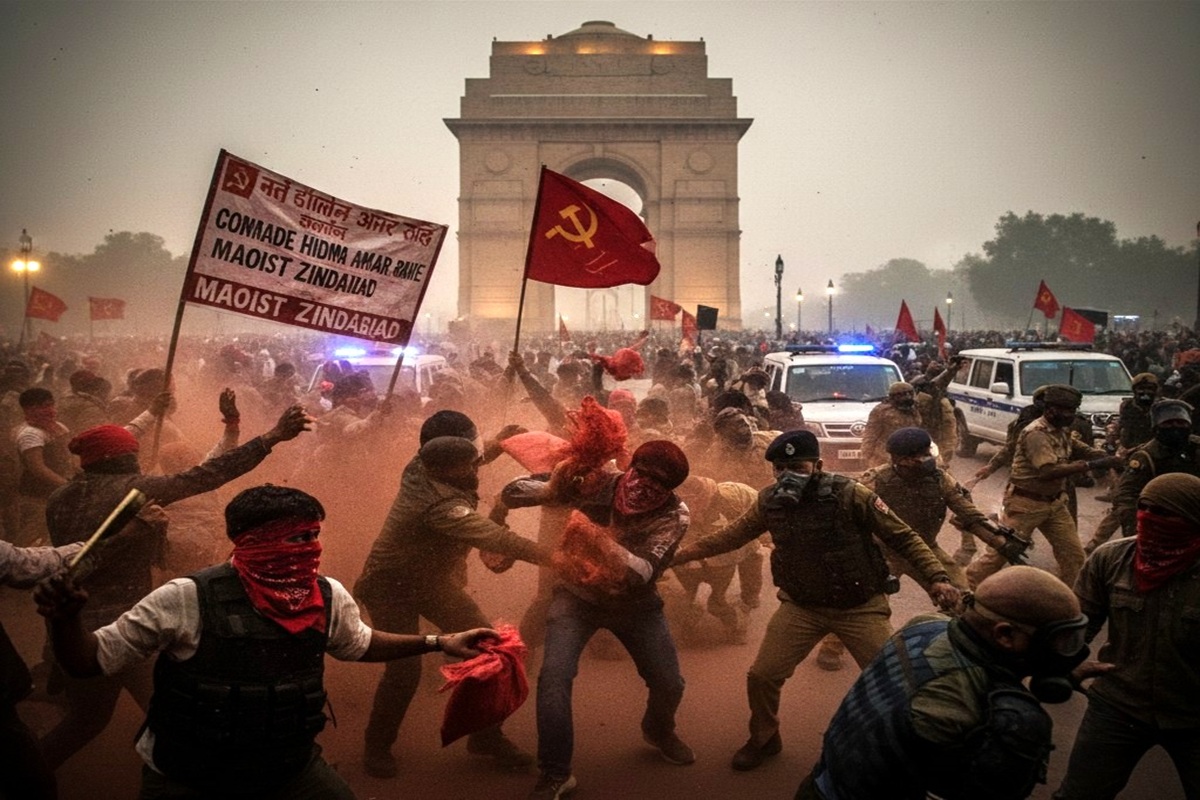
New Delhi, November 24, 2025 — A protest over Delhi’s worsening air quality turned unexpectedly violent at India Gate on Sunday evening, as some demonstrators raised posters of Madvi Hidma, the recently killed Maoist commander, and chanted slogans like “Madvi Hidma Amar Rahe” (Long live Hidma). The demonstration, initially framed as an environmental outcry, escalated into a clash with police, who allege that protesters used pepper (chili) spray, injuring several officers and leading to 15 arrests.
What Sparked the Protest — and the Turn to Violence
The gathering at India Gate was originally organized to decry the city’s skyrocketing air pollution — with residents calling attention to dangerously high levels of smog and toxic particulate matter. But tensions flared when a faction of the crowd reportedly broke through police barricades and moved into the roadway, refusing repeated orders to disperse.
According to police, ambulances and medical personnel were blocked by the protesters, who had sat down in the C-hexagon, a traffic-heavy area near India Gate. As authorities attempted to clear the road, several protesters allegedly used chili (pepper) spray against officers, resulting in three to four policemen being hospitalized with eye irritation and other injuries.
Hidma Slogans and Maoist Posters Raise Alarm
In a startling development, protestors held up posters of Madvi Hidma, a Maoist commander who was killed on November 18 and had a reported bounty on his head. Some in the crowd shouted “Madvi Hidma Amar Rahe,” while others held placards that linked environmental struggle to tribal and Maoist rebellion: “From Birsa Munda to Madvi Hidma, the struggle of our forests and environment will go on.”
The appearance of these slogans has raised deep concern among law enforcement and political observers. The Delhi Police announced that those chanting for Hidma will be identified and legally prosecuted.
Arrests, Legal Action, and Police Response
Authorities have detained 15 individuals in connection with the incident — citing criminal charges including assault on police, obstructing public functions, and public order violations. Several of the detained were picked up from India Gate and Parliament Street, where they were moved after the scuffle.
A First Information Report (FIR) was lodged under multiple sections of the Bharatiya Nyaya Sanhita, including 133 (assault on public servant) and 221 (obstructing a public servant), according to Delhi Police.
Law enforcement officials said this marked the first time they had encountered the use of chili or pepper spray by protesters in a Delhi demonstration. Several officers injured in the clash have been admitted for treatment at Ram Manohar Lohia (RML) Hospital.
Pollution, Frustrations, and Politics Collide
The underlying catalyst for the protest was a genuine crisis: Delhi’s air quality has once again entered the severe “hazardous” range, driving public frustration to a boiling point. Activists blame what they call a profit-driven development model — with infrastructure expansion, lax environmental regulation, and exploitation of fragile ecosystems fueling pollution.
But the unexpected shift to Maoist symbolism has added a volatile political dimension. For many observers, the inclusion of Hidma imagery and slogans points to a deeper undercurrent: an ideological takeover or the use of a mass protest to amplify a broader anti-state, tribal-rights, or extremist message.
A senior officer warned that such displays could embolden fringe groups and set a dangerous precedent for future mobilizations.
Voices from the Ground & Online Reaction
On social media — particularly Reddit — the protest has sparked heated debate. One user on r/delhi wrote:
“People went to protest for good air but these people hijacked the protest for their own agenda … now every protest for clean air would be termed Naxalite agenda.”
Another thread on r/AskIndia questioned whether this was a planned subgroup or opportunistic hijacking:
“Does anyone know why a small group suddenly began raising slogans for Madvi Hidma … Was it tribal-rights, or just people pushing a different agenda?”
Meanwhile, Redditors on the left expressed alarm at the crackdown — calling the protest a reflection of growing state repression and misuse of environmental activism.
Authorities Respond and Next Steps
Delhi Police have committed to a full investigation. According to officials, those identified for raising Maoist slogans will face legal consequences, and further arrests could follow. At least one FIR is expected to be expanded to include charges related to extremist propaganda.
Meanwhile, environmental groups are calling the protest a mix of legitimate citizen anger and ideological opportunism. The Delhi Coordination Committee for Clean Air, whose members joined the rally, stated that the core demand remains: real accountability and actionable policy measures to curb pollution, not symbolic gestures.
Politically, the incident is likely to intensify debate on whether environmental protests are being co-opted by radical elements — or whether they simply reflect deeper socio-economic grievances. Critics argue that linking Maoist calls to an air quality movement could delegitimize genuine activism and invite a heavy-handed state response.
In a city where smog becomes a seasonal reality, the India Gate rally exposed not just a public health emergency, but a fault line between citizen frustration, political ideology, and public order.
Bottom line: What began as a protest for breathable air has morphed into a volatile spectacle — with Maoist slogans, chili-spray attacks, and ideology-laced conflict threatening to eclipse urgent calls for environmental reform. The fallout from Sunday’s events could reshape how protests over pollution are perceived, policed, and politicized in Delhi.