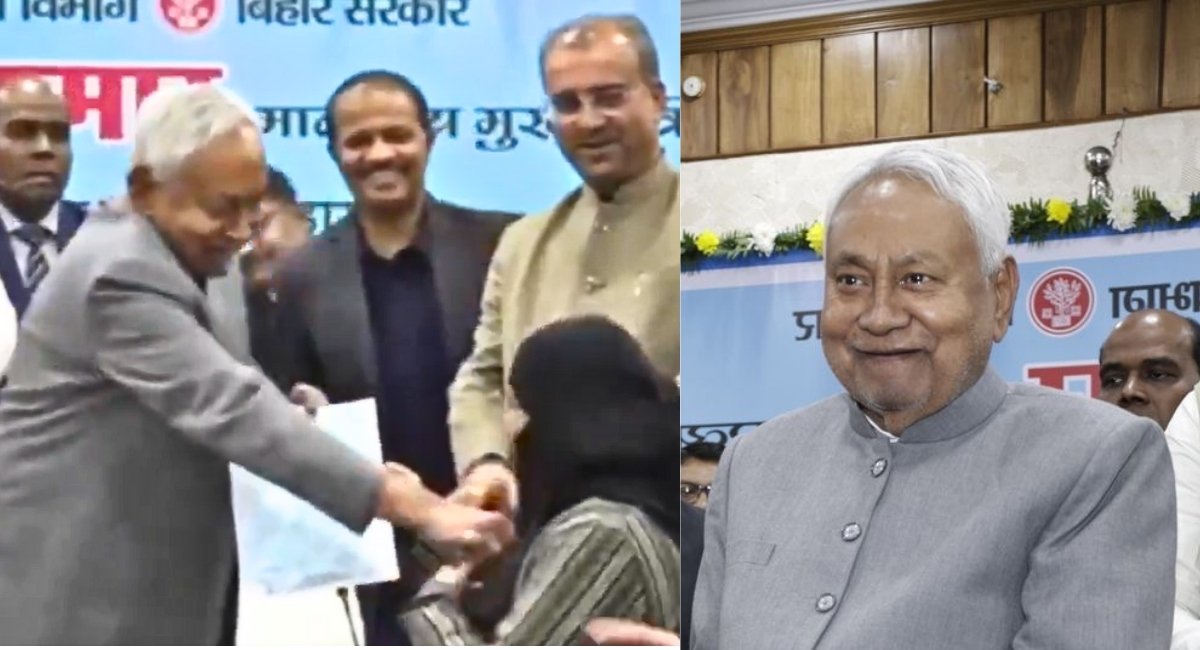
In a startling public incident that has ignited political outrage across India, Bihar Chief Minister Nitish Kumar physically pulled down the hijab of a Muslim AYUSH doctor during an official appointment ceremony in Patna on Monday, December 15, 2025. The act — captured on video and widely shared on social media — has prompted sharp criticism from major opposition parties, public figures, and civil rights advocates.
At its core: Nitish Kumar was seen removing the hijab from the face of Nusrat Parveen, a newly appointed AYUSH doctor, while handing her appointment letter on stage — a moment that many are calling a blatant violation of personal dignity and religious freedom.
What Exactly Happened at the Patna Event?The Setting
The ceremony was held at Samvad, the official secretariat in Patna, where appointment letters were being distributed to more than 1,283 newly recruited AYUSH doctors — including practitioners of Ayurveda, Homeopathy, and Unani medicine.
Sequence of the Incident
- Nusrat Parveen, an appointee, approached the stage wearing a hijab that partially covered her face.
- Nitish Kumar, aged 75 and serving his ninth term as Chief Minister, appeared startled by the headscarf, asked about it, then reached out and pulled it down from her face.
- The doctor appeared visibly uncomfortable.
- Deputy Chief Minister Samrat Choudhary was seen trying to restrain Kumar.
This action — occurring at a high-profile government event with cameras rolling — rapidly went viral across platforms like X and YouTube.
Immediate Political Fallout
Opposition Blasts the Chief Minister
Within hours, opposition leaders from the Congress and Rashtriya Janata Dal (RJD) condemned the act:
- Congress called Kumar’s behavior “vile” and demanded his resignation, saying that a person in the highest office of the state must exemplify respect for dignity and safety, especially for women.
- RJD questioned the Chief Minister’s mental state, suggesting his conduct was erratic and unbecoming of a senior public servant.
Political Reverberations
This incident has now become a flashpoint in Bihar’s political discourse, not just on religious freedom, but on leadership accountability. Opposition parties have amplified the moment as a symbol of what they describe as disrespect toward religious minorities and women in official spaces.
Public Reaction: Local & National Voices
The uproar hasn’t been confined to party statements — social media and public figures have weighed in as well:
- Actress Zaira Wasim, known for her outspoken support on matters of faith and dignity, demanded an unconditional apology from Nitish Kumar, calling the act disrespectful and demeaning.
- Muslim public figures and politicians, including MPs, called the act a direct affront to personal and religious liberties.
- On platforms like Reddit, users described the incident as a violation of personal space, with some equating it to harassment — especially given the professional context of the ceremony.
There’s also been polarization online, with some defending the Chief Minister’s intentions — but even many of those commentators concede that the act was inappropriate and potentially damaging to his political image.
Legal and Cultural Context
There’s no law in India that prohibits wearing a hijab in a public event. Religious freedom — including attire — is constitutionally protected under Article 25. While court rulings in some states have addressed uniforms and school dress codes, no binding national mandate bars adult women from wearing hijab at public functions. Legal experts say that a public official forcibly removing someone’s hijab could be interpreted as assault and violation of personal liberty, depending on circumstances and complaints filed. (Note: This is based on general legal interpretation — specific charges or charges filed have not yet been reported.)
The controversy thus straddles personal rights, religious freedoms, and political conduct of public servants — a complex mix that India’s judiciary and media often grapple with in similar cases.
Political Implications for Nitish Kumar and Bihar
Crisis for Leadership Image
Nitish Kumar has long cultivated a persona of a stable, centrist, and experienced leader, especially in coalition politics. But this incident — broadcasted, dissected, and debated across national platforms — has now become a defining flashpoint that could realign perceptions within both his own political base and among opponents.
Potential Electoral Impact
- It’s still early to measure electoral fallout, but the timing — in a politically charged period ahead of upcoming local polls — could be significant.
- Minorities and women voters, who already face complex socio-economic challenges in Bihar, may view this incident as symptomatic of deeper biases.
Legal Scrutiny and Complaints
As of now, no official FIR (First Information Report) or legal complaint has been widely reported. However, activists and legal rights groups have suggested they may consider pursuing legal action, citing potential violations of personal liberty and dignity.
Did the Chief Minister Respond?
At the time of writing, no formal statement or apology from Nitish Kumar or the official Bihar Chief Minister’s Office has been issued in response to the backlash — a silence that many political analysts see as politically risky given the scale of reaction.
Why This Matters (Beyond Bihar)
This incident isn’t merely a regional political controversy; it’s part of broader national conversations on:
- Religious freedom and secular rights
- Women’s dignity and autonomy
- Conduct expectations for public officials
- Political polarization in India’s democratic system
For many observers, a senior elected leader’s action — especially involving a woman in a professional context — doesn’t just reflect an isolated lapse but signals a broader cultural and administrative challenge. Whether this leads to policy discussions, judicial scrutiny, or shifts in public sentiment remains to be seen, but its immediate political impact is unmistakable.
Conclusion: A Leadership Crisis or Misunderstood Gesture?
What happened in Patna on December 15 isn’t easily dismissed as a simple misstep — it was captured on camera, replayed, and condemned across political lines because it touched core values of dignity and personal liberty. Whether Nitish Kumar’s action was a misjudged spontaneous reaction or a deeper reflection of governance philosophy, the fallout will likely shape political narratives in Bihar and beyond for months to come.
This event underscores a critical truth: leaders are not just judged by policy outcomes but by how they conduct themselves in public spaces — especially when it involves citizens’ identity, belief, and dignity.