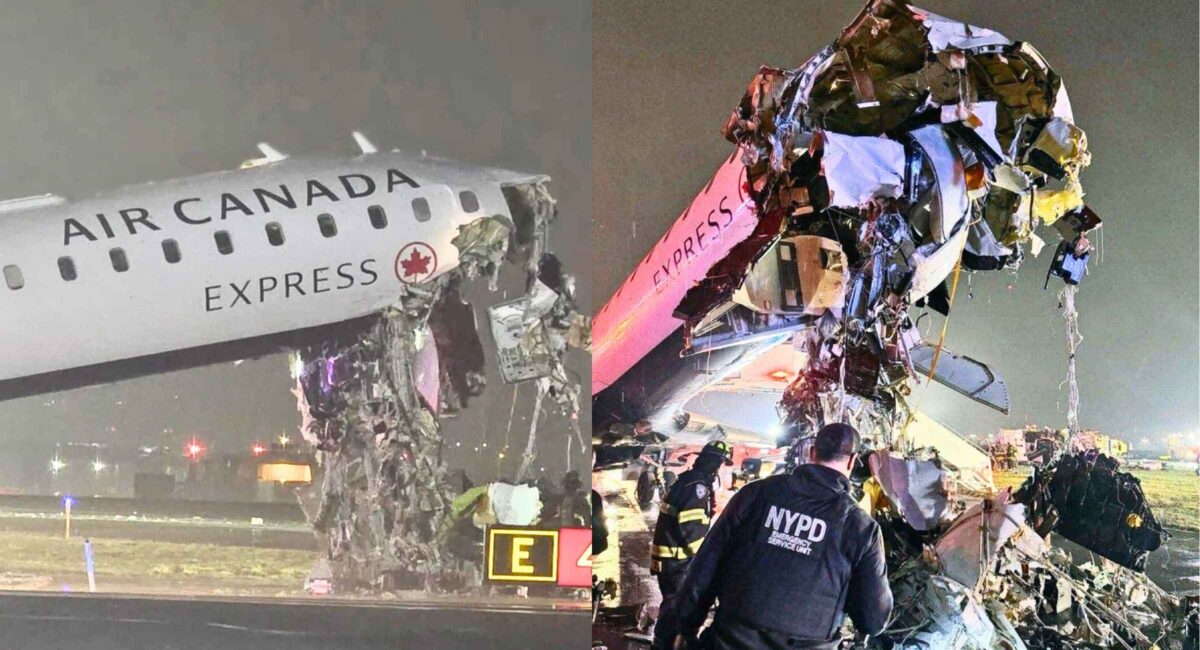
A fatal aviation accident occurred at LaGuardia Airport on March 22–23, 2026, when Air Canada Express Flight AC8646 collided with a fire truck on the runway during landing, killing both pilots and injuring more than 40 people. The airport was temporarily shut down by the Federal Aviation Administration as the National Transportation Safety Board launched a full investigation into what is now one of the most serious U.S. runway incidents in recent years.
What Happened at LaGuardia Airport?
Late Sunday night, just before midnight, a regional jet operated by Air Canada—specifically Flight AC8646—was completing its landing approach from Montreal when disaster unfolded on Runway 4.
At the same moment, an airport fire truck had been cleared to cross the runway to respond to a separate emergency involving another aircraft.
Seconds later, the aircraft and the vehicle collided.
Verified Incident Details
- Aircraft: Bombardier CRJ-900 (operated by Jazz Aviation)
- Passengers & crew: 76 onboard
- Fatalities: 2 (pilot and co-pilot)
- Injuries: 41 people, including passengers and first responders
- Collision speed: Approximately 20–30 mph on landing roll
- Location: Runway 4, LaGuardia Airport, New York
The impact destroyed the cockpit section, instantly killing both pilots—an outcome aviation experts describe as consistent with frontal runway collisions at landing speed.
The Critical Seconds Before Impact
What makes this incident especially troubling is what happened in the final moments.
Air traffic control (ATC) recordings—now central to the investigation—indicate:
- The fire truck was initially cleared to cross the runway
- Controllers then realized the aircraft was on final approach
- Urgent commands were issued: “Stop, stop!”
- The vehicle did not clear the runway in time
From years of covering aviation safety, this is a textbook example of what the industry fears most: a runway incursion, where two authorized movements conflict in the same space.
Why LaGuardia Airport Was Shut Down
Following the crash, the Federal Aviation Administration issued an immediate ground stop, effectively shutting down all incoming and outgoing flights.
Immediate Operational Impact
- Airport closed until at least 2:00 PM ET Monday
- Over 250+ flights canceled or delayed
- Aircraft diverted to:
- JFK International Airport
- Newark Liberty International Airport
For a high-traffic hub like LaGuardia, even a few hours of closure can ripple across the entire U.S. aviation network.
What Caused the Crash? Early Investigation Focus
The National Transportation Safety Board has deployed a “go team” to New York, and early focus areas include:
1. Air Traffic Control Coordination
- Was there a communication breakdown?
- Were multiple frequencies being handled simultaneously?
2. Runway Incursion Protocols
- Why was a vehicle allowed on an active runway during landing?
- Were standard safety buffers followed?
3. Weather Conditions
- Reports indicate rain and reduced visibility at the time
- Wet runway conditions may have limited braking distance
4. Human Factors
ATC audio suggests possible controller error, which—if confirmed—would place this incident among a growing list of near-misses and incursions in U.S. aviation.
Understanding Runway Incursions: A Growing Concern
If you’ve followed aviation safety trends recently, this incident fits a worrying pattern.
A runway incursion occurs when:
- An aircraft, vehicle, or person enters a runway without proper clearance
- Or when clearances are misunderstood or miscommunicated
In the past two years, regulators have flagged a rise in near-miss incidents across major U.S. airports.
From my experience covering FAA safety briefings, insiders have repeatedly warned that staffing shortages, high traffic density, and aging systems are increasing risk margins.
This crash may become a turning point.
Human Impact: Survivors, Injuries, and Emergency Response
Despite the severity of the crash, the survival rate among passengers was remarkably high.
Injury Breakdown
- 39 passengers treated for injuries
- 2 fire truck personnel hospitalized
- Majority of injuries reported as non-life-threatening
Emergency responders arrived within minutes, evacuating passengers and securing the crash site.
One detail stands out:
A flight attendant was reportedly thrown forward during impact but survived—a reminder of how chaotic these moments can be inside the cabin.
Air Canada and Official Response
Air Canada issued a statement confirming:
- Full cooperation with investigators
- Activation of a family assistance hotline
- Support for injured passengers and crew families
Meanwhile, U.S. officials emphasized that:
- There is no indication of terrorism
- The incident is being treated strictly as an aviation accident
Step-by-Step: What Happens in an Aviation Crash Investigation
For readers trying to understand what comes next, here’s how the process unfolds:
Step 1: Site Secured
Debris, black boxes, and vehicle remains are documented.
Step 2: Data Collection
Flight data recorder (FDR) and cockpit voice recorder (CVR) analyzed.
Step 3: ATC Audio Review
All communications reviewed second-by-second.
Step 4: Human Factors Analysis
Controller decisions, workload, and fatigue examined.
Step 5: Final Report
The NTSB releases findings—often months later—with safety recommendations.
Why This Incident Matters for Global Aviation
This wasn’t a high-speed crash. It wasn’t a mid-air collision.
And yet—it was fatal.
That’s what makes it significant.
Runway safety is supposed to be the most controlled environment in aviation. When failures occur here, they point to systemic issues—not just isolated mistakes.
For global aviation regulators, this incident will likely trigger:
- Review of ATC procedures
- Enhanced runway surveillance technology
- Possible staffing and training reforms
Conclusion
The LaGuardia Airport crash involving Air Canada Flight AC8646 is a stark reminder that aviation safety depends on precision at every level—from pilots to ground crews to air traffic controllers.
Two pilots lost their lives in a collision that, on paper, should never happen.
As investigators from the National Transportation Safety Board and Federal Aviation Administration work to uncover the exact cause, one thing is already clear:
This incident will reshape how runway safety is managed in the years ahead.
And for travelers, it reinforces a truth the industry rarely says out loud—
even in one of the safest modes of transport, the margin for error is razor thin.