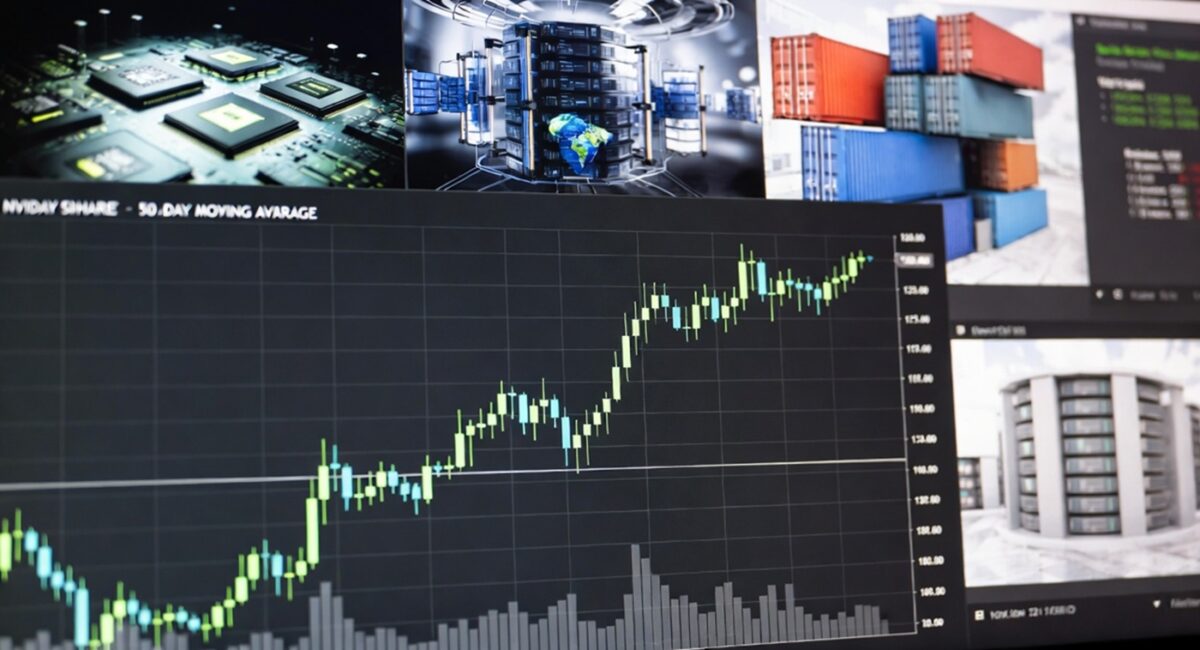
Nvidia shares are climbing above the key $185 50-day moving average because the U.S. government has eased export restrictions on Nvidia’s H200 AI chips, potentially unlocking shipments of 40,000–80,000 H200 GPUs to China — a development that significantly reduces geopolitical risk, restores a lucrative market segment, and promises a clearer revenue outlook. This regulatory shift is being priced into Nvidia’s stock, boosting investor confidence amid an otherwise tense U.S.–China tech rivalry.
Why the Market Moved — The Real Catalysts Behind the Rally
A Strategic U-Turn in U.S. Export Policy
In a striking reversal of earlier national security-driven export bans, the U.S. — under the current administration — has approved limited exports of Nvidia’s H200 AI accelerators to approved Chinese customers, subject to a 25% fee/revenue arrangement for the U.S. government. This marks a pivot from total denial to a regulated, taxed access model that allows Nvidia to monetize its inventory and tap into long-dormant demand.
From my experience covering semiconductor geopolitics, this isn’t a simple policy tweak — it’s a statement of intent that Washington is willing to balance national security concerns with commercial realities (something many analysts argued was overdue).
What Exactly Is the H200 — And Why It Matters
H200 — Not Cutting-Edge, But Still Crucial
The H200 GPU isn’t Nvidia’s latest flagship — that title belongs to the Blackwell and Rubin architectures — but it remains one of the most powerful chips widely used in AI training workloads. Though technically part of the prior Hopper generation, its performance sits roughly six times above Nvidia’s China-compliant H20 chip, making it far more attractive to compute-hungry customers.
In real terms, that means enterprises striving to train large language models or run complex AI workflows without cutting-edge domestic silicon could see their capabilities leap forward once the H200 enters the market.
The 40,000–80,000 Chips Figure — What It Really Means
Breaking Down the Shipment Plans
According to multiple sources close to Reuters reporting, Nvidia has informed Chinese clients that it plans to begin shipping mid-February 2026, ahead of the Lunar New Year. The shipments would leverage existing inventory, with initial totals slated at 5,000–10,000 H200 modules — which industry counting metrics translate to about 40,000–80,000 individual H200 chips.
This is significant because:
- These units represent real, shippable product, not just future aspirations.
- They stem from existing stock — meaning Nvidia isn’t disrupting its core production pipeline for domestic customers.
- It opens the door to expanded production in 2026, with new capacity potentially coming online in Q2.
Why Investors Care — And Why Shares Are Rising
Reopening China Revenue Streams
Before this policy shift, Nvidia was essentially priced out of one of the largest AI compute markets on earth. Domestic revenue accounted for a hefty share — hit hard by restrictions — while China was largely locked out for high-end chips. This had a chilling effect on future revenue forecasts, with analysts building in a “geopolitical risk discount.”
Now, with the prospect of regulated H200 sales returning to China:
- The revenue outlook becomes more predictable.
- Analysts can model in incremental China sales again.
- Stock price targets — already rising above $185 — are now being reassessed higher in some forecasts.
Investors are showing relief that Nvidia has a clear path (albeit regulated) to capture latent demand that had previously been inaccessible.
Still a High-Risk, High-Reward Scenario
Approval and Timing Uncertainty
Here’s where nuance matters: these shipments are not guaranteed. Chinese government approval is still officially pending, and timelines could shift, especially given the heavy political spotlight on technology transfers between superpowers.
Beijing’s regulators could impose conditions — for example, bundling domestic chips with H200 orders — which would alter the economics for buyers and potentially reduce volumes.
Political Backlash in Washington
On the U.S. side, bipartisan skepticism remains, with some lawmakers pushing back against any relaxation of export controls, arguing that it could erode broader technology containment efforts. If Congress moves to tighten controls again, the window could narrow abruptly.
So, while shares are rising now, the path forward isn’t without potential policy headwinds that could reverse sentiment quickly.
Beyond Nvidia — Broader Industry Impacts
Competitor Positioning
This development doesn’t just help Nvidia. Major semiconductor players like AMD and Intel could see similar dynamics for their eligible chips under the new framework. While they don’t dominate the GPU space quite like Nvidia, increased China access could broaden their markets too.
China’s AI Ambitions
China has been aggressively pursuing its domestic AI chip ecosystem, but nowhere near matching performance on high-end silicon yet. If shipments proceed, that could help local firms accelerate model training and innovation — raising competitive pressure globally.
Conclusion: The Next 12 Months Will Define the Trade Narrative
Nvidia’s stock breaking above the $185 50-day average isn’t random — it’s a direct market response to a rare easing of export restrictions that may finally reopen one of the most strategic revenue channels in tech. The H200’s reentry into China (even under a tariff regime) reshapes expectations for near-term growth after years of punitive export controls.
But investors should keep their seats. The story is far from over, hinging on regulatory approvals in Beijing, Congressional attitudes in Washington, and how China chooses to balance domestic chip priorities with imported compute power. If this tentative thaw evolves into sustained China access, Nvidia’s next earnings season could look very different — and so could the competitive AI landscape.
Bottom Line: It’s not just about shipments — it’s about confidence returning to a stock whose future had been clouded by geopolitics.