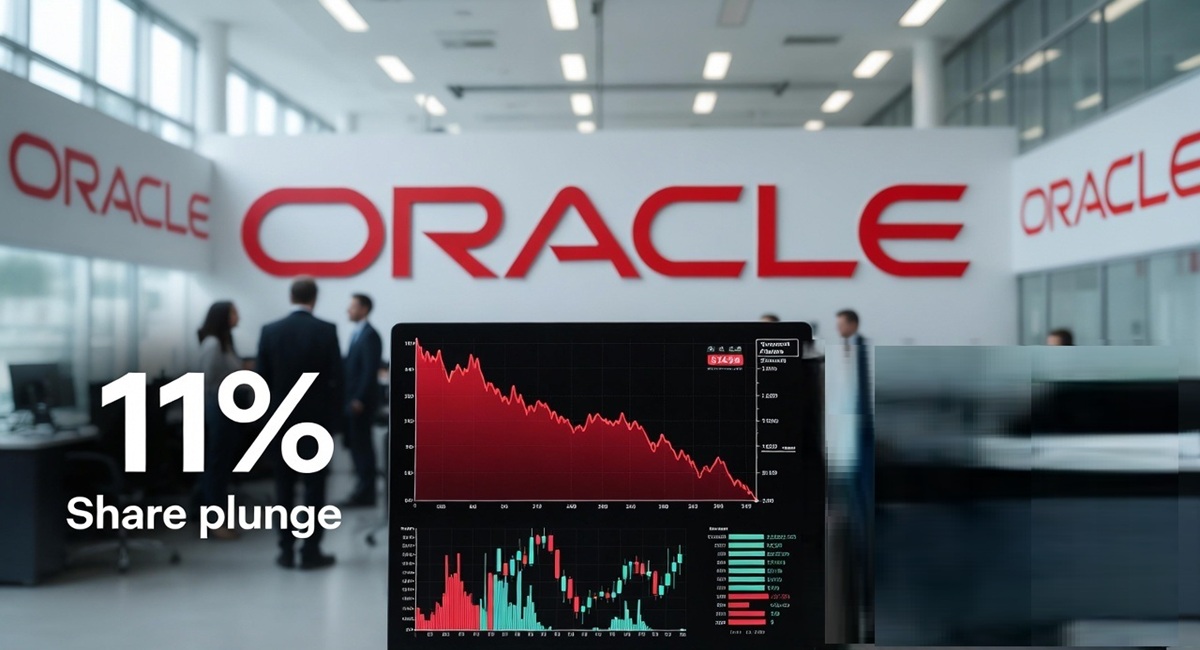
Oracle’s stock cratered ~11–11.5% after reporting fiscal Q2 2026 (quarter ended Nov 2025) results that missed revenue expectations despite strong AI-related growth. The sell-off was driven by a surge in AI-related capital expenditure guidance (to ~$50 billion) and escalating debt levels approaching $100 billion, fueling investor concern that Oracle won’t generate sustainable positive free cash flow until around 2028.
From the trading desk to the C-suite, this story is now one of AI ambition versus financial discipline.
Why Oracle Shares Sank After Q2 2025 Earnings
1. Revenue Beat But Still Below Expectations
Oracle reported ~$16.1 billion in total revenue—up double digits year-over-year but below Wall Street forecasts (~$16.2 billion). Even decent cloud growth (34% overall; 68% in cloud infrastructure) wasn’t enough to placate investors.
In markets like software and cloud, timing is everything—the market expected growth to translate into recognized revenue sooner, and it didn’t.
2. Capex Upped Sharply for AI Infrastructure
Oracle’s capital expenditure plan jumped to ~$50 billion for the fiscal year, including ~$12 billion in this quarter alone—far above analysts’ expectations. This capex is mostly tied to building and expanding AI data centers, especially GPU-heavy facilities Oracle hopes will anchor future cloud AI workloads.
But this creates a disconnect: spending now, revenue recognition later—which, in the short term, hits margins and cash reserves.
- Capex outpaced revenue growth
- Free cash flow turned negative deep into the quarter
- Investors feared the conversion into profit might be slower than Oracle claims
3. Rising Debt On Investor Radar
Oracle’s long-term debt now sits near $100 billion, a ~25% year-on-year increase. That rising leverage—and talk of up to $100 billion in AI financing—worries markets because:
- Debt amplifies risk when cash flow lags
- Increased leverage may pressure credit ratings
- Debt service reduces flexibility for future innovation or buybacks
Even rating agencies have signaled a more negative outlook on Oracle’s credit profile as leverage intensifies.
4. Delayed Cash-Flow Payoff Until ~2028
Here’s the crux: Oracle is spending heavily long before it sees corresponding cash inflows.
The company’s own guidance indicates that free cash flow conversion (and sustainable positive cash flow) may not fully materialize until around 2028, once its massive AI- and cloud-driven infrastructure begins generating reliable earnings and the backlog converts into revenue.
That’s a multi-year wait from what many investors hoped would be a quicker payoff.
The Numbers Behind the Narrative
| Metric | Reported |
|---|---|
| Total Revenue (Q2) | ~$16.1B (14% YoY) |
| Cloud Revenue Growth | 34% YoY (SaaS + IaaS) |
| Cloud Infrastructure (IaaS) | 68% YoY |
| Remaining Performance Obligations | ~$523B (up 438%) |
| GAAP EPS | $2.10 (up 91%) |
| Non-GAAP EPS | $2.26 (up 54%) |
| CapEx (Quarter) | ~$12B |
| Full-Year CapEx Guidance | ~$50B |
| Long-Term Debt | ~$100B range |
| Free Cash Flow Trend | Negative recently |
Note: Strong EPS figures were bolstered by one-time gains (e.g., sale of Ampere) rather than organic growth, which clouds the true operational picture.
What Oracle Is Betting On
Oracle isn’t shifting strategy lightly—in fact, this pivot traces back over a year:
Massive Cloud Backlog
Oracle’s remaining performance obligations (RPO) ballooned to over $523 billion, a record backlog anchored by deals with enterprises and AI players like Meta and Nvidia. Unlike revenue recognized today, RPO represents future contracted income.
That’s a long-range contract book that could pay off over several years—if all else goes right.
AI Infrastructure as a Differentiator
Oracle is targeting AI workloads with:
- GPU-heavy data centers
- Specialized cloud regions
- Contracts to support training and inference workloads
Management is positioning Oracle as an alternative to AWS, Azure, and Google Cloud—but that’s expensive: cloud infrastructure bets are capital-intensive with slow ROI.
Investor Sentiment: Fear vs. Future
Right now, sentiment is a mix of hope and caution:
Positive Indicators
- Strong backlog that may produce future revenues
- Cloud growth still well above industry average
- Earnings per share beating street expectations
Risks That Spooked Markets
- Revenue misses vs. expectations (even with growth)
- Capex outpacing cash generation
- Debt levels rising faster than operating cash flow
This combination—that Oracle is growing, but not yet in a way Wall Street rewards—is exactly why the stock price got hit.
What Analysts Are Watching Next
From my years covering tech earnings, the real inflection point for Oracle won’t be a single quarter—it’ll be when these three variables align:
- Capex Growth Slows
Investors want to see spending taper as infrastructure becomes self-serving. - Free Cash Flow Turns Positive Again
Not just operating cash flow—but free cash flow that earns money back for shareholders. - Cloud Revenue Converts Faster Than Spending
That’s the holy grail: spend less, realize more.
Until then, Oracle is in investment mode, and markets historically punish long drawn-out payoffs.
Editor’s Verdict
Oracle’s Q2 2025 stock drop wasn’t a fundamental collapse—it was a valuation reset.
Investors aren’t rejecting AI ambitions; they’re questioning timing and financing:
- $50 billion in capex is real
- Debt rising near $100 billion is real
- Free cash flow not yet back to positive is real
And markets don’t like uncertainty over multi-year cash flow realization.
Oracle’s management believes the payoff will come by 2028, when the cloud backlog converts and infrastructure investments mature. That’s a bold bet—and one investors are still pricing for risk.