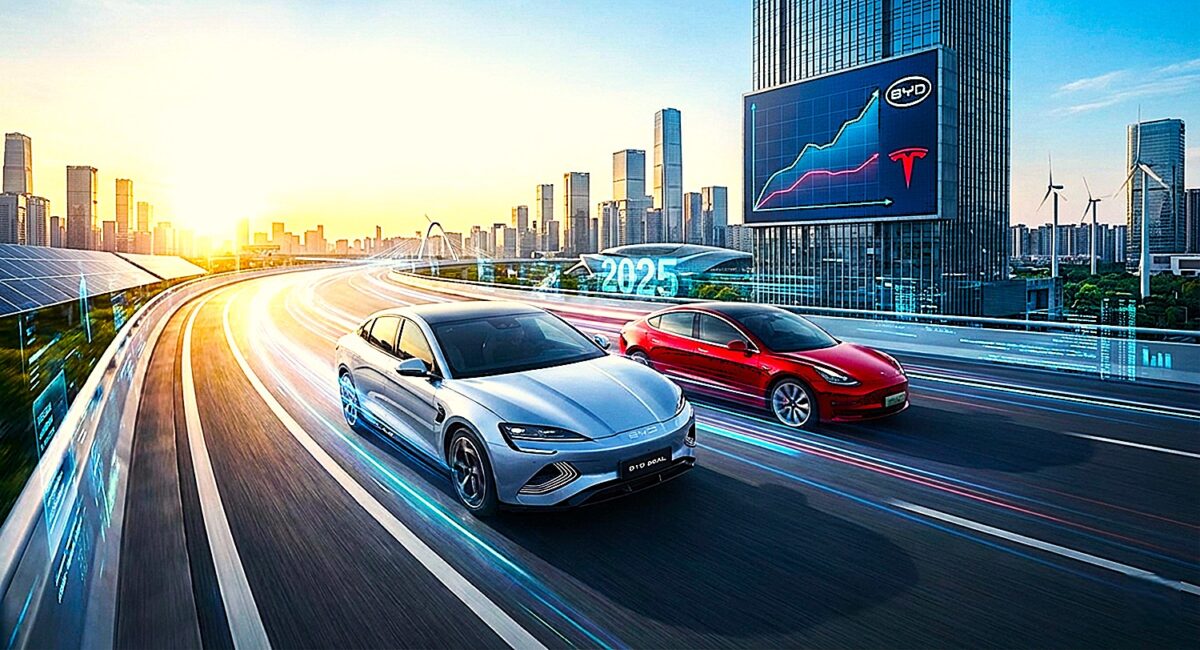
In one of the most significant shifts in the automotive industry in years, Chinese automaker BYD overtook Tesla in global electric vehicle sales in 2025, selling approximately 2.26 million battery-electric vehicles (BEVs) compared to Tesla’s 1.64–1.65 million deliveries — marking the first time in history that Tesla has lost its annual crown as the world’s top EV seller. This milestone reflects broader changes in global EV demand, competitive pressures, and evolving policy landscapes.
News Highlights (Quick Facts)
- BYD EV Sales (2025): ~2.26 million (world’s largest)
- Tesla EV Sales (2025): ~1.64 million (declined year-over-year)
- First Time Tesla Lost Annual EV Crown: Yes, ever.
- Growth Drivers: Affordable pricing, strong China demand, global expansion.
What Happened
BYD officially surpassed Tesla in full-year EV sales for 2025, with about 2.26 million all-electric cars sold, driven by strong domestic and international demand, aggressive pricing, and expanding model offerings. Tesla, meanwhile, saw a year-over-year decline in deliveries, marking its second annual decrease and allowing BYD to claim the world’s top spot.
The Numbers — BYD vs Tesla 2025 Sales
BYD’s Record Year
- Total EV Deliveries (2025): ~2.256 million units
- Year-over-Year Growth: ~28 % increase
- Exports: Over 1 million vehicles shipped overseas — a dramatic expansion of global footprint.
BYD’s success stems from an expansive lineup — from affordable city cars to more premium BEVs — and its ability to combine economies of scale with competitive pricing, especially in China, the largest EV market in the world.
Tesla’s 2025 Performance
- Deliveries: Approx. 1.636–1.65 million EVs
- Year-over-Year Change: Estimated ~8–9 % decline from 2024
- Production vs Delivery Gap: Tesla also produced fewer vehicles in 2025 than 2024, compounding market headwinds.
Tesla’s slower sales reflect several pressures including the expiration of U.S. EV tax incentives in late 2025, supply chain factors, and intensifying competition.
Why This Shift Matters for the EV Market
This isn’t just a tally of units sold — it’s a structural turning point in the global automotive market.
Price, Portfolio, and Scale
BYD’s success is rooted in its diverse portfolio and cost advantage. Unlike Tesla, which focuses largely on premium models, BYD offers a wider range of affordable BEVs and hybrids, giving it appeal across multiple market segments — from first-time buyers to fleet operators.
In China, where EV adoption remains strongest globally, BYD’s lineup consistently outpaced rivals, aided by robust production capacity and an integrated supply chain that reduces reliance on external suppliers.
Tesla’s Strategic Challenges
Tesla’s lower 2025 deliveries are partly due to macroeconomic shifts — especially the removal of tax credits that had boosted U.S. EV sales — and heightened competition from both legacy automakers and Chinese brands. Its strategy focusing heavily on higher-priced models has become a contrast to the more accessible pricing seen at BYD and other competitors.
Additionally, regulatory and consumer sentiment fluctuations — including debates over autonomous driving and political positioning — have introduced headwinds for Tesla in key markets.
Regional Dynamics — China, Europe, and Beyond
China: The World’s EV Powerhouse
China remains the largest EV market globally by far, accounting for a significant share of the world’s BEV sales. There, BYD’s strong domestic base provided the launchpad for its global leadership, supported by government policies favoring new energy vehicles and substantial investment in charging infrastructure.
Europe: Growing Competition
In Europe, BYD has been making inroads, with increasing sales and dealership presence, even as regulatory complexities around technologies like Tesla’s Full Self-Driving (FSD) feature create challenges for U.S. manufacturers.
North America: Market Shifts
The U.S. EV market saw overall demand slow in late 2025, with plug-in incentives removed and consumers showing increased price sensitivity — a trend that favored BYD’s value-oriented offerings.
What This Means for the Global EV Landscape
Industry Leadership is Shifting
Tesla’s loss of the annual EV sales crown isn’t just symbolic — it underscores how competitive forces are reshaping the EV hierarchy. BYD’s rise reflects China’s industrial strength, its vertically integrated manufacturing, and its global ambition.
Electric Vehicle Adoption Trends
The broader EV market continues to expand rapidly. Global EV sales (including BEVs and plug-ins) are rising, and while detailed 2025 totals are still being compiled, existing data show continued momentum in many regions — particularly China and Europe — even as North American sales slow relative to prior years.
Challenges and Future Outlook
Even as BYD celebrates its new title, the road ahead isn’t without challenges:
- Pricing Pressure: Sustaining profitability while competing on price globally.
- Infrastructure Needs: Scaling charging networks, particularly outside China.
- Regulatory Variance: Navigating differing EV policies across markets.
For Tesla, 2026 could be a year of strategic recalibration: focusing on model refreshes, potential price adjustments, and diversification into software and AI remains part of its longer-term vision.
Conclusion — A New Chapter in EV History
The 2025 EV sales figures mark a defining moment for the automotive industry. BYD’s ascent over Tesla as the top EV seller is not merely a ranking change — it’s a clear signal that global EV leadership is evolving, with value-driven, diversified portfolios and strong regional ecosystems taking center stage. As policymakers, consumers, and competitors watch closely, 2026 will likely be a year of intense competition, strategic pivots, and innovation as the EV revolution continues to accelerate.
Tesla remains a powerful brand with a massive market valuation, but BYD’s concrete sales advantage underscores how scale, affordability, and global reach are shaping the future of electrified mobility. — Senior Automotive Analyst