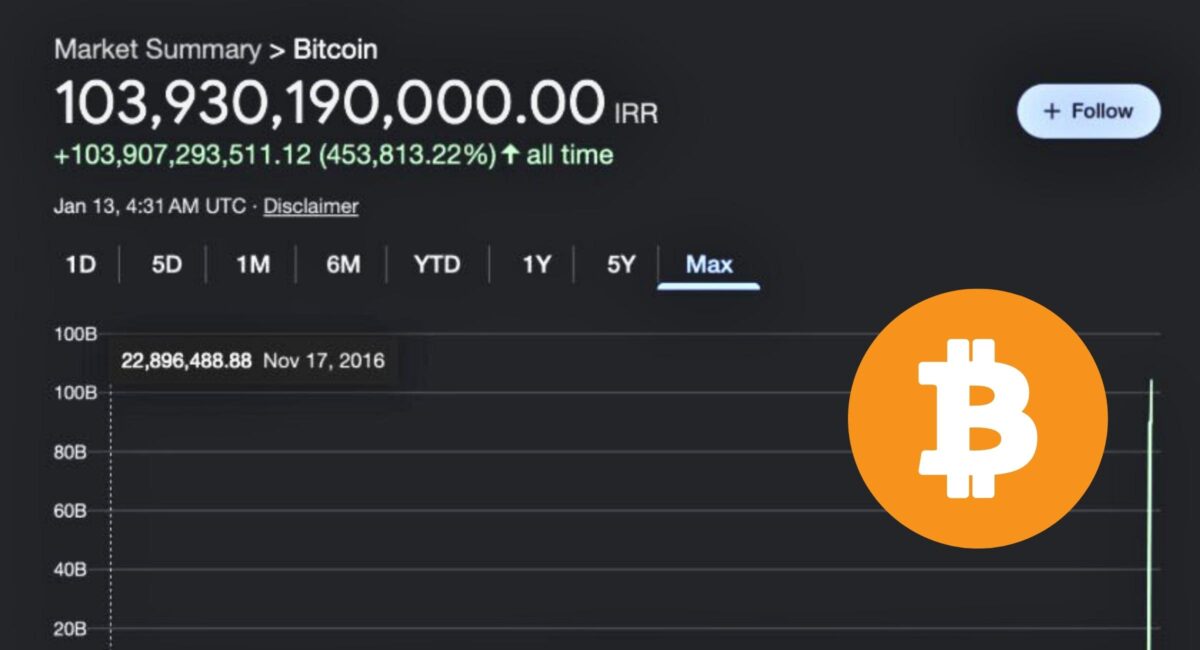
Bitcoin has recently traded for an unprecedented 100 billion Iranian rials on local exchange Nobitex, a staggering reflection of the rial’s collapse to roughly 1.45 million rials per U.S. dollar amid one of the worst inflation crises in Iran’s modern history. This dynamic isn’t just a market oddity — it’s a symptom of a broader macroeconomic implosion that’s driving ordinary Iranians and investors alike to seek refuge in scarce, borderless digital assets as the national currency shrinks in value by the day.
Why Bitcoin’s Local Price Ballooned to 100 Billion Rials
To understand this record nominal price — 100 billion rials — you need to grasp the math behind it. In a functioning currency system, exchange rates reflect real purchasing power. But in Iran, the free-market parallel rate (not the official state rate) is what matters to citizens, traders, and crypto enthusiasts. At this parallel rate, the Iranian rial has slid precipitously, most recently quoted near 1.45 million rials per U.S. dollar — a historic low driven by sustained inflation and macro stress.
So when Bitcoin — valued globally near $90,000–100,000 USD in open markets — is priced in rials on Nobitex and similar platforms, the raw local number can soar into the tens or hundreds of billions of rials. That doesn’t mean BTC is worth more in real purchasing power — it simply reflects the extreme depreciation of the national currency. For example, even if BTC is $90,000 (≈ 130 trillion rials at 1.45 M per USD), a local price can exceed 100 billion rials easily once fees, volatility, and exchange spreads are factored in.
Economists describe this as a price level effect — the nominal figure looks eye-popping only because the unit of account (the rial) has collapsed. It’s akin to hyperinflation scenarios seen historically in places like Zimbabwe or Venezuela, where prices must be reported in astronomically high local denominations.
The Iranian Rial Crisis: A Currency in Free Fall
Iran’s currency didn’t depreciate overnight. The rial has endured years of structural pressure, sanctions-induced shortages of foreign reserves, and chronic fiscal mismanagement. In 2025 alone, the annual inflation rate ran above 40 percent, with food prices and basic goods climbing sharply.
By late December 2025 and into early 2026, the parallel free-market rate — the one that matters for everyday Iranians — had plunged to around 1.42–1.47 million rials per dollar, a rate vastly different from the official state figure. That collapse helped spark nationwide protests, particularly in Tehran’s Grand Bazaar and other commercial hubs, as citizens struggled to keep pace with rising costs.
Such extreme depreciation erodes purchasing power, destroys savings, and forces many to seek alternatives — both material (like gold coins) and digital (like Bitcoin and other cryptocurrencies). Gold coins in Tehran briefly surged to 1.7 billion rials, illustrating how Iranians turn to hard assets amid monetary crisis.
Bitcoin as a Hedge: Perception Versus Practical Reality
With the rial in free fall, Bitcoin — though still volatile — has gained prominence among Iranians as a hedge against local currency risk. Analysts report that Bitcoin is increasingly viewed as a store of value, especially by those who see fiat savings eroding rapidly.
There’s historical precedent. During severe currency devaluations in Argentina, Lebanon, and Turkey, digital assets and gold have each found favor among citizens looking to preserve wealth beyond the reach of domestic monetary policy failures. Iran’s case mirrors these patterns, albeit with unique political and sanctions-related layers.
However, it’s crucial to distinguish nominal prices in local currency (like 100 billion IRR) from real value. Bitcoin’s global valuation still centers on USD markets, where it trades at roughly $90,000 — a level shaped by global demand, macro liquidity, ETF flows, and wider crypto investor sentiment. The rial price simply multiplies that by a collapsing exchange rate. This isn’t a reflection of Bitcoin suddenly being worth more in global terms, but rather the rial being worth much less.
Nobitex and the Mechanics of Iranian Crypto Markets
Nobitex remains the dominant exchange in Iran’s crypto ecosystem, handling a large majority of Iran-linked crypto volume. In 2025, even after a $90 million hack that shook confidence in local platforms, Nobitex processed over 87 percent of Iranian crypto transactions, illustrating its central role.
That concentration means price discovery on Nobitex heavily influences how Iranians perceive crypto valuations in local terms. When supply is constrained, fiat weakens, and demand spikes for digital assets as stores of value, the equilibrium local price naturally reflects those pressures — often in jaw-dropping nominal figures.
Why Iranians Are Turning to Crypto (and What’s Holding It Back)
There are several intertwined factors pushing Bitcoin adoption in the face of rial collapse:
- Loss of confidence in fiat: With annual inflation rates above 40 percent and everyday goods skyrocketing, preserving purchasing power becomes paramount.
- Sanctions and capital restrictions: International sanctions limit access to foreign exchanges and hard currencies, making non-sovereign assets more attractive — despite regulatory ambiguity.
- Mining economics: Cheap electricity in Iran has historically made Bitcoin mining profitable, though regulatory crackdowns have periodically disrupted operations.
- Remittance needs: In an economy with restricted capital flight, crypto offers an informal channel for moving value — albeit one fraught with legal risk.
Yet despite these drivers, practical adoption barriers remain significant. Regulatory ambiguity, occasional crackdowns, exchange hacks, and technical access limitations mean that crypto’s potential as a mass hedge is still constrained relative to its theoretical appeal.
The Broader Economic and Social Implications
The astonishing figures — like Bitcoin at 100 billion rials — send a stark message about how deeply the rial has deteriorated. These are not abstract financial metrics; they reflect daily reality for Iranians struggling to afford staple goods and maintain savings. Such extreme nominal prices — even if mathematically inevitable given the exchange rate — feed political discontent and shape debates around economic policy, social stability, and future reform.
Widespread protests driven by currency collapse and inflation aren’t just economic phenomena; they carry political and social weight, influencing everything from local governance to foreign policy, civil unrest, and migration decisions.
Conclusion: A Symbol of Crisis, Not a New Asset Valuation Paradigm
Bitcoin’s surge past 100 billion Iranian rials on Nobitex is a potent symbol — but not a standalone valuation miracle. It’s a real-world consequence of one of the most dramatic currency collapses in recent decades, where the Iranian rial has slid to around 1.45 million per U.S. dollar in free-market trading.
For Iranians watching the value of their savings decay, Bitcoin offers an alternative lens — a decentralized, non-sovereign asset untethered from domestic monetary policy. But it also presents challenges, risks, and market realities that complicate its role as a hedge or store of value.
Viewed globally, Bitcoin’s value remains anchored in USD markets, where price reflects investor sentiment, macro liquidity conditions, and evolving regulatory landscapes. Locally, its astronomical rial price is a stark reflection of fiat collapse — not a standalone statement of intrinsic value.
This dynamic is a high-stakes, high-complexity intersection of economics, politics, and technology — one whose implications will be felt well into 2026 and beyond.