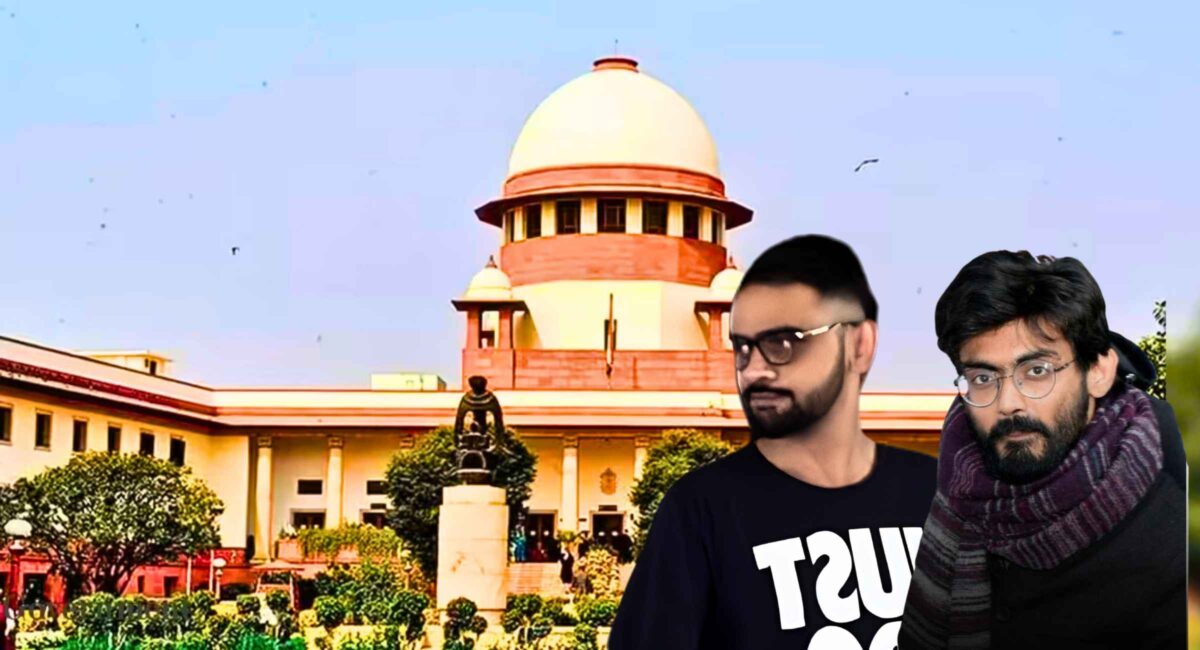
India’s Supreme Court has denied bail to activists Umar Khalid and Sharjeel Imam in the controversial 2020 Delhi riots larger conspiracy case, ruling against their release under the stringent Unlawful Activities (Prevention) Act (UAPA) despite prolonged pre‑trial incarceration. The apex court verdict, handed down on January 5, 2026, concluded that the prosecution material disclosed prima facie allegations against both Khalid and Imam, placing them on a “qualitatively different footing” from co‑accused who were granted bail under strict conditions. In delivering the decision, the bench underscored that allegations of conspiracy and national security concerns outweighed arguments for bail, and noted that their applications could be reconsidered after the examination of protected witnesses or after one year from the date of the order.
The case stems from the February 2020 northeast Delhi riots, violent clashes that erupted during protests against the Citizenship Amendment Act (CAA) and the National Register of Citizens, which left at least 53 people dead and hundreds injured. Khalid and Imam have been held in custody for over five years under UAPA and related charges, accused by the prosecution of playing central roles in a conspiracy to incite violence and disrupt public order. The Supreme Court’s refusal to grant bail to them — while releasing five other accused such as Gulfisha Fatima, Meeran Haider, Shifa Ur Rehman, Mohammad Saleem Khan and Shadab Ahmad — highlights the judiciary’s more stringent application of bail law in UAPA cases involving alleged threats to national security and serious public order offences.
The court’s judgment emphasized that Section 43D(5) of the UAPA — which creates a statutory bar on bail if the prosecution’s prima facie case is established — was attracted in the cases of Khalid and Imam due to the nature and depth of the allegations and available material. Justices Aravind Kumar and N.V. Anjaria noted that at the bail stage, courts are not required to conduct a detailed evaluation of evidence but must determine whether the prosecution’s claims, if accepted as true on face value, satisfy the statutory threshold. In the view of the bench, the prosecution’s material met this standard for both Khalid and Imam, warranting continued custody pending trial.
In denying bail, the Supreme Court carefully distinguished personal liberty under Article 21 of the Constitution from the stringent bail regime under UAPA, stating that while liberty is a fundamental right, it is not absolute in the context of serious charges that engage national security and public order concerns. The court rejected the defence argument that delay in trial or prolonged incarceration alone could justify bail, reiterating that such delays do not automatically override the statutory protection against bail in UAPA cases. However, the bench also clarified that the accused are not permanently barred from bail — they may seek reconsideration after the examination of protected witnesses or after one year from the order, whichever is earlier, and any fresh application would be considered independently without prejudice.
The decision has triggered strong reactions. Supporters of Khalid and Imam — who have maintained that charges are politically motivated and deny involvement in orchestrating violence — condemned the ruling as reflective of a harsh anti‑bail stance under anti‑terror laws, especially given the length of time spent in custody without a concluded trial. Critics argue that prolonged pre‑trial detention raises serious concerns about justice and fair trial rights. Conversely, some political leaders welcomed the Supreme Court’s strict approach, characterizing the denial of bail as affirmation of accountability for those allegedly linked to the deadly riots.
The larger Delhi riots conspiracy case continues to proceed, with trial court processes ongoing. The Supreme Court’s latest bail ruling underscores enduring tensions in India’s legal and political landscape over the balance between civil liberties and state security, particularly in high‑profile UAPA cases with significant public order implications such as the 2020 Delhi riots.