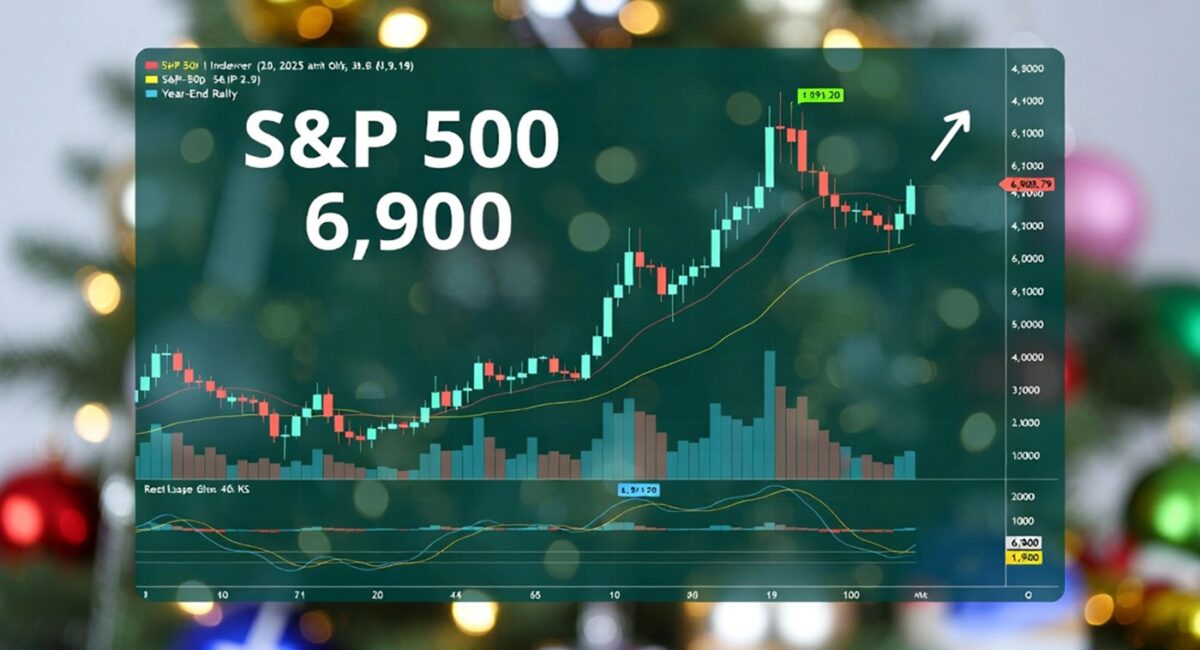
The S&P 500 has officially crossed the 6,900 level, closing at **6,909.79 — its 38th record high of 2025 — driven by robust U.S. economic growth data, continued strength in large-cap tech stocks, and positive year-end sentiment. This milestone reflects unprecedented investor confidence even as inflation and rate-cut expectations evolve.
In my decade of covering U.S. equity markets, it’s rare to see an index sustain this pace of record closes late in the year — especially with headline inflation still above target and rate-cut prospects in flux.
Why the 6,900 Breakout Matters
A Psychological and Technical Barrier Surpassed
Crossing **6,900 is more than a number — it’s a technical and psychological barrier that had capped sentiment for months. What once looked like a lofty target has now become the new floor for market optimism heading into 2026.
Investors pay attention to round-number thresholds because they often coincide with automated trading algorithms, hedge fund positioning levels, and retail psychology — and breaking above them can trigger renewed momentum buying.
The Drivers Behind the Record Close
Economic Growth That Outperformed Expectations
The latest U.S. GDP data delivered a surprise. The U.S. Commerce Department reported real GDP growth of 4.3% annualized in Q3 2025, well above consensus estimates near ~3.3%. That kind of performance not only justifies current valuations — it suggests corporate earnings may remain resilient into early 2026.
From my market calendar experience, when growth measures like real final sales outpace forecasts, markets interpret that as earnings durability — even when the Fed’s rate path is uncertain.
Large-Cap Tech Stocks Leading the Charge
If you look under the hood of the S&P 500’s jump, big technology and AI-linked stocks — notably Nvidia and Alphabet — anchored much of the rally. These names carry outsized weight in the index, meaning their gains can propel the entire benchmark even when many individual stocks lag.
It’s a pattern familiar to anyone who has tracked the Magnificent Seven and Mag 7+ cohorts: a concentrated group of high-growth names can lift the whole market, especially when broader economic data is supportive.
Santa Claus Rally Expectations
Late December and early January often see the so-called “Santa Claus rally” — a seasonal uptick driven by thinner trading volumes, festive buying, and position squaring ahead of a new year. Analysts sometimes quantify this effect as a modest but statistically notable bump in equity prices.
Whether this seasonal effect is real or simply coincidental has been debated on trading floors forever — but sentiment matters, and traders are certainly watching the calendar.
How Markets Are Internally Positioned
Breadth Still Narrow
Here’s a nuance that doesn’t always make headlines: while the index itself hit a record, many individual stocks within the S&P 500 actually declined on the day. That’s a sign of narrow breadth — where a handful of larger constituents are driving the index higher while the average stock lags.
This is critical context: from my experience, rallies with narrow breadth may be more vulnerable to reversals if leadership weakens.
Small Caps Lagging
The Russell 2000 — a benchmark for smaller U.S. stocks — declined by roughly 0.7% on the day the S&P 500 hit 6,909.79, suggesting that the market’s strength isn’t uniform.
When smaller names lag, it often implies risk-on sentiment is concentrated in large-cap growth stocks rather than broad economic optimism — a nuance that experienced investors track closely.
What This Means for 2026
Valuation Considerations
At this level, the S&P 500 is trading at elevated valuation multiples relative to its historical average. Even with strong earnings growth, elevated valuations can raise questions about future returns — particularly if rate cuts are delayed or inflation remains sticky.
Economic vs. Rate Risks
There’s an interesting interplay right now between economic strength and Federal Reserve policy. On the one hand, strong GDP figures — like the recent 4.3% print — support equity valuations. On the other, bond markets are pricing in a smaller chance of early 2026 rate cuts because robust growth often pushes yields higher.
That tension could produce choppy trading early next year, even if the overall trend stays bullish.
Market Leadership and Rotation
Beyond tech megacaps, sectors like financials and materials have shown intermittent strength, which some analysts point to as a sign of broader participation in the rally. The evidence is mixed — growth stocks remain dominant, but rotation narratives gain traction when yields rise alongside equities.
From my editorial vantage, this mixed participation will be a key theme to watch in early 2026 — it’s often where long-term bull markets either deepen or begin to falter.
Historical Context: A Milestone, Not a Bubble Flag
Retrospectively, crossing 6,900 isn’t an isolated spike; it’s part of a year filled with record closes driven by sustained earnings beats, AI-led tech strength, and accommodative monetary conditions for much of 2025.
However, similar peaks in history — like the late 1990s bubble or the 2020-21 tech run — showed that sustained valuations without broad participation can precede corrections.
So while today’s milestone is impressive, context and caution are still warranted.
Risks That Could Shift the Narrative
Inflation and Fed Policy
If inflation proves more persistent than expected, the Fed could delay rate cuts, which typically weighs on high-growth sectors — potentially slowing the advance of indices like the S&P 500.
Earnings Surprises
Strong Q3 GDP data doesn’t guarantee future earnings growth. If corporate profits disappoint early in 2026, that could quickly recalibrate market expectations.
Conclusion: A Historic Close with Strategic Nuance
The S&P 500 crossing the 6,900 milestone and scoring its 38th record close of 2025 is undeniably a hallmark event in this year’s market narrative — showing investor resilience, strong economic data influence, and continued tech leadership. Yet beneath that headline lie nuanced signals: narrow breadth, small-cap underperformance, and lingering policy questions that seasoned investors will watch closely.
In other words: this is a moment of achievement, but not a free ticket to complacency. The real test will be how markets behave in early 2026 — especially as rate assumptions, earnings trends, and sector breadth all evolve.