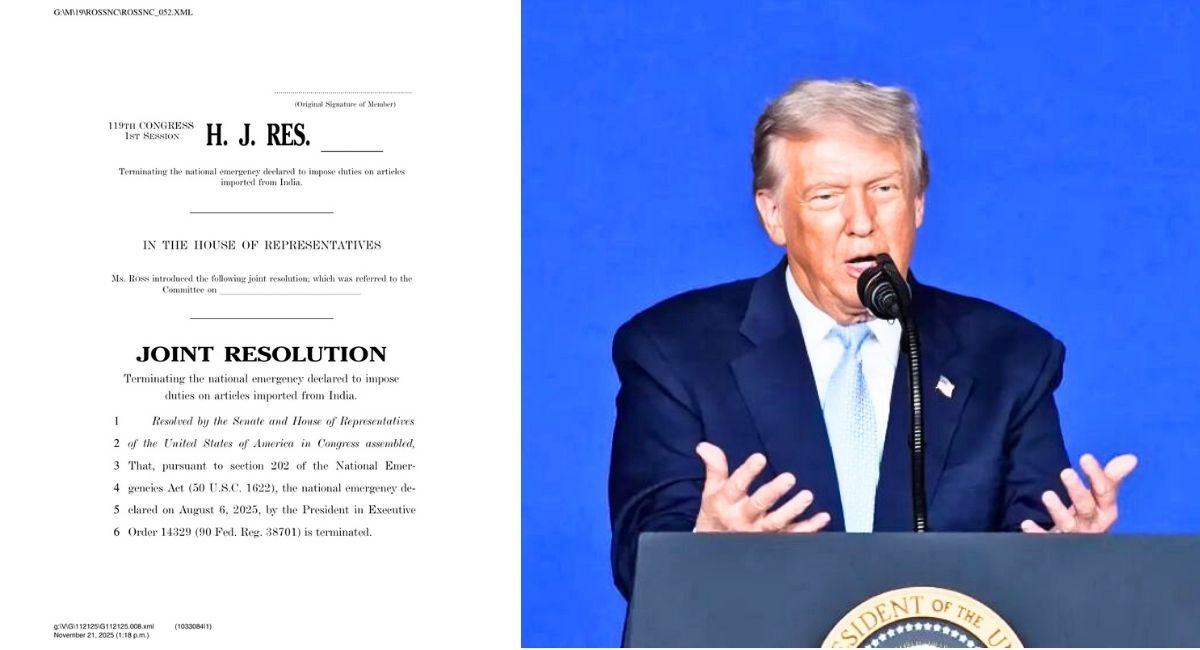
In a decisive move that’s already reverberating through Washington and New Delhi, U.S. Representatives Deborah Ross, Marc Veasey, and Raja Krishnamoorthi introduced a resolution in the House of Representatives on December 13, 2025 to end former President Donald Trump’s contentious 50% tariffs on Indian imports, a policy introduced earlier this year under a national emergency declaration. The lawmakers argue the tariffs are not only economically harmful—but also unconstitutional, damaging to U.S. jobs, and detrimental to the broader U.S.–India strategic partnership.
This legislative push frames itself as both a defense of Congress’s constitutional authority over trade policy and a bid to shield American industries and consumers from counterproductive tariff escalations.
U.S. Representatives Deborah Ross, Marc Veasey, and Raja Krishnamoorthi introduced a House resolution in December 2025 to terminate the national emergency that enabled President Trump’s tariffs of up to 50% on Indian imports. The resolution seeks to rescind these tariffs—imposed under the International Emergency Economic Powers Act—on the grounds that they disrupt supply chains, raise consumer costs, harm U.S. workers, and weaken the strategic U.S.–India relationship.
What the Resolution Seeks to Do
Terminate the National Emergency & Rescind Tariffs
The measure specifically targets Trump’s national emergency declaration under the International Emergency Economic Powers Act (IEEPA) that justified steep tariffs of up to 50% on goods imported from India. It would:
- Terminate that national emergency declaration.
- Rescind the additional 25% “secondary” tariffs that Trump imposed on August 27, 2025, which were layered on top of existing duties, bringing the total to as high as 50% on many Indian products.
This legal framing matters: the resolution doesn’t just attack tariff levels; it questions the executive’s use of emergency powers to impose trade barriers without congressional approval, setting up broader constitutional scrutiny of unilateral trade actions.
Why Lawmakers Are Pushing Back
“Illegal and Counterproductive”
In their joint statement, the lawmakers called the tariff regime “illegal” and “counterproductive.” They made several critical points:
- Supply chains disrupted: Higher duties have led to logistical distortions that burden U.S. manufacturers and exporters.
- Consumer costs rise: Everyday Americans face higher prices on goods that incorporate Indian components.
- Hurt U.S. workers: The tariffs have backfired in sectors reliant on Indian inputs, the lawmakers say, harming the very jobs the policy was supposed to protect.
Congressman Krishnamoorthi — himself Indian-American and a member of key appropriations and trade-related committees — said the duties “disrupt supply chains, harm American workers, and drive up costs for consumers,” underscoring how the policy has hit U.S. industries.
Economic and Strategic Stakes
U.S.–India Trade Ties at Risk
Trade between the United States and India ranks among the world’s most important bilateral economic relationships — encompassing sectors like manufacturing, pharmaceuticals, life sciences, chemicals, textiles, and technology services.
In North Carolina alone, Indian firms have invested over $1 billion, creating thousands of jobs in life sciences and tech sectors while supporting hundreds of millions in U.S. exports — a point Congresswoman Ross highlighted to illustrate the real-world impact of tariff escalation.
These economic ties also have strategic dimensions: India is a critical partner in countering regional threats in the Indo-Pacific, and sustained trade disruptions risk political fallout beyond mere commerce.
How We Got Here
Trump’s Tariff Escalation in 2025
President Trump’s administration initially introduced tariffs on Indian goods earlier in 2025 as part of a broader reciprocal tariff strategy. This policy aimed to match high Indian tariff rates on U.S. goods by imposing similar duties on Indian exports — a controversial approach rolled out globally but sharply intensified against India due to geopolitical tensions and specific trade frictions, especially India’s purchase of Russian oil.
By August 27, 2025, Trump’s executive action had effectively reached 50% duties on targeted Indian imports — among the highest bilateral tariffs ever imposed by the U.S. outside of wartime measures.
Broader Political and Constitutional Implications
Congressional Authority vs. Executive Power
This resolution is part of a wider reaction in Congress against expansive executive trade actions — especially the use of emergency powers to upend established tariff regimes without clear legislative authorization. Earlier in 2025, lawmakers responded with bipartisan initiatives (e.g., the Trade Review Act) intended to require the executive branch to notify and obtain approval from Congress before imposing major trade barriers.
By challenging Trump’s emergency designation, Representatives Ross, Veasey, and Krishnamoorthi are staking a claim for Congressional oversight of trade policy — a constitutional prerogative many lawmakers feel has eroded over recent decades.
Reactions: U.S. and India
Washington Divide
The resolution has drawn support largely from Democratic members of Congress, who argue that trade policy should be predictable and negotiated, not unilaterally imposed. Meanwhile, some Republican lawmakers and business groups supportive of protectionist measures have defended Trump’s tariff approach as necessary for balancing trade deficits — though that view is losing traction amid economic pushback.
New Delhi’s Position
India has publicly expressed concern about trade barriers affecting its exports, while engaging in ongoing negotiations with U.S. officials to pursue trade cooperation and a broader bilateral agreement that could address tariff and non-tariff barriers alike. Recent diplomatic interactions — including high-level discussions in New Delhi — reflect this urgency.
What Happens Next in Congress
Legislative Prospects
A House resolution is not law — but it plays a pivotal role in signaling Congress’s intent. If passed, it could compel:
- A vote to rescind the national emergency and associated tariffs.
- Pressure on the Senate to consider companion measures.
- A broader political debate over U.S. trade policy authority.
Political Calendar & Impact
With midterm dynamics, looming elections, and shifting economic indicators, this resolution’s progress will be watched closely in both party caucuses and in trade-dependent industries. Its success — or failure — could redefine how the U.S. approaches trade with India and other major partners.
Conclusion: A Turning Point in U.S.–India Trade Policy
From my experience covering U.S. trade politics — where rhetoric often outpaces results — this resolution is notable not just for its immediate goal of ending punitive tariffs, but for its constitutional challenge to executive overreach and its implications for future U.S.–India economic cooperation. The lawmakers’ framing — that tariffs harm jobs, inflate prices, and weaken alliances — resonates across American supply chains and international diplomacy.
Whether this measure becomes law, or becomes a catalyst for broader trade reform, it is clear that Congress is pushing back: reclaiming its role in shaping tariffs and insisting that U.S. trade policy protect both workers and strategic partnerships — not undermine them. As this unfolds through early 2026, its impacts will ripple from industrial towns in North Carolina and Texas to boardrooms in Mumbai and Bengaluru, shaping the next chapter in one of the world’s most consequential economic relationships.