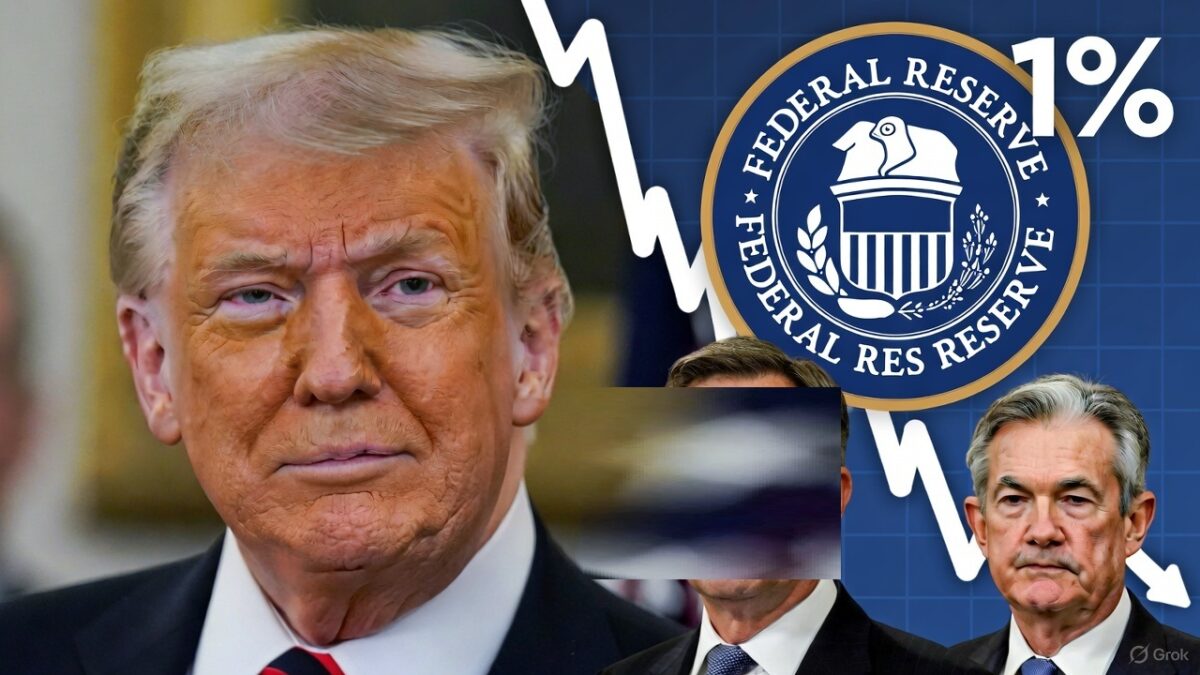
In a highly unusual and politically charged stance, U.S. President Donald Trump said the US interest rates should be 1% — or even lower — by 2026, directly challenging the Federal Reserve’s current monetary policy framework and the independence of the central bank. Trump has publicly pressured the Federal Reserve to reduce borrowing costs and signaled that his preferred successor to Fed Chair Jerome Powell — whose term ends in May 2026 — would be someone committed to aggressive rate cuts. Former Fed governor Kevin Warsh and White House economic adviser Kevin Hassett are now widely reported as the leading contenders for the next Fed chair, with Warsh receiving notable support from financial industry leaders.
What makes this moment extraordinary is not just the target rate Trump advocates, but how openly he is pushing for political influence over what has traditionally been a technically independent monetary authority — a shift that could reshape U.S. central banking if implemented.
Why Trump Wants Rates at 1% (or Lower)
President Trump’s call for the US interest rates should be 1% stems from a combination of economic and political motivations:
- Debt affordability: Trump has argued that lower interest rates would sharply reduce government debt servicing costs — a point he made repeatedly in recent interviews.
- Growth over inflation: Trump’s narrative prioritizes economic growth, arguing that lower rates stimulate borrowing for consumers and businesses.
- Political messaging: By contrasting himself with Fed Chair Powell — whom he has criticized for not cutting rates fast enough — Trump frames the issue in stark political terms.
Economists, however, caution that reducing the federal funds rate to 1% from current levels (near ~3.6–3.75%) — after a period of historically high inflation — carries risks, including rekindling price pressures and undermining inflation expectations.
What the Fed’s Position Is Right Now
As of the December 2025 policy meeting, the Federal Reserve cut the benchmark interest rate by 25 basis points to a range of 3.5%–3.75% — marking the third reduction in a row. But the central bank’s own projections suggest only one more cut in 2026, far short of the drastic reductions to 1% that Trump wants.
Fed officials have stressed caution, noting continued uncertainty around inflation dynamics and labor market strength. This divergence between White House expectations and Fed projections fuels the ongoing debate about monetary policy’s future path.
Jerome Powell’s Term Ending in 2026
Federal Reserve Chair Jerome Powell — whom Trump appointed for a second term in 2022 — is set to see his leadership term end in May 2026. Trump has repeatedly criticized Powell for being too slow to cut rates, but he has also stated he will not fire Powell before the end of his term.
Powell has maintained that the Fed must balance price stability and employment, and he has reaffirmed the central bank’s independence from political influence — even as Trump publicly pressures him to take more aggressive action.
The Fed Chair Succession: Kevin Warsh and Kevin Hassett
Kevin Warsh: A Strong Candidate
Former Federal Reserve Governor Kevin Warsh — who served on the Fed’s Board from 2006–2011 and is now a Hoover Institution economist — has emerged as a top choice in Trump’s shortlist. Warsh’s monetary policy views include a focus on growth and a willingness to consider rate cuts under certain conditions. He received a notable endorsement from JPMorgan CEO Jamie Dimon, which underscores his credibility within financial circles.
Warsh’s background in both central banking and private sector policymaking gives him a profile that appeals to markets — though some economists warn that his previous critiques of the Fed’s independence may invite controversy.
Kevin Hassett: The Insider Alternative
National Economic Council Director Kevin Hassett is another leading contender. Known for his longstanding advisory role to Trump and a relatively dovish stance on rate cuts, Hassett is seen as more aligned with the president’s aggressive monetary easing goals. Trump has publicly engaged with him about supporting cuts should he become Fed chair.
Unlike Warsh — who has deep Fed experience — Hassett’s strength lies in his alignment with Trump’s economic priorities, which could translate into more politically influenced rate decisions if appointed.
Other Candidates and the Selection Process
A broader shortlist under consideration includes:
- Fed Governor Christopher Waller
- Fed Vice Chair for Supervision Michelle Bowman
- BlackRock CIO Rick Rieder
Sources suggest the Trump administration aimed to finalize its nominee by early 2026, ahead of Powell’s term expiration.
What It Would Mean for Monetary Policy
1. A Shift in Fed Independence?
Trump’s insistence that the US interest rates should be 1% and that the next Fed chair should consult with the White House on rate decisions marks a significant departure from the modern practice of central bank independence. Historically, U.S. central banking has sought to insulate monetary policy from political cycles — an institutional safeguard dating back to the Treasury-Federal Reserve Accord of 1951.
If Trump’s nominee were to follow his directive, markets could see:
- More aggressive easing cycles
- Increased sensitivity to political pressures
- Greater volatility in bond and equity markets
This could also affect global confidence in the dollar as the anchor of international finance.
2. Economic Growth vs. Inflation Risk
Lowering rates to 1% could boost growth by making borrowing cheaper for consumers and businesses. But the Fed’s dual mandate requires price stability as well, and some Federal Reserve policymakers have sounded caution about cutting too deeply if inflation pressures remain sticky.
3. Financial Markets Reaction
Bond yields, equity valuations, and currency markets would all respond sharply to such a policy shift. Analysts warn that a sudden pivot toward deep rate cuts could:
- Weaken the dollar
- Lift long-term inflation expectations
- Push investors into riskier assets
Given the Fed’s gradual approach to cutting rates thus far, such a divergence could unsettle markets.
What Trump Is Saying — In His Words
Trump has said publicly that future Fed leadership should consult him on rate decisions, arguing that such consultation was routine in earlier eras and would lead to better economic outcomes. He also stated he thinks interest rates should be “1% and maybe lower than that”, aiming to make U.S. borrowing costs among the lowest in the world.
Expert & Market Commentary
Financial markets and economists are divided:
- Supporters of rate cuts argue that lower rates can stimulate growth, especially if inflation recedes further.
- Critics warn that overly aggressive rate cuts can stoke inflation and weaken central bank credibility.
Central bankers themselves have been cautious. Fed projections suggest only modest easing in 2026, not the deep cuts Trump advocates.
What Happens Next
Timeline to Watch
- Early 2026: Trump expected to announce his official nominee for Fed chair.
- Spring–Summer 2026: New Fed leadership could begin shaping monetary policy.
- Inflation & Jobs Data: Key economic indicators will influence how aggressive the next chair feels about rates.
Whether US interest rates should be 1% remains a theoretical goal for Trump — but the practical hurdles are significant.
Conclusion: A Turning Point for U.S. Monetary Policy
Trump’s public push for interest rates at 1% or lower by 2026 — paired with his vocal support for nominees like Kevin Warsh and Kevin Hassett — isn’t just an economic policy debate. It’s a broader challenge to the Fed’s independence and the framework that has governed U.S. monetary policy for decades.
Whether this vision becomes reality depends on who becomes the next Federal Reserve chair and how they balance political influence, market stability, and the central bank’s dual mandate. For now, the US interest rates should be 1% call is more a political rallying cry than a consensus economic forecast — but it has already reshaped the central banking conversation.