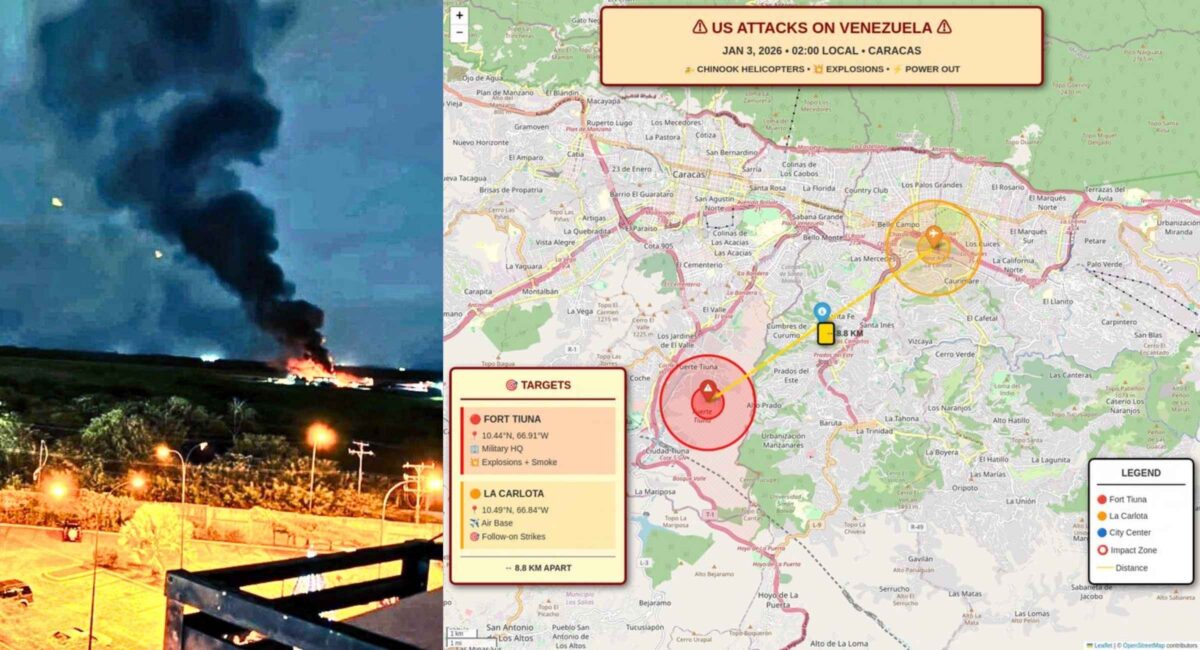
In a stunning escalation early January 3, 2026, President Donald Trump confirmed that the United States had bombed Venezuelan military bases — including the massive Fuerte Tiuna complex in Caracas — as part of a broad military offensive against Venezuela, and claimed that Venezuelan President Nicolás Maduro and his wife, Cilia Flores, were captured and flown out of the country. Trump made the announcement via social media rather than a formal White House briefing, stating the U.S. had conducted a “large-scale strike” inside Venezuela that successfully removed Maduro from power. The statement triggered a chaotic, rapidly developing situation with explosions reported across the capital, widespread condemnation from Caracas, and an officially declared state of emergency by the Venezuelan government.
Videos shared by witnesses and public domain footage show multiple explosions and low-flying aircraft over Caracas, with smoke rising near key sites such as Fuerte Tiuna and La Carlota airbase, consistent with Trump’s description of US strikes on Venezuela’s critical military infrastructure. Residents reported at least seven powerful detonations just after 2 a.m. local time, causing alarm, sporadic power outages, and widespread confusion. The Federal Aviation Administration also banned civilian flights over Venezuelan airspace, citing the dangerous military activity.
According to the most recent verified reporting, the offensive struck Fuerte Tiuna, the nerve center of Venezuela’s armed forces, La Carlota Air Base, key communications antennas at Cerro El Volcán, and the port at La Guaira, along with other military installations across several states. Flyers and local sources noted fires and heavy smoke rising from Fort Tiuna shortly after the explosions, though the full extent of damage and casualties remains unclear at the moment.
Trump’s announcement went further than acknowledging the strikes: he asserted that Maduro and his wife had been seized during the operation and flown out of Venezuela in coordination with U.S. law enforcement. A Truth Social post from the president described the case as a successful capture mission, with more details expected later in an announced press conference at Mar-a-Lago. However, independent confirmation of Maduro’s capture and current location has not been established by Venezuelan authorities or independent international journalists. Venezuela’s Vice President, Delcy Rodríguez, said the government does not know the whereabouts of Maduro or Flores and demanded “immediate proof of life,” strongly rejecting the U.S. account as a pretext for aggression.
The Venezuelan government denounced the strikes as a “grave military aggression” that violated international law and the United Nations Charter, with formal statements calling on the international community to condemn U.S. actions. Caracas claims that residential areas and civilian infrastructure were hit alongside military targets, and that the attacks constitute an attempt to destabilize the nation and seize control of its vast natural resources. President Maduro’s response, delivered prior to the U.S. assertions of his capture, included a nationwide emergency decree and appeals for popular mobilization to defend the country.
What makes this event extraordinary — beyond the bombs themselves — is the claimed removal of a sitting head of state by U.S. military action. No foreign leader has been captured and extricated in this manner in Latin America since the U.S. overthrow of Panama’s Manuel Noriega in 1989, setting off urgent questions about treaty obligations, wartime authority, and international norms. Trump’s statement hints at long-standing tensions over allegations of Maduro’s alleged involvement in drug trafficking and support for criminal networks, which the U.S. has used to justify ongoing pressure campaigns, including strikes on boats and a naval buildup in the region. Still, direct land strikes within Venezuelan territory represent an escalation of a conflict that had previously been confined to maritime interdictions and diplomatic sanctions. Wikipedia
International reactions to the strikes and Trump’s confirmation have already begun to swirl. Some U.S. allies voiced cautious support for efforts to counter narco-trafficking and criminal governance, while others — including nations allied with Caracas — condemned the action as unlawful and dangerous. Calls for an emergency United Nations Security Council session are circulating, with regional leaders urging restraint and clarity on the legal basis for the strikes. At the same time, Venezuelan neighbors like Colombia have reported increased military readiness along their borders, anticipating potential spillover effects.
Despite the high political stakes and dramatic claims, critical gaps remain in independent verification. No visual evidence authenticated by press agencies or international monitors confirming Maduro’s detention has yet been published, and the Venezuelan government’s response suggests it still retains structural control of elements of the state apparatus. This juxtaposition of official U.S. assertions against Caracas’s denials has created a fog of competing narratives that will shape reporting, diplomacy, and potential escalation in the days to come.
In sum, while Trump confirms US bombs Venezuela military bases including Fuerte Tiuna and asserts the capture of Nicolás Maduro and his wife, the independent verification of these assertions — especially regarding Maduro’s extraction from Venezuela — remains unverified at this early stage. The explosions across Caracas and targeted strikes on major military facilities mark a significant turning point in U.S.–Venezuela relations, with wide-ranging legal, regional, and humanitarian implications unfolding in real time.