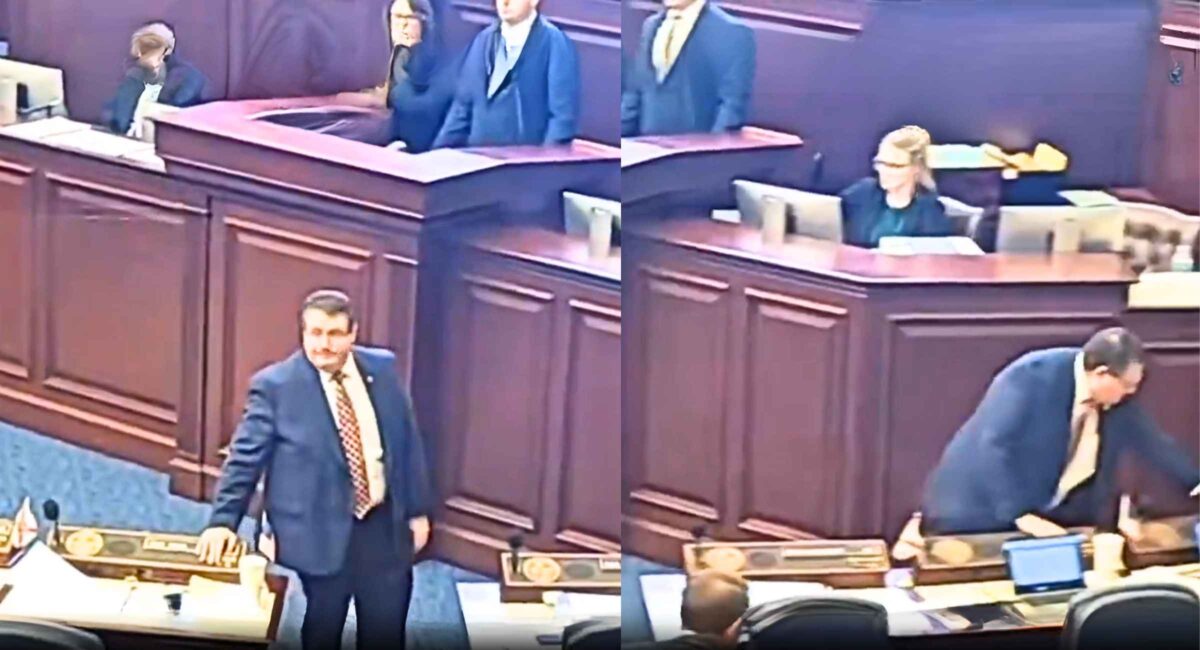
A video clip of Rep. Randy Fine (R-Fla.) appearing to cast votes on behalf of absent colleagues on the House floor has resurfaced online during the heated SAVE America Act debate in Congress, triggering sharp accusations of hypocrisy from critics. Fine and his allies insist the actions conform to longstanding House proxy voting practices (where permitted), even as opponents argue it undermines his criticisms of voting integrity. The clash spotlights broader tensions over legislative procedures and messaging in the contentious national election reform fight. (Reporting verified from public posts and political commentary).
The Video That Sparked the Outcry
In the past 48 hours, short clips circulating on social media showed Rep. Randy Fine seemingly marking a vote on the House floor for absent members, sparking accusations that he was either engaging in or mimicking “illegal proxy voting.”
- Users on platforms like Reddit and Instagram have shared the video — some claiming it shows Fine voting on behalf of other lawmakers who were not present in the chamber.
- Critics on social media and grassroots political forums seized on the footage to label his actions “hypocritical,” given Fine’s recent vocal defense of strict voting rules in the SAVE America Act debate.
At this stage, there is no independently verified reporting confirming that the video depicts unlawful activity — and the House of Representatives does allow certain proxy voting mechanisms under specific conditions.
Proxy Voting in the U.S. House – Rules vs. Misconceptions
To understand the controversy, you need the House voting context:
What Proxy Voting Is (and Isn’t)
- Proxy voting rules exist — but only under narrowly defined circumstances. Proxy casting requires explicit authorization, notice to the Clerk, and specific instructions.
- Historically, the House expanded proxy voting rules during the COVID-19 pandemic to allow Members to cast votes via designated proxies. Those procedures were not permanent and are subject to internal rules and committee resolutions.
- Critics argue that any vote cast by someone other than the Member with explicit authorization is improper, a position some House Republicans took when they objected to proxy voting in the 117th Congress.
In short: casting another Member’s vote without formal proxy authorization would violate rules, but there are documented ways Members can vote on behalf of colleagues if procedures are followed.
Where This Touches the SAVE America Act Debate
The controversy comes at a political flashpoint: the SAVE America Act’s progress in the 119th Congress.
- The SAVE America Act (also known as the Safeguard American Voter Eligibility Act) seeks to tighten voter registration requirements by necessitating documentary proof of U.S. citizenship and potentially other ID requirements for federal election registration.
- Republicans champion it as an election integrity reform, while voting rights groups warn it could disproportionately disenfranchise certain demographics.
Fine — a vocal supporter of the Act — has framed his backing as necessary to secure elections and ensure only eligible citizens vote. That makes the proxy video — whole or taken out of context — politically potent fodder for opponents to accuse him of double standards: pushing election rules while allegedly engaging in atypical voting behavior.
Fine’s Defense and Republican Messaging
Representatives aligned with Fine have responded in recent days with a coordinated message: criticism of Democrats’ opposition to the SAVE America Act as “trying to cheat” and framing the broader fight as one of election integrity.
- Official posts from Fine’s accounts emphasize that the Act is needed to ensure “secure elections.”
- Allies have doubled down on defending the legislation and by implication defending Fine’s voting record
To date, Fine himself has not issued a major public statement specifically addressing the resurfaced video or whether it accurately represents his actions, and there are no verified mainstream news reports confirming wrongdoing. But on social platforms and partisan channels, the narrative has already taken a life of its own.
Proxy Voting in Congress
Proxy voting — and alleged misuse — isn’t new:
- During the pandemic, when in-person attendance was risky, proxy voting expanded as a temporary accommodation under House rules.
- In normal times, proxy voting is rare and highly regulated, and “ghost voting” (casting a vote for an absent Member without authorization) is widely considered against House precedents.
So when footage appears to show Members voting on behalf of others, two questions arise:
- Was it conducted within authorized proxy procedures?
- If not, was it merely a misinterpretation of a procedural moment?
At this point, independent verification is lacking, but the resurfaced video has become a political flashpoint precisely because of how proxy rules have been debated in recent years.
Political Fallout — Why This Matters Ahead of 2026
The timing is politically significant. The midterm elections of 2026 are shaping up to be tightly contested on issues of election law and voting rights. The SAVE America Act’s progress, coupled with debates over access to the ballot box, voter ID, and federal versus state control of elections, means that every allegation of irregularity — real or perceived — gets magnified.
Fine’s critics argue that even the appearance of procedural inconsistency undercuts GOP messaging on integrity; his defenders say opponents are weaponizing ambiguous clips to score political points.
Without independent verification of the video’s context — who, when, under what rule Fine purportedly acted — the debate remains in the political sphere rather than the legal one.
Conclusion: A Controversy of Perception and Procedure
The resurfaced video of Randy Fine and proxy voting — whether misinterpreted, miscaptioned, or legitimate under House procedures — highlights a broader narrative tension:
- Proxy voting has a complicated procedural history in Congress.
- The SAVE America Act debate hinges on election integrity messaging that both parties aggressively leverage.
- In a hyper-polarized moment ahead of 2026 elections, any procedural ambiguity quickly becomes political ammunition.
At its core, this controversy reflects how technical legislative rules — like proxy voting — can be reframed as symbols of broader political arguments about electoral legitimacy, accountability, and hypocrisy.
If you need a precise legislative timeline for the SAVE America Act’s passage and a breakdown of how proxy voting is currently codified, I can compile that next.