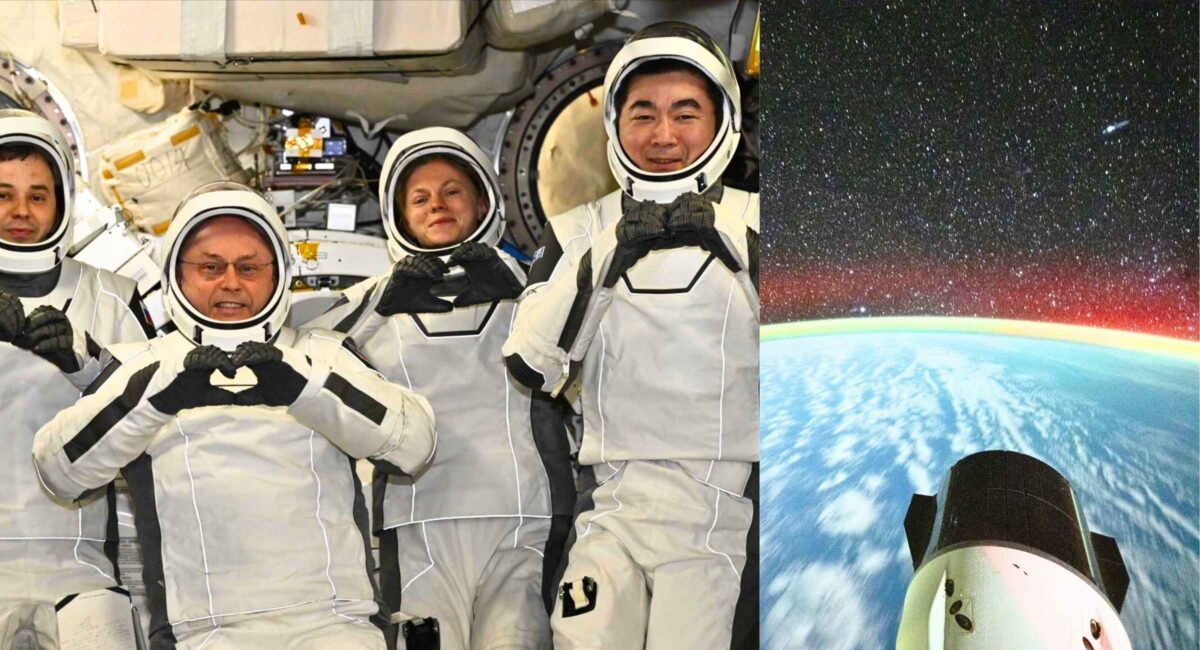
In an unprecedented move for NASA and the International Space Station (ISS) program, NASA astronauts return early to Earth as the SpaceX Crew-11 mission is being cut short due to a serious but stable medical condition affecting one of the crew members — triggering the first-ever ISS medical evacuation in the orbiting laboratory’s 25-year history. The four astronauts — NASA’s Zena Cardman and Mike Fincke, Japan’s Kimiya Yui, and Russia’s Oleg Platonov — are scheduled to undock from the ISS on January 14, 2026, with a splashdown off the coast of California early on January 15, NASA and SpaceX officials said, as mission planners prioritize the health and safety of the crewmember and the entire team.
Why NASA Ordered an Early Return: Medical Priority Over Mission Duration
This early return marks the first time NASA has ended a crew rotation ahead of schedule for medical reasons; traditionally, ISS crews stay in orbit for six to eight months unless there’s a hardware issue or geopolitical necessity. The Crew-11 team launched aboard a SpaceX Crew Dragon Endeavour on August 1, 2025, and had been conducting long-duration science, spacewalk preparations, and station maintenance as part of Expedition 74 when the medical concern arose.
On January 7, NASA mission control detected what officials describe as a serious but non-emergency health issue involving a single crew member. While the astronaut remains in stable condition, the agency determined that the station’s medical facilities — though robust — are insufficient to fully diagnose or treat the condition on orbit, and that comprehensive evaluation and care require a ground-based medical environment. This decision was made in close consultation with NASA’s Chief Health and Medical Officer, Dr. James Polk, who emphasized that the situation isn’t a crisis but merits a precautionary return to Earth.
NASA has not disclosed which of the four astronauts is affected or detailed the specific nature of the health issue due to strict medical privacy policies that protect astronaut health information. This confidentiality extends to past missions as well and is standard practice, even in rare cases where medical concerns prompt operational changes.
Crew-11: The Team and Their Time in Orbit
The Crew-11 mission is composed of seasoned space travelers and international partners:
- Zena Cardman (NASA) – Mission Commander and experienced flight engineer, representing NASA’s astronaut corps known for rigorous training and diverse mission experience.
- Mike Fincke (NASA) – Pilot of the Crew Dragon and designated station commander during their stay. Fincke is one of NASA’s veteran astronauts with multiple long-duration missions and previous ISS command experience.
- Kimiya Yui (JAXA) – Japanese astronaut on his second ISS mission, celebrated among colleagues for his scientific discipline and space photography.
- Oleg Platonov (Roscosmos) – Russian cosmonaut completing his first long-duration flight, contributing to station operations and international collaboration.
These four crew members have been aboard the ISS for roughly five months, contributing to microgravity research, life sciences experiments, and station maintenance, and had planned to return in mid-February 2026 — a schedule altered by this health event.
The scheduled cancelled spacewalk — which would have involved Cardman and Fincke — underscored the seriousness with which NASA viewed the situation. The planned extravehicular activity was postponed on January 7 when the medical concern emerged, marking a rare disruption to station operations.
Timeline: From Medical Concern to Planned Splashdown
NASA and SpaceX have established a clear timeline for the early return:
- January 7, 2026: NASA identifies a medical concern aboard the ISS, postpones a planned spacewalk and begins evaluating crew return options.
- January 8, 2026: The agency officially announces the decision to bring Crew-11 home early, citing the affected astronaut’s stable condition and the need for more complete medical care on Earth.
- January 12, 2026: An accelerated change of command ceremony is planned aboard the ISS, with the Crew-11 command role passing to mission partners remaining aboard.
- January 14, 2026: Target date for undocking of Crew-11 from the ISS, aboard the SpaceX Crew Dragon Endeavour.
- January 15, 2026: Splashdown off the coast of California early in the morning, with exact timing contingent on weather and recovery conditions.
NASA and SpaceX emphasize that this is not an emergency evacuation, but a controlled medical evacuation to allow a spaceflight medical issue to be addressed fully and safely on the ground.
The Significance: First Medical Evacuation in ISS History
Although astronauts occasionally receive medical attention on orbit — including medications, treatments for minor ailments, and real-time consultations with flight surgeons — the ISS was never before the scene of a full crew medical evacuation. This moment represents a significant milestone in space medicine and operational risk management, underscoring the complexities of providing comprehensive healthcare hundreds of kilometers above Earth.
Astronauts train extensively for a wide array of contingencies, including minor medical care, emergency response, and coordinated ground support from NASA flight surgeons. Still, the ISS medical suite has limits — designed for stabilizing and treating many conditions, but not for complete medical diagnostics and advanced treatment that Earth-based facilities can provide.
NASA Administrator Jared Isaacman and other agency leaders have stressed that the priority remains the crew’s well-being and that protocols for such situations — developed over decades — were followed to ensure a safe and orderly return.
Operational and Research Impact on the ISS
The early departure of Crew-11 will temporarily reduce the ISS resident population. After the undocking of the four Crew-11 astronauts, the station will continue operations with a three-person crew, including NASA’s Christopher Williams and Roscosmos’ Sergey Kud-Sverchkov and Sergei Mikaev, who arrived in November aboard a different spacecraft.
A reduced crew means logistical adjustments for station operations and research scheduling, but NASA has contingency plans for maintaining critical systems and experiments. Routine science may be rescheduled or shifted, and robotic support may supplement human tasks where feasible.
Meanwhile, preparations continue for the Crew-12 launch, currently targeted for mid-February 2026, with discussions underway about potentially accelerating its schedule to restore full staffing aboard the orbiting lab once Crew-11 departs.
Looking Forward: Space Medicine and Future Missions
This medical evacuation underscores how far space medicine has evolved since the early days of human spaceflight, where crews on short Mercury or Gemini missions faced far simpler environments. Today, astronauts on long-duration ISS missions confront microgravity’s effects on cardiovascular function, immune response, bone density and fluid distribution — all factors that complicate diagnosis and treatment during flight.
As NASA prepares for future crewed missions beyond low Earth orbit — including Artemis missions around the Moon and eventually to Mars — understanding and planning for health risks in deep space remains critical. Early returns, even when non-emergency, offer valuable data on how medical protocols and spacecraft systems perform under real-world stressors.
Conclusion: Prioritizing Health in Human Spaceflight
The early return of NASA’s Crew-11 astronauts is a testament to the prioritization of astronaut health and mission safety, rather than an operational setback. While specifics about the medical condition remain private, the careful and coordinated approach taken by NASA, SpaceX and international partners highlights the strength of protocols governing human spaceflight.
This first-ever ISS medical evacuation, culminating in the planned January 15 splashdown, reflects decades of progress in space healthcare, risk management and collaboration — and serves as a reminder of the inherent challenges of living and working in orbit.