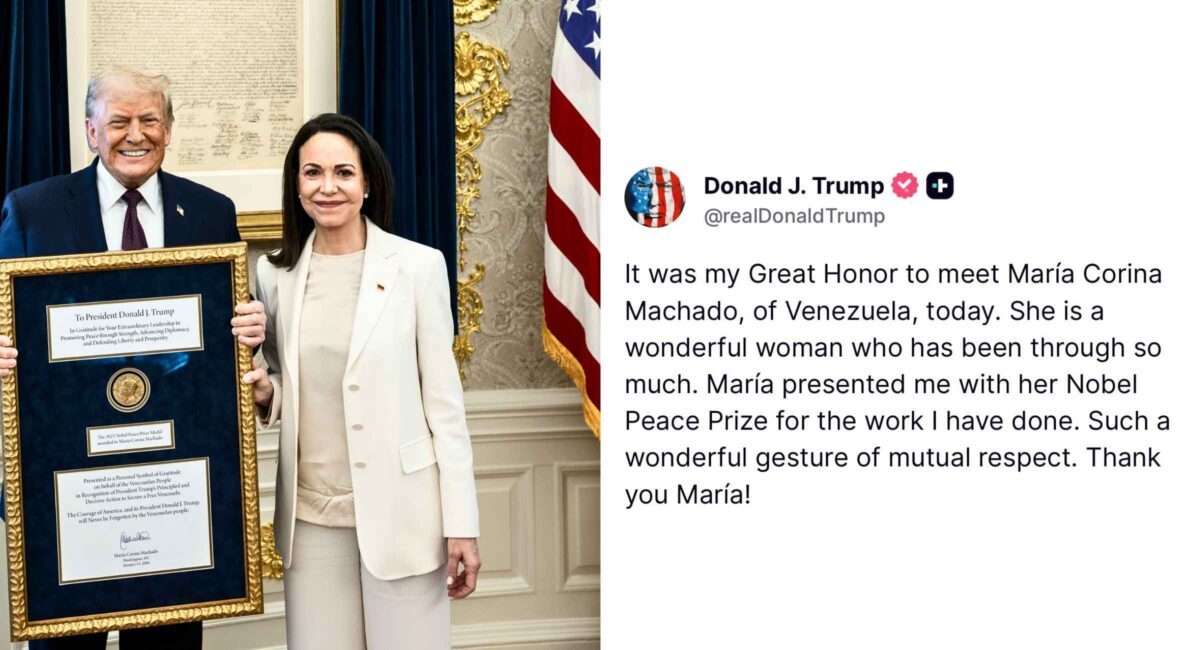
Venezuelan opposition leader María Corina Machado, who was awarded the 2025 Nobel Peace Prize for her role in pushing for democratic change in Venezuela, presented her Nobel Peace Prize medal to U.S. President Donald Trump during a White House meeting on January 15, 2026 as a symbolic gesture of gratitude and recognition for his support toward Venezuelan freedom. However, the Norwegian Nobel Committee has made clear that the actual award — the title of Nobel Peace Prize laureate — remains her own, and the honor cannot be transferred or awarded to another person.
Why This Moment Is Significant
From the Oval Office’s polished halls, it’s not often that you see the Nobel Peace Prize — perhaps the world’s most famous accolade for peace efforts — brought into U.S. political theatrics. On January 15, 2026, Machado’s move created a global stir. It would be one thing for a laureate to donate their medal to a museum or a university; it’s something quite different to gift it — even symbolically — to a sitting or former head of state.
This wasn’t just ceremonial theatre. It intersected with:
- Venezuela’s volatile politics, where Machado stands as a leading opposition figure.
- U.S.–Venezuela relations, following months of upheaval after Nicolás Maduro’s capture in early January.
- The broader debate over the meaning of international honors and political symbolism — and whether such gestures dilute their intended purpose.
What Happened at the White House
Machado’s Gesture
In what officials described as a “personal symbol of gratitude on behalf of the Venezuelan people,” Machado met President Donald Trump in the Oval Office and presented him with her framed Nobel Peace Prize medal. According to multiple reports:
- The medal was encased in a gilt frame with an inscription honoring Trump’s “extraordinary leadership in promoting peace,” citing his actions in relation to Venezuela’s struggle for democratic governance.
- Machado told reporters she offered the medal “as recognition for his unique commitment with our freedom.”
- Trump confirmed on social media (Truth Social, now X) that the meeting took place and called the gesture a “wonderful sign of mutual respect.”
Photographs circulated by the White House showed both figures standing together, with the framed medal prominently displayed — a political and public relations moment that quickly dominated global headlines.
Context of Their Meeting
This event came against a backdrop of political turbulence:
- Machado, a longtime critic of Nicolás Maduro’s regime, had been awarded the Nobel Peace Prize in 2025 for her role in unifying the fragmented opposition and pressing for democratic reforms.
- Trump’s involvement in Venezuelan affairs included supporting actions against Maduro, though critics questioned whether those efforts genuinely advanced democratic governance or served broader policy goals.
Machado’s decision to present the medal at the White House — rather than donate it to an institution or display it publicly — was widely interpreted as a political overture.
What the Nobel Committee Says
Medal vs. Title: A Crucial Distinction
Shortly after the White House event, the Norwegian Nobel Committee and Nobel Foundation officials issued clarifications:
- A Nobel Peace Prize medal, diploma, or monetary award may be physically given away or sold by a laureate if they choose — that much is permitted under the statutes.
- But the title of “Nobel Peace Prize laureate” cannot be transferred or reassigned to any other person. This stands as a core principle of the Nobel Prize’s statutes, which state that once awarded, the decision is final and irreversible.
- In other words: Trump can possess the medal; he remains not a Nobel laureate. The honor remains forever tied to Machado, as recorded officially by the Nobel Committee.
This clear distinction matters — not just legally, but symbolically. Nobel honors are meant to be recognitions of individual contributions to peace, and the committee’s rules safeguard that integrity against reinterpretations or political repackaging.
Reactions: Praise, Skepticism, and Criticism
Support and Symbolism
Among some supporters, Machado’s gesture was seen as:
- A reflection of gratitude for U.S. support in Venezuela’s tumultuous transition period.
- A symbolic act underscoring diplomatic and moral alignment between parts of the Venezuelan opposition and Washington.
Trump’s response — praising Machado and thanking her publicly — further amplified the moment’s resonance among certain political circles, especially those who view the former president as a pivotal figure in Western geopolitics.
Criticism and Backlash
Not all reactions were positive:
- Norwegian politicians and Nobel observers described the act as “absurd” and even damaging to the prestige of the Nobel Peace Prize.
- Commentators warned that linking the Nobel Peace Prize with contemporary political maneuvering — particularly in a context as controversial and contested as U.S.–Venezuela relations — could undermine the award’s tradition of honoring nonpartisan peacemaking.
- Some analysts labeled the gesture a political gambit rather than a genuine act of peace diplomacy — especially given the sharply divided opinions about Trump’s global leadership style.
This debate has spilled into public discourse, with critics in Norway and beyond questioning the appropriateness of harnessing a globally respected accolade for domestic or bilateral political messaging.
The Broader Political Landscape
Venezuela’s Ongoing Transition
Machado’s gesture can’t be separated from what’s happening inside Venezuela:
- After Maduro’s capture and detention in early January 2026, the country entered a deeply uncertain phase.
- U.S. policy toward Venezuela, under Trump’s leadership, has emphasized strategic interests, including energy and regional stability.
- Machado’s symbolic offering of the medal was widely interpreted as both a thank-you and a plea for continued support at a critical juncture.
Trump’s Continued Desire for a Nobel Peace Prize
Trump historically has expressed strong interest in receiving a Nobel Peace Prize himself — a point of media coverage and political commentary dating back to his first term.
While publicly accepting Machado’s medal may satisfy a personal or political desire, it does not change the Nobel record. Experts emphasize that the prize’s rules protect against precisely this type of reinterpretation.
Conclusion: Symbolism, Protocol, and Legacy
María Corina Machado’s presentation of her Nobel Peace Prize medal to President Trump during a White House meeting in January 2026 was rich in symbolism and political messaging. It underscored both Venezuela’s fraught journey toward democratic transition and the intricate overlaps between global honors and geopolitical strategy.
But beneath the ceremony lies a firm procedural reality: the Nobel Peace Prize — the title, the honor, the standing — remains with Machado. While she could legally give away the physical medal, the Norwegian Nobel Committee’s statutes remain unchanged. The moment will be remembered not for creating a second Nobel laureate, but for sparking global conversation about what such awards mean in the 21st century.