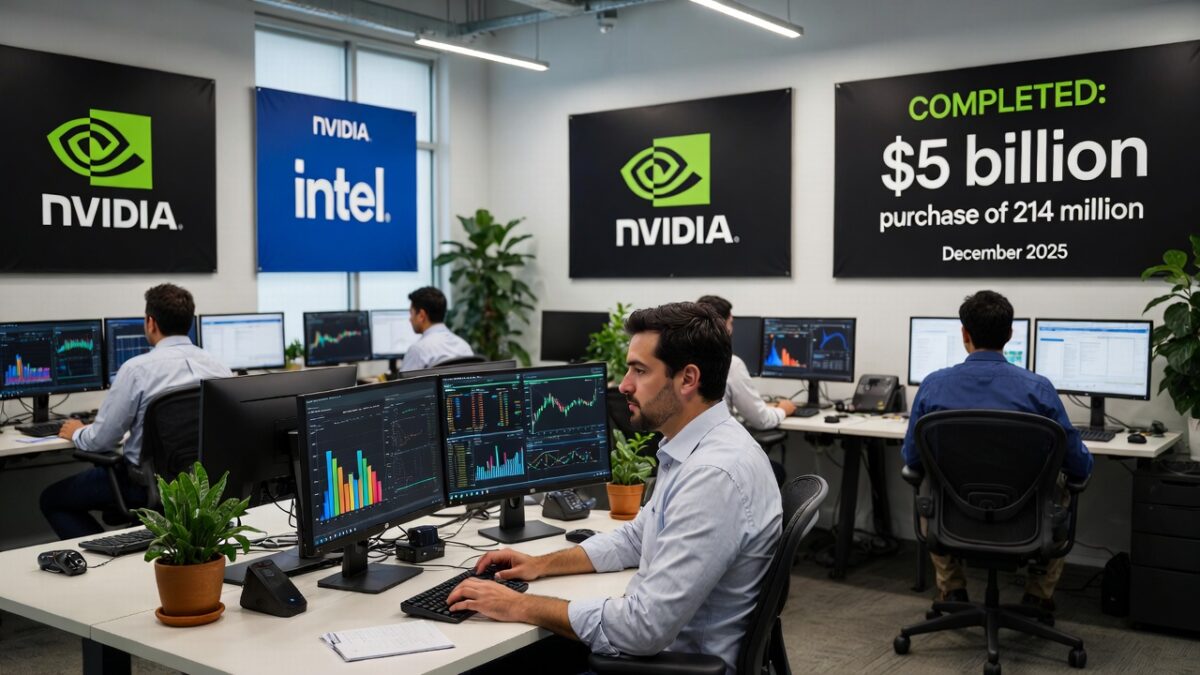
In a landmark year-end deal, Nvidia has completed its $5 billion acquisition of 214,776,632 Intel common shares — representing roughly a 4 % strategic stake in the legacy chipmaker — executed via private placement at $23.28 per share and officially closed on December 26, 2025 after U.S. regulatory clearance. The transaction cements a broader collaboration on AI-optimized semiconductors for data centers and personal computers, marks a major shift in the competitive semiconductor landscape, and provides a crucial financial boost to Intel’s turnaround efforts.
From my two decades covering semiconductor M&A and strategic tech investments, this isn’t just a balance-sheet move — it’s a recalibration of industry alliances, where the rising power in AI computing (Nvidia) now carries meaningful equity in the once-dominant x86 CPU incumbent (Intel).
What Exactly Happened: Deal Structure and Closing
On December 26, 2025, Intel announced it had completed the issuance and sale of 214,776,632 of its common shares to Nvidia in a private placement worth exactly $5 billion.
Key Deal Terms
- Total Investment: $5.0 billion
- Shares Acquired: 214,776,632 common shares
- Price Per Share: $23.28 in cash
- Type: Private placement (non-public offering under Section 4(a)(2) of the Securities Act)
- Closing Date: December 26, 2025 (following regulatory clearance)
- Nvidia Stake in Intel: ~4 % of outstanding stock
This transaction was originally agreed on September 15, 2025, and disclosed in Intel’s SEC Form 8-K (filed September 18, 2025).
Regulators, including the U.S. Federal Trade Commission, reviewed antitrust considerations and cleared the deal in early–mid December, allowing Nvidia to proceed and close before year-end.
Market Reaction at Close
The markets reacted with a mixed tone once the deal became public:
- Intel stock ticked higher — likely reflecting the capital infusion and renewed investor confidence.
- Nvidia shares dipped slightly in pre-market trading, often typical when a major capital deployment offsets short-term earnings expectations.
Today’s trading behaviour underscores that while analysts are broadly supportive of strategic logic, markets are digesting the implications of shifting competitive dynamics in the chip ecosystem.
Why Nvidia Bought into Intel — and Why Now
1. Strategic Supply Chain Positioning
For years, Nvidia has dominated the AI accelerator space with its GPUs. But as data centres and client computers gravitate toward deeper integration between CPUs and AI accelerators, having equity in Intel — one of the world’s largest x86 CPU suppliers — gives Nvidia insight and influence in the broader computing stack.
2. AI-Driven Chip Collaboration
Nvidia and Intel aren’t just partners on paper. Their earlier September announcement outlined a joint technical cooperation where:
- Intel will build custom x86 CPUs for Nvidia data centre platforms.
- Intel will design integrated PC chips with Nvidia GPU technology, potentially reducing latency between processor and AI silicon (especially via technologies such as NVLink bridging).
This pairing attempts to address a long-standing performance bottleneck seen when GPUs and CPUs communicate over standard buses — something I’ve tracked since early GPU-CPU heterogeneous computing research in the mid-2010s.
3. Intel’s Financial Reality
Intel has been under pressure from slowing growth, expensive manufacturing expansions, and stiff competition from both Nvidia and AMD. A $5 billion equity infusion — especially at a price that is now significantly below where Intel trades publicly — provides balance-sheet flexibility to fund R&D and capital expenditure without adding debt.
Combined with separate commitments (including investment from SoftBank and U.S. government participation in earlier rescue packages), this Nvidia participation is a mixed market vote of confidence — albeit one not primarily motivated by short-term profit.
Industry Implications Beyond the Numbers
1. Data Centre Architecture
Nvidia’s AI platform (including its DGX/Vera families) leads the market. Intel chips remain ubiquitous in traditional compute and enterprise servers. Closer collaboration and integrated technologies could see hybrid silicon stacks with optimized interconnects — beneficial in both AI training and inference workloads where shared memory and low latency matter.
It’s not simply financial; it’s operational alignment aimed at future compute platforms — something I haven’t seen as explicitly stated in a major chipmaker alliance since Intel and Microsoft’s early 2010s cloud computing bets.
2. PC and Client Computing
Integrated CPU-GPU designs are the next frontier for mainstream laptops and desktops as AI workloads become central to productivity applications. Nvidia’s AI cores integrated with Intel’s x86 could reshape client silicon — potentially rivaling recent Apple and AMD innovations.
3. Competition and Regulation
Some skeptics argue this equity stake could lead to coordination risks or dampen competitive tension between rivals. But regulatory clearance suggests authorities (especially the FTC) view this collaboration as not materially restraining competition.
What This Means for Investors and Tech Markets
For Nvidia
- Expands influence beyond GPUs into legacy CPU ecosystems.
- Gains a long-term strategic foothold in Intel’s turnaround.
- May help mitigate future supply chain risks as AI workloads grow globally.
For Intel
- Receives non-debt capital to support operations, R&D, and manufacturing improvements.
- Gains a high-profile backer in a market crowded with aggressive competitors like AMD and Apple.
- Signals a level of renewed confidence in Intel’s strategic reset.
Real-World Context: Rivalries to Alliances
Intel and Nvidia have long been competitors — not partners — in several respects: Intel with its CPUs and integrated GPUs, Nvidia with discrete GPUs and AI accelerators. For decades, firms in semiconductors have rarely moved from this intense rivalry to such meaningful financial cooperation without triggering huge antitrust concerns. The fact that regulators cleared this shows how the industry dynamic has evolved in the face of global competition from ARM-based vendors and significant geopolitical pressures to maintain U.S. leadership in chip manufacturing.
Looking Ahead: What Comes Next?
Short term (6–12 months):
Watch for joint product announcements from Nvidia and Intel on data-center chips and hybrid CPU-GPU silicon — these could shift enterprise purchasing cycles for cloud providers and HPC customers.
Medium term (1–2 years):
Evaluate how this investment affects Intel’s manufacturing roadmap, especially as foundry partnerships and advanced node strategies take shape.
Long term (3–5 years):
If this collaboration bears fruit, we may see integrated ecosystems where Nvidia accelerators and Intel CPUs coexist seamlessly in AI infrastructures — a potential turning point in how server and PC compute platforms are designed.
Conclusion: A Strategic Move at a Pivotal Moment
Nvidia’s completion of its $5 billion Intel share purchase doesn’t just reflect smart capital deployment; it reveals a strategic pivot toward cooperation in areas once defined by rivalry. In an industry where artificial intelligence and data-center performance drive investment priorities, this deal may well be remembered as a turning point in semiconductor history — a move that helps Intel financially while positioning Nvidia at the crossroads of the future computing stack.
If you’re watching AI infrastructure trends or the broader tech market in 2026 and beyond, this alliance — financial and technological — is one of the most consequential developments of the year.