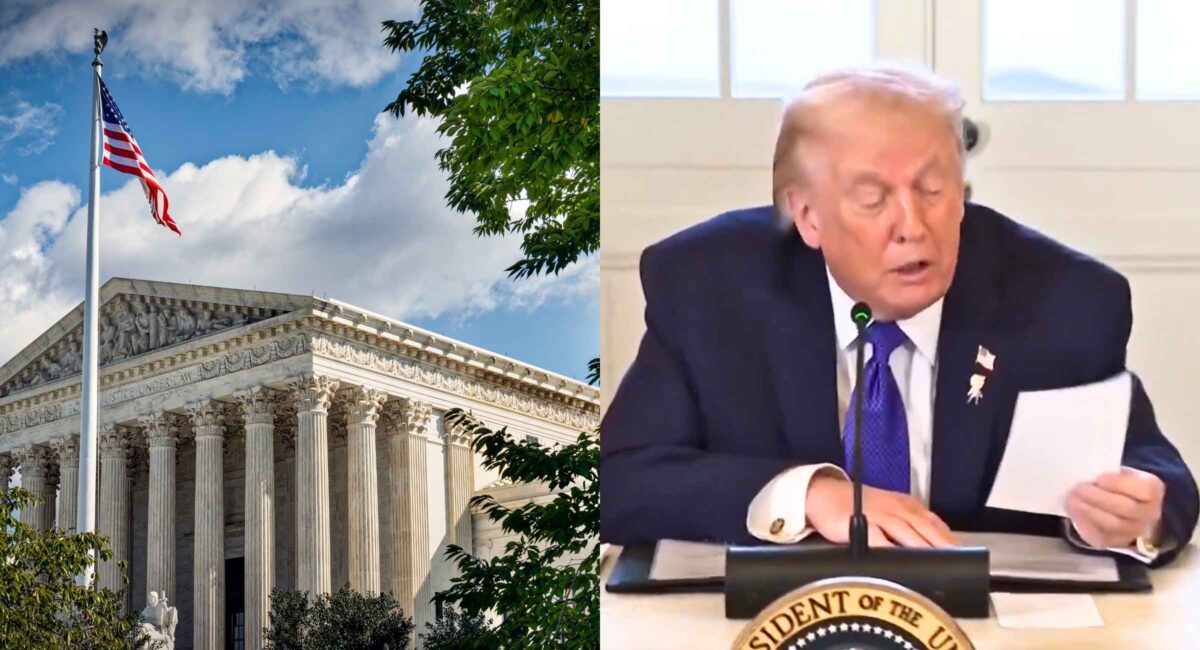
In a watershed moment for U.S. trade law on February 20, 2026, the U.S. Supreme Court ruled 6-3 that President Donald Trump exceeded his constitutional authority by imposing sweeping global tariffs under the International Emergency Economic Powers Act (IEEPA) — effectively striking down those tariffs as unlawful. In direct response, Trump signed an executive order to impose a new 10 % global tariff under Section 122 of the Trade Act of 1974, shifting his legal basis from IEEPA to statutory trade authority while sparking a fierce legal, economic, and political backlash both domestically and internationally.
What the Supreme Court Ruling Changed
IEEPA Authority Rejected
In a majority opinion authored by Chief Justice John Roberts, the Supreme Court held that the International Emergency Economic Powers Act — a 1977 law originally designed to grant the president powers to impose sanctions during genuine national emergencies — does not authorize the president to impose tariffs. The Court found that:
- IEEPA lacks explicit language granting tariff authority, and
- Congress, when it intends to grant tariff powers, typically does so in specific trade statutes, not in general emergency powers.
“The Government thus concedes that the President enjoys no inherent authority to impose tariffs during peacetime,” Roberts wrote, singling out the constitutional separation of powers and the requirement that tariff authority resides primarily with Congress.
6 – 3 Vote With Conservative and Liberal Unity
The decision was notable for its bipartisan judicial agreement. Conservatives like Roberts joined all three liberal–leaning justices to form the majority, while Justices Brett Kavanaugh, Clarence Thomas and Samuel Alito dissented, asserting that tariff imposition under IEEPA could be lawful and emphasizing historical precedent and executive flexibility in trade policy.
Kavanaugh’s dissent argued that reading IEEPA to allow tariffs was within long-standing presidential practice, even if controversial.
Why This Matters: Constitutional and Economic Context
IEEPA’s Limits Confirmed
IEEPA was enacted during the cold war to give the president tools to impose sanctions and block transactions during genuine emergencies. The Supreme Court majority insisted that deploying IEEPA for broad tariff levies — affecting more than 100 countries and touching trillions in trade — was beyond what Congress authorized.
This isn’t just legal theory: tariffs function as taxes on imports, which the Constitution’ Article I explicitly grants to Congress to regulate. By rejecting the broad IEEPA interpretation, the Court reaffirmed that major economic policy changes require clear statutory authorization from Congress — a ruling that could influence future disputes over executive power.
Economic Upset and Revenue Impact
Trump’s IEEPA-based tariffs had formed a core part of his second-term trade policy, generating tens of billions in revenue by taxing imports from partners including China, Canada, and Mexico. With the tariffs invalidated, companies and states — including Nevada and Illinois — are now pressing for refunds of collected duties, a process that could tie up federal funds and courts for years.
Trump’s Immediate Reaction: New 10 % Global Tariff
Within hours of the ruling, President Trump responded forcefully:
- He denounced the Court’s decision, calling it a “disgrace” and accusing certain justices of undermining national interests.
- Trump signed an executive order imposing a temporary 10 % global tariff under Section 122 of the Trade Act of 1974, which gives the president authority to levy duties of up to 15 % for up to 150 days to address trade imbalances.
Section 122 is a statutory authority which, unlike IEEPA, was explicitly designed to give presidents trade tools in specific circumstances, although its use is time-limited and more constrained.
Trump described this pivot as preserving his trade agenda while asserting that the Supreme Court had overreached, even as legal scholars noted that Section 122 tariffs are narrower and might not fully replicate the breadth of the former IEEPA levies.
Political and Legal Fallout
White House and Republican Response
Trump’s immediate criticism was blistering: he blasted the justices who supported the majority opinion, including two he had himself appointed, and vowed to “continue to fight for American workers” via legislative and executive avenues.
The administration also signaled plans to launch Section 301 trade investigations under the Trade Act of 1974, which could justify additional tariffs on countries engaging in unfair trade practices.
Congressional and Industry Reaction
While some Republicans echoed Trump’s critique, others acknowledged the constitutional line drawn by the Court, emphasizing that trade policy must involve Congress.
Industry groups were divided: importers welcomed the ruling as a return to legal clarity, while others expressed concern that tariff uncertainty could chill investment and complicate supply chains.
Global Trade Partners Respond
Foreign governments weighed in cautiously. Many, including Brazil and ASEAN members, welcomed the ruling as reducing protectionist pressure. Others, like Argentina and some European countries, warned that new tariff initiatives could maintain economic uncertainty.
What Happens Next — Refunds, Legal Battles, and Policy Debates
Refunds and Litigation
One of the most pressing unresolved questions is whether and how refunds will be issued for tariffs collected under the now-struck IEEPA authority. Courts may need to determine whether importers have a right to repayment and how that affects federal finances.
Alternative Tariff Tools
While IEEPA tariffs are gone, other statutory authorities remain:
- Section 232 of the Trade Expansion Act — allows tariffs for national security reasons.
- Section 301 — allows tariffs in response to unfair trade practices after investigations.
- Section 338 — rarely used, but provides another presidential tariff option.
These tools may allow the administration to preserve parts of its trade agenda, but they require findings, procedures, and legal justification that are significantly more transparent and subject to challenge than unilateral IEEPA edicts.
Conclusion — A Major Shift in U.S. Trade Policy and Executive Power
The Supreme Court’s 6-3 ruling striking down President Trump’s global tariffs under IEEPA represents a seminal moment in U.S. governance — reaffirming the constitutional limits on executive authority and rebalancing the separation of powers in trade policy. Trump’s swift response, employing Section 122 of the Trade Act of 1974 to impose a new 10 % global tariff, underscores the administration’s determination to pursue its trade objectives even within tighter statutory bounds.
Economists, policymakers, and trade lawyers alike will be watching closely as this dispute unfolds through litigation, legislative engagement, and international reactions — a contentious chapter shaping the future of American trade authority and global market dynamics.onomically to IEEPA tariffs, I can provide that next.