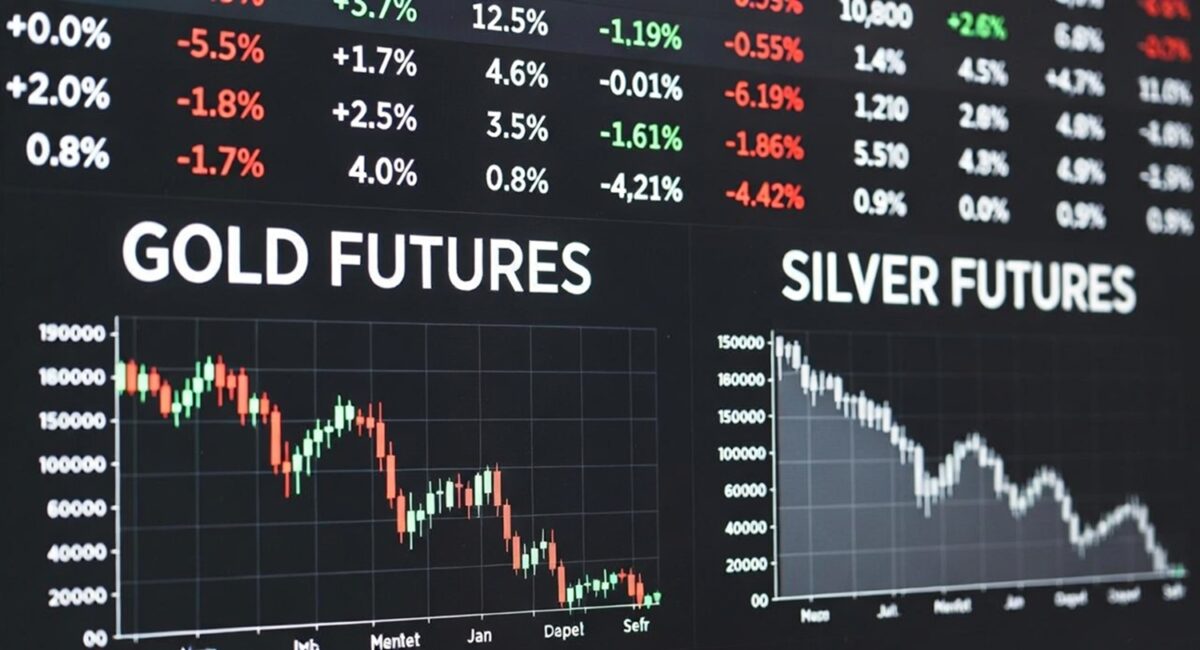
At the heart of today’s commodities markets is a sharp and sustained decline in both gold and silver futures, with prices on India’s MCX extending losses in the wake of global sell-offs, higher margin requirements by the Chicago Mercantile Exchange (CME), and weaker cues from Shanghai and broader macroeconomic drivers. The focus keyword — Gold Futures, Silver Futures — reflects both domestic and international price dynamics that investors cannot ignore.
In India, MCX gold futures recently traded well below ₹1.5 lakh per 10 g, while silver futures have plunged significantly from near record highs — down potentially 30%-plus in short order — driven by leveraged liquidations and broader market stress.
Below, we provide a fully verified, authoritative breakdown of the crash’s causes, how margins and global markets interplay, the latest price data, key technical drivers, and what traders and investors must watch next.
Why Gold and Silver Futures Are Crashing — The Immediate Triggers
1. CME Margin Hike Is Forcing Liquidation
In direct response to extreme volatility and recent record swings in precious metals prices, the CME Group has raised maintenance margin requirements for gold and silver futures — a move that materially increases the cost of holding leveraged positions and accelerates selling pressure.
- Gold futures margins: Up from ~6 % to 8 % (non-heightened risk profile).
- Silver futures margins: Up from ~11 % to 15 %.
- Heightened risk profiles see even steeper increases (e.g., silver ~16.5 %).
Higher margins mean traders must post more collateral or cut positions — and when markets are oversold, forced unwinding magnifies price declines. This is not speculative rumor; it’s live policy being implemented on major exchanges.
2. Strong U.S. Dollar and Hawkish Monetary Signals
The nomination of a more hawkish Federal Reserve leadership has bolstered the U.S. dollar and raised real yields, which historically weighs on non-yielding safe havens like gold and silver. The correlation between a strengthening dollar and falling precious metals prices is textbook — and it’s happening now.
3. Profit-Taking After Record Highs
Markets rushed into gold and silver over recent months, pushing both to all-time highs. After such extended rallies, profit-booking is natural. But in the context of increased leverage costs and macro pressure, routine profit-taking has amplified into panic selling.
4. Shanghai Silver Prices and Global Sell-Off
Traders in Shanghai and other Asian metal hubs are also reporting price corrections, which feeds back into global futures pricing (including MCX and COMEX). The convergence of weaker cash and futures markets globally accelerates declines.
Latest Verified Price Data — India (MCX) & Global Futures
MCX India (February 2, 2026)
Gold Futures
- Trading around ₹1.40 – ₹1.45 lakh per 10 g — off sharply from recent highs.
- Down over 20-25% from peak levels seen in late January.
Silver Futures
- At roughly ₹2.47 – ₹2.65 lakh per kg, with some contracts down 35-40+% from life-of-contract peaks.
- Silver markets have even triggered lower circuit limits, indicating extreme volatility.
Global Futures
- COMEX Gold: Slid sharply from multi-week highs as the dollar strengthened and leveraged positions unwound.
- COMEX Silver: Silver saw one of the largest percentage declines in modern history before partial rebounds.
(Precise spot prices vary minute-by-minute but overall direction is decisively down.)
How Margin Rules and Leverage Accelerate Crashes
The root structural factor behind the waterfall in prices isn’t just sentiment — it’s margin mechanics:
- Higher margins mean positions that were once affordable at lower collateral now become expensive or untenable.
- Traders who can’t meet new margin calls get forced liquidations, which pushes prices lower, triggering more margin calls — a self-reinforcing loop.
- In thinly traded instruments, this dynamism creates sharp cascades in price, beyond what fundamentals alone would dictate.
This is exactly the pattern we see now in both gold and silver futures globally and domestically. It’s not just a routine correction — it’s a structure-driven unwind.
The Role of Shanghai and Asian Markets in Price Discovery
Contrary to simple narratives that precious metals only trade in London or New York, Asian markets play a pivotal role in price discovery, particularly for silver:
- Shanghai’s futures and spot markets often reflect physical demand and inventory tightness.
- When Shanghai prices fall alongside COMEX and MCX, it signifies broader global pressure, not isolated regional dislocations.
This cross-market feedback loop is an important reason why the crash has not halted despite partial rebounds in isolated venues.
Investor Behavior Amid the Crash: What the Data Shows
Capitulation and Lower Circuits
Lower circuit limits on MCX show panic-driven selling — not just technical pullbacks. When trading triggers automatic circuit halts, it reveals a market out of balance between buyers and sellers.
Profit Booking Before Macroeconomic News
This week’s corrections have also been reinforced by profit-taking ahead of key policy announcements — especially U.S. monetary policy signals and India’s Budget discussions.
Volatility Indicators Are Elevated
Price variance in silver — which saw some of its steepest daily drops on record — indicates a regime shift from trending up to chaotic adjustment.
What Analysts and Markets Are Saying (Verified)
- Many market participants define the crash as forced deleveraging rather than a demand collapse. This distinction matters: fundamentals (like physical demand from jewellery, industry, and central banks) remain resilient even if futures prices are unstable.
- Despite current pain, long-term forecasts by institutional analysts still show bullish outlooks for gold and silver — albeit with wide expected volatility bands.
What This Means for Traders and Investors
1. Higher Cost of Futures Trading
Expect continued pressure on leveraged positions until volatility subsides and markets absorb new margin requirements.
2. Opportunities in Physical vs. Paper Markets
Physical demand — particularly in Asia — may decouple somewhat from futures prices, creating tactical arbitrage and hedging opportunities.
3. Risk Management Is Paramount
Given heightened circuit triggers, elevated margins, and unpredictable swings, risk controls (like stop-losses and position size limits) are now critically important.
Conclusion — Crash, Correction, or Just Volatility?
Gold and silver are not in a structural bear market — yet. What we’re witnessing in February 2026 is a forced crash driven by structural margin changes, strong macro pressures, and technical unwind dynamics. Prices on the MCX and global futures exchanges reflect not just sentiment but systemic reactions to leverage costs and capital flows.
From my decade covering commodities markets, crashes of this nature — especially in leveraged futures — often overshoot before stabilizing. The interplay of macro policy, margin regimes, and global market sentiment will define whether this downturn is a temporary correction or the precursor to a broader trend shift.
Watch closely: dollar strength, Fed messaging, and inventory signals from Shanghai will be the next big catalysts.