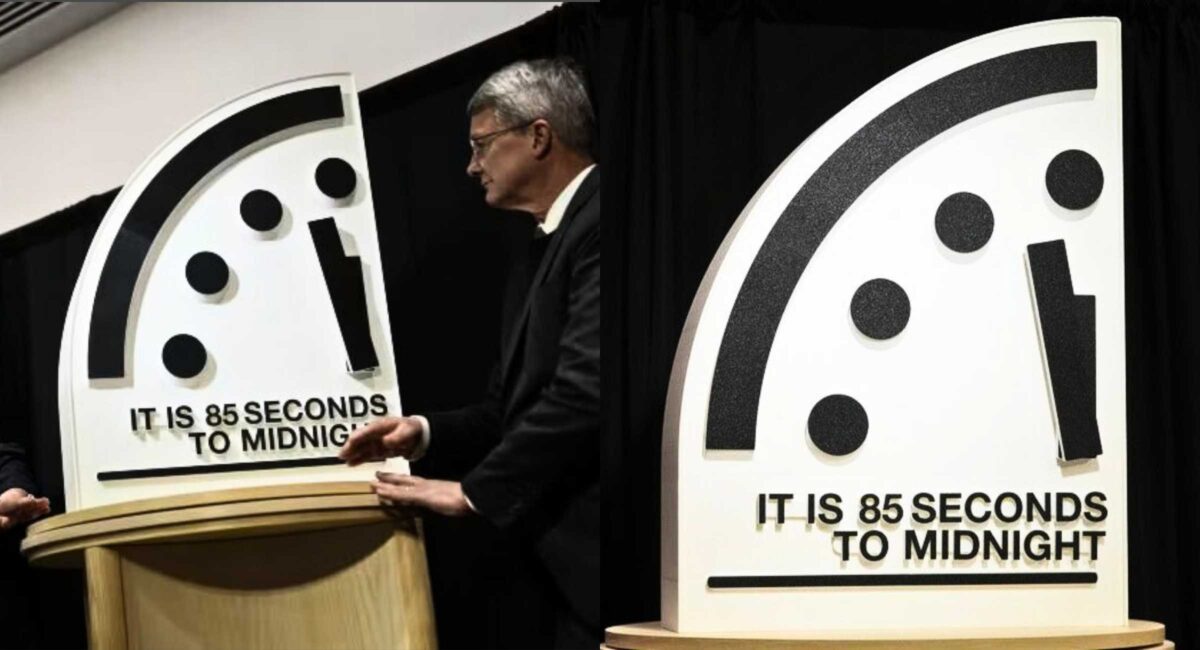
In January 2026, the Bulletin of the Atomic Scientists — the authoritative organization founded in 1945 by Albert Einstein, J. Robert Oppenheimer and leading University of Chicago physicists — moved the Doomsday Clock to 85 seconds to midnight, the closest this symbolic measure of global catastrophe risk has ever been. This shift reflects sharply rising dangers from nuclear tensions, climate change, artificial intelligence, biological threats and a widespread breakdown in international cooperation.
What Is the Doomsday Clock?
The Doomsday Clock is a symbolic representation of how close humanity is to existential catastrophe — literally the metaphorical “midnight.” The closer the minute hand is to midnight, the higher the assessed risk of global disaster due to human-made threats. In 2026, that time was set at 85 seconds to midnight, the closest ever recorded since the Clock’s inception in 1947.
Why 85 Seconds to Midnight?
1. Nuclear Weapons Risks Have Escalated
The Bulletin’s statement highlighted that deteriorating diplomacy among nuclear-armed powers — especially the United States, Russia and China — is a primary factor. Global nuclear arms control frameworks are unraveling, leaving the world more vulnerable:
- The New START treaty, the last major U.S.–Russia nuclear arms limitation pact, is expiring with no clear replacement.
- Major powers are investing in new strategic and defensive weapons that could fuel escalatory arms races.
- Traditional deterrence norms are weakening, pushing non-nuclear states to reconsider nuclear options.
From my experience covering arms control negotiations, such breakdowns typically signal a strategic inflection point — one where miscalculation risks become acute.
2. Climate Change Remains an Existential Force
Climate impacts weren’t merely a side note; in 2026 the Clock’s authors treated them as co-equal with nuclear danger:
- Global carbon emissions continued to rise.
- 2025 ranked among the hottest years on record.
- Insufficient global action on climate mitigation and adaptation persists, undermining long-term stability.
This isn’t alarmist — climate scientists have warned for years that systemic risk multiplies when environmental destabilization intersects with geopolitical stress.
3. Artificial Intelligence: A New Frontier of Risk
Artificial intelligence is now explicitly factored into the Clock’s risk calculus — a major step from past decades:
- The Bulletin flagged AI’s integration into military systems and decision-making processes as a destabilizing force.
- Experts warn unregulated AI could accelerate weapons proliferation or erode social cohesion through misinformation.
- AI-aided biotechnologies raise the specter of engineered biological threats.
Given the rising role of large language models and automation in national security frameworks, this inclusion reflects genuinely unprecedented risk channels.
4. Collapse of International Cooperation
One theme that threads through the 2026 assessment is the failure of global leadership:
- The Bulletin bluntly described global politics as increasingly aggressive and nationalistic.
- Cooperation on arms control, climate policy and technological governance has stalled or regressed.
- The erosion of international norms — especially in biosecurity and information ecosystems — deepens systemic fragility.
This breakdown isn’t abstract. It’s the lived reality of diplomats and scientists who tell me that without sustained trust and mechanisms for cooperation, even incremental risk reduction becomes harder year by year.
Historical Context: How We Got Here
The Doomsday Clock has been adjusted nearly every year since 1947. In the early Cold War, it fluctuated between minutes and even 17 minutes to midnight at its safest point after the 1991 Strategic Arms Reduction Treaty.
Past decade shifts have been stark:
- 2020: 100 seconds to midnight (nuclear, climate, cyber disinformation).
- 2023: Moved to 90 seconds, influenced by Russia’s invasion of Ukraine.
- 2025: 89 seconds — the closest yet at that time.
- 2026: 85 seconds — a 4-second jump, marking the most perilous setting in the Clock’s history.
This rapid compression over just a few years underlines how interconnected today’s threats have become.
What Experts Are Saying
Alexandra Bell, President and CEO of the Bulletin, stated clearly: “The Doomsday Clock’s message cannot be clearer. Catastrophic risks are rising, cooperation is declining, and we are running out of time.”
Daniel Holz, chair of the Bulletin’s Science and Security Board, stressed that the rise of nationalistic autocracies and the collapse of norms around arms control and climate policy are acute risk multipliers.
Importantly, while some commentators debate the scientific precision of the Clock, leading risk analysts view it as a heuristic tool grounded in expert judgment — not a deterministic forecast of apocalypse.
What This Means in Practical Terms
This year’s assessment lays out a stark but precise roadmap of systemic vulnerabilities:
- Nuclear Arms Control: Renew or replace key treaties, de-escalate modern arms races.
- Climate Policy: Scale emissions cuts, expand renewable energy deployment aggressively.
- AI Regulation: Create enforceable international frameworks for AI development and use.
- Biosecurity: Strengthen global cooperation on pathogen surveillance and containment.
These are not abstract goals — they align with what public policy and risk management specialists have been advocating for years.
Conclusion: The Clock as a Warning, Not a Prediction
The Doomsday Clock at 85 seconds to midnight is a quantitative metaphor of human-made existential risk, not a literal timer counting down to inevitable destruction. It reflects expert consensus that geopolitical fragmentation, unchecked technological deployment, environmental degradation, and eroding diplomatic norms have converged into an era of unprecedented danger.
From my experience covering global security policy, this setting isn’t an alarmist gimmick — it’s a clarion call grounded in decades of scientific and strategic assessment. The Clock doesn’t predict doom; it warns that our collective trajectory — unless altered through strong leadership and cooperation — increases the probability of catastrophic outcomes.
We’re not powerless. The Doomsday Clock moves forward because leaders have failed to act — and it can move backward if they choose to change course.
Next Steps for Policymakers and Citizens
- Demand transparent international negotiations on arms control.
- Advocate for robust, enforceable climate agreements.
- Call for global AI safety standards and ethical oversight.
- Support scientific diplomacy and multilateral biological threat reduction.
Humanity’s future isn’t fixed — but at 85 seconds to midnight, the window for meaningful action is unmistakably narrowing.