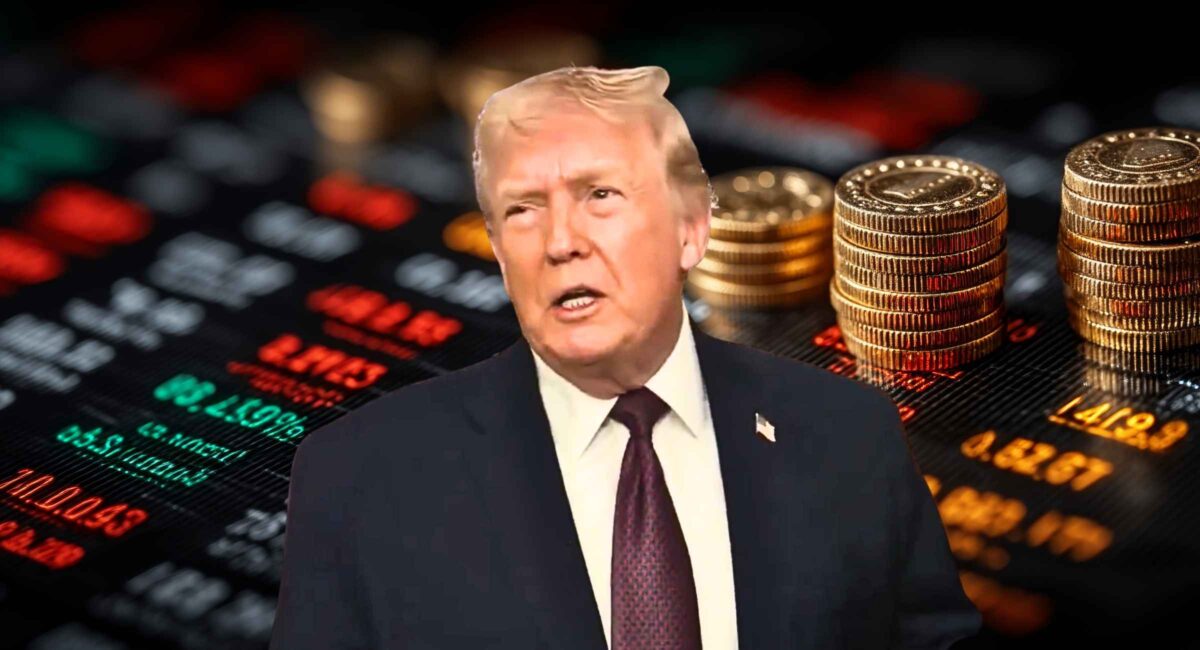
Investors around the world reacted sharply in mid-January 2026 after President Donald Trump announced sweeping tariff threats tied to his demand that the United States be allowed to acquire Greenland. U.S. stock futures plunged — pointing to more than 600-point drops on the Dow, S&P 500 futures down over 1.4 percent, and Nasdaq futures sliding nearly 1.7 percent — while gold prices hit record highs and Treasury yields spiked to multi-month peaks as traders sought safe-haven assets amid geopolitical uncertainty and fears of a trade-war escalation.
Why Trump’s Greenland Tariff Threats Rocked Markets
On January 17–19, 2026, President Trump publicly threatened to impose additional tariffs of 10 percent starting February 1 — rising to 25 percent by June 1 — on imports from eight European countries unless those nations supported his ambition to control Greenland.
That message — tying trade policy directly to territorial demands — was an unusual mix of geopolitical posturing and economic coercion. Markets, which detest uncertainty (especially when it comes from top-level policy), reacted swiftly. The result: a broad sell-off across equities, and a rush into traditional safe havens like gold and long-dated U.S. Treasuries.
How Stock Futures Reacted — A Global Risk Sell-Off
U.S. Markets Brace for Major Dow Drops
When markets reopened after the Martin Luther King Jr. holiday, stock futures plunged sharply — signaling a turbulent week for Wall Street:
- Dow Jones Industrial Average futures were down about 1.3 percent, pointing to a more than 600-point drop at the open.
- S&P 500 futures sank 1.4 percent.
- Nasdaq 100 futures slid nearly 1.7 percent.
On overnight trading Sunday into Monday, futures tied to the Dow were already indicating declines of 350 points or more, as traders braced for the fallout from weekend tariff rhetoric.
The defining factor here is investor psychology and positioning — Trump’s tariff threats weren’t tied to economic fundamentals like earnings or growth, but to geopolitical brinkmanship, a type of uncertainty financial markets generally price in with significant downside moves.
European Markets Slide on Trade Tension Fears
The impact wasn’t limited to the United States. In Europe:
- The STOXX 600 fell around 1.3 percent.
- France’s CAC 40 slid nearly 1.8 percent,
- Germany’s DAX dropped about 1.4 percent,
- The UK’s FTSE 100 eased modestly.
European markets reacted to the realization that tariffs aimed at exports from Denmark, Norway, Sweden, France, Germany, the Netherlands, Finland, and the United Kingdom — all key trading partners — could significantly dent growth if implemented and met with retaliation.
This broad sell-off reflects investor concerns that trade policy is increasingly being weaponized for geopolitical ends, creating a risk premium across global equities.
Flight to Safety — Gold, Silver, and Treasuries Surge
When risk assets like stocks tumble, investors typically seek refuge in safer assets. In this episode of tariff-induced market stress:
- **Gold prices touched record highs — topping around $4,689 per ounce, with futures also surging strongly.
- Silver saw notable strength too, at times climbing above $94 per ounce.
These moves are classic “flight-to-quality” responses — as equities lose appeal under geopolitical strain, capital shifts to stores of value like gold and silver.
At the same time, Treasury yields climbed, particularly at the long end of the curve (10- and 30-year rates), as investors priced in higher inflation expectations and risk premiums tied to geopolitical tensions and potential retaliation. (Yield data are time-sensitive, but broad market commentary confirms a move toward higher long-term yields.)
Currencies and Safe-Haven Flows
The threat of tariffs also rippled into currency markets:
- The U.S. dollar weakened against the Swiss franc and Japanese yen — both traditional safe havens — as markets priced in elevated global risk and potential U.S. political instability.
- The euro recovered some ground after initial declines, reflecting a shift away from dollar safety in a scenario where the U.S. itself is seen as a source of market instability.
This currency action underscores that Trump’s tariff threats impacted not just equity pricing but also perceptions of macroeconomic risk and currency safe-haven status.
Why This Matters — Beyond Short-Term Market Volatility
Geopolitical Risk Is Now a Market Driver
In my years covering markets and geopolitics, few policy announcements have rattled markets so deeply without any immediate implementation date. Here’s the kicker: Trump’s additional tariff threats don’t even take effect until February 1 and aren’t set to escalate until June 1. Yet the response was immediate. That speaks volumes about how sensitive markets have become to geopolitical cues in the post-pandemic, higher-volatility environment.
Trade Wars Have a History of Deep Market Impact
Recall the 2018–2019 U.S.–China tariff wars: markets fluctuated sharply not only when tariffs were implemented but even more on days when traders interpreted policy signals about escalation or de-escalation. Those moves often dwarf actual tariff effects on corporate earnings because they erode investor confidence and risk appetite. In January 2026, investors are playing a similar script.
Retaliation Could Deepen the Sell-Off
European leaders are already discussing retaliatory tariffs of up to €108 billion against U.S. goods in response to Trump’s Greenland tariff threats — a potential escalation that could turn a bilateral standoff into a broader trade conflict.
Markets trade on anticipation as much as reality. The prospect of tit-for-tat tariffs between the U.S. and major European economies adds another layer of uncertainty to global economic growth forecasts.
Inflation, Interest Rates, and Treasury Markets
Another powerful market theme tied to tariff threats is inflation expectations. Tariffs typically raise the cost of imported goods, which can feed into broader price levels. In the current environment — with central banks already balancing tightening and potential rate cuts — the specter of inflation driven by trade barriers complicates policy outlooks.
- If tariffs push up import prices, the Federal Reserve might delay rate cuts, keeping borrowing costs higher for longer.
- Higher long-term yields reflect this recalibration of inflation and growth expectations.
In practical terms: the bond market’s response is a reassessment of the Fed’s likely policy path, which has implications for everything from mortgage rates to corporate financing costs.
Conclusion: A Market Shock Rooted in Geopolitics, Not Fundamentals
The January 2026 market turmoil tied to Trump’s Greenland tariff threats highlights how much influence geopolitical policy now holds over global financial markets. Stock futures plunged more than 600 points in anticipated selling pressure, European equities slid, safe-haven assets like gold and silver surged, and Treasury yields reacted to shifting risk and inflation expectations.
This isn’t a classic earnings or economic data-driven correction; it’s a geopolitical shockwave. And in markets, uncertainty is often the most corrosive force of all. As investors watch whether these tariff threats materialize or are dialed back in negotiations around Greenland and broader Allied relations, volatility — and the repricing of risk — is likely to continue.