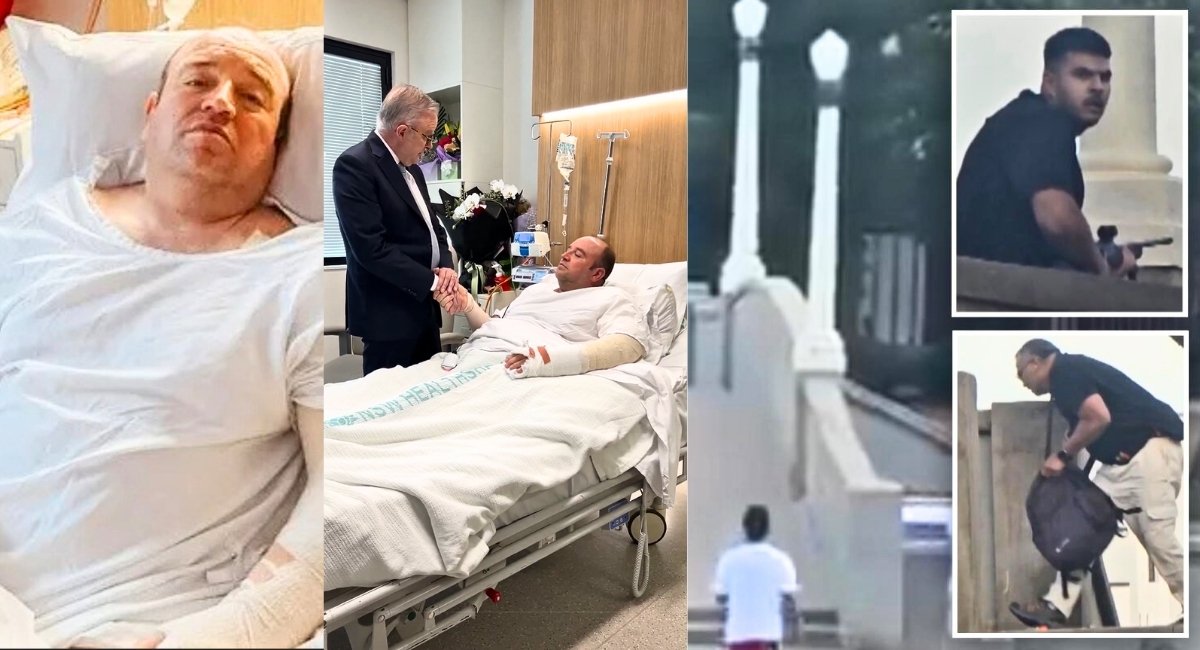
On December 14, 2025, during a widely attended Chanukah by the Sea celebration at Bondi Beach in Sydney, Australia, two shooters opened fire on the crowd, killing at least 15 people and injuring dozens in what Australian authorities have classified as a terrorist attack inspired by Islamic State-style ideology. In the chaos, an unarmed bystander, Ahmed al-Ahmed, courageously tackled and disarmed one of the gunmen—actions that are widely credited with saving many lives and earning him national praise as a hero.
Immediate Summary — What Happened
- What: Mass shooting at a Jewish Chanukah by the Sea event.
- Where: Bondi Beach, Sydney, Australia.
- When: December 14, 2025, around 6:45 p.m. local time.
- Deaths: At least 15 people killed, including children and community leaders.
- Injuries: ~40 people, some critically injured.
- Perpetrators: Two gunmen — a father and son; father killed by police, son in custody.
- Hero: Ahmed al-Ahmed, a 43-year-old local, tackled and disarmed one shooter despite being unarmed himself.
- Motive: Authorities say the attack was targeted and inspired by radical ideology and antisemitism.
How the Attack Unfolded
On a warm Sunday evening at Sydney’s iconic Bondi Beach, thousands had gathered for the Chanukah by the Sea event — a family-friendly celebration marking the first night of Hanukkah, with music, food, and lights. Shortly after 6:45 p.m., witnesses reported bursts of gunfire from a pedestrian bridge near the Bondi Pavilion.
The shooters, later identified by police as Sajid Akram (50) and his 24-year-old son Naveed Akram, opened fire indiscriminately into the crowd. Multiple rounds were fired over several minutes, sending attendees fleeing in terror. Police, who were quickly on the scene, returned fire; Sajid was killed at the scene, while Naveed was wounded and taken into custody.
Authorities also discovered improvised explosive devices in a vehicle linked to one of the attackers, which were safely removed by bomb squads, underscoring the premeditated nature of the attack.
Who is Ahmed al-Ahmed? The Man Who Stopped a Shooter
One of the most remarkable and widely reported aspects of the tragedy was the bravery of Ahmed al-Ahmed, a 43-year-old fruit shop owner and father of two from Sydney’s Sutherland Shire.
Videos verified by multiple outlets show Ahmed, unarmed and caught in the chaos, charging at one of the gunmen, tackling him to the ground, and wresting the rifle away. Even after the gunman retreated and another assailant continued firing, Ahmed’s intervention disrupted the attacker’s ability to cause further death and injury.
In the struggle, Ahmed sustained gunshot wounds to his arm and hand and was hospitalized. Medical sources later confirmed he underwent surgery and was in stable condition the following day.
New South Wales Premier Chris Minns publicly praised Ahmed as “a genuine hero,” stating that many lives were likely saved by his actions. Australian Prime Minister Anthony Albanese also acknowledged his courage, noting that confronting an active shooter without a weapon is the ultimate act of self-sacrifice.
Ahmed’s family, who arrived from Syria in recent months, echoed the sentiment — asserting that his instinct to protect others came from a deep moral conviction rather than any training or expectation.
The Victims — Lives Lost and Communities Shaken
Among the 15 people killed were individuals ranging from children to elders. Reported victims include:
- A 10-year-old girl.
- Rabbi Eli Schlanger, a leader in the Chabad community.
- A Holocaust survivor and other community members.
- Visitors from abroad, including a French national.
Dozens more — including bystanders, families, and two police officers — were injured and taken to nearby hospitals, many in critical condition. The toll reflects both the indiscriminate nature of the shooting and the vulnerability of large public gatherings to such attacks.
Official Response & Classification as Terrorism
Australian authorities quickly described the incident as a terrorist attack shaped by antisemitic intent, noting that ISIS-style ideology appeared to have inspired the gunmen. Flags and other material related to extremist groups were found in one of the suspect’s vehicles, and investigative leads include prior surveillance by domestic intelligence.
Prime Minister Albanese was unequivocal in his condemnation, calling the act “pure evil” and “an attack on Jewish Australians.” He emphasized unity across the nation and vowed to pursue justice and legislative reforms in the wake of the tragedy.
New South Wales Police Commissioner Mal Lanyon confirmed the police response, noting the rapid deployment of specialized units and efforts to secure the area and protect survivors.
Australia’s Gun Laws Under Scrutiny
This shooting — the deadliest mass shooting in Australia since the 1996 Port Arthur massacre — has reignited intense debate about the country’s firearms laws. Australia is known for some of the strictest gun regulations in the developed world, enacted after Port Arthur, but the Bondi tragedy has prompted leaders to propose new limitations on licensing, periodic review of ownership, and tighter controls on high-risk individuals.
Authorities indicated that the elder suspect had legally obtained and maintained multiple firearms licenses and had owned several weapons, raising questions about monitoring and review mechanisms.
Public Reaction — Mourning and Tribute
Across Sydney and around the world, responses ranged from grief to admiration. Memorials — flowers, candles, and messages — have sprung up around Bondi Beach. Public figures and religious leaders have underscored the need for solidarity against hate and violence, stressing the importance of community resilience.
Leaders from allied countries and communities also voiced support — recognizing both the victims and the courage of individuals like Ahmed al-Ahmed, whose actions provided a rare beacon of hope amid profound tragedy.
Why This Matters — Beyond the Headlines
What happened at Bondi Beach isn’t just another awful headline. For Australians, it’s a seismic shift — a rare act of terror on home soil that has shaken national confidence in security and raised difficult questions about radicalization, community cohesion, and preventive frameworks.
And yet, in the face of that darkness, the actions of a single ordinary man — unarmed, unexpected, and incredibly brave — remind us that individuals can still intervene to change outcomes in moments where seconds count and lives hang in the balance.
Conclusion — Courage in the Midst of Crisis
The Bondi Beach shooting will be remembered for its horror, its toll, and the profound sorrow it brought to families and communities. But it will also be remembered for Ahmed al-Ahmed’s extraordinary act of bravery — a reminder that courage doesn’t always come from uniformed heroes, but from ordinary people who refuse to stand by when others are in danger.
As investigations continue and Australia grapples with the implications of this attack, one truth remains clear: his decision to confront danger saved lives — and in a world all too familiar with tragedy, that legacy matters.