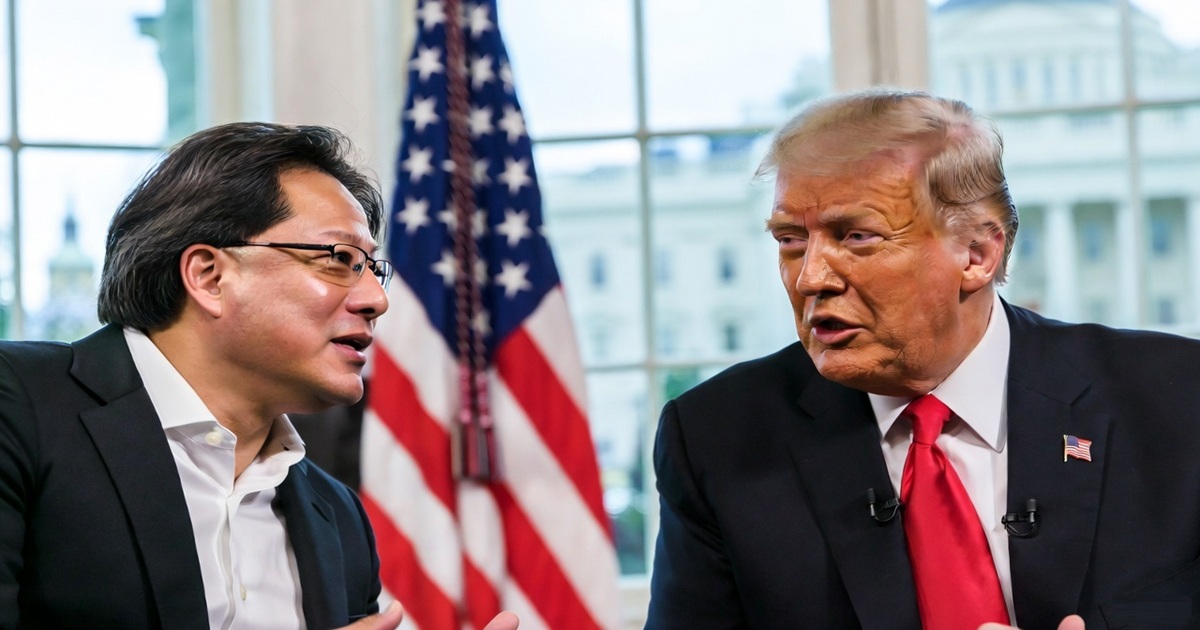
Yes — Jensen Huang met Donald Trump and publicly criticized fragmented, state-by-state AI regulations. He argued such patchwork laws threaten U.S. competitiveness and that federal export-control policy — not dozens of varying state laws — must shape AI’s future.
Key Takeaways
- Huang met Trump and lawmakers to push for consistent export controls and oppose state-level AI restrictions.
- He warned that state-by-state AI regulations would “halt” industry progress and even pose national-security risks by fragmenting U.S. technological leadership.
- On chips for China: Huang backs a controlled export-license system but argues any exported AI hardware must remain competitive—degraded versions are unworkable.
- He framed restrictive export curbs as self-destructive: they pushed China to build its own stack — reducing U.S. market share and accelerating foreign competition.
What Happened — Quick Facts
- On December 3, 2025, Nvidia CEO Jensen Huang held closed-door talks with Trump and several Republican senators in Washington, focusing on export controls for AI chips, regulatory policy, and global competitiveness.
- Post-meeting, Trump praised Huang and noted Huang “knows” the administration’s stance — indicating the conversation aligned with White House thinking.
- During discussions, Huang reiterated support for export-control regimes — but under strict conditions: chips exported abroad must remain fully functional, not crippled or “degraded.” He warned that diffusing inferior versions will be rejected by customers and undermines U.S. firms’ credibility.
Why It Matters
A Fragmented Regulatory Approach Could Undermine U.S. AI Edge
Huang didn’t mince words: allowing each U.S. state to craft its own AI regulations would fracture the industry. That means moving parts, inconsistent compliance rules, and greater uncertainty for companies working across states. It might slow development, erode U.S. firms’ competitive advantage — and indirectly benefit international rivals.
He put it bluntly: state-by-state rules “would slow down everything,” and might even pose national-security risks.
Export-Control Policy is More Than Trade — It’s Tech Strategy
This meeting is also about the export of AI chips. Under earlier restrictions, exports to China were largely blocked — a policy Huang and Nvidia say backfired. Instead of stalling China’s AI ambitions, restrictions drove them to accelerate domestic alternatives.
Huang argues that a nuanced policy — allowing export under license and ensuring exported chips remain competitive — better serves U.S. economic and strategic interests.
The Stakes Are High: Global AI Market, Jobs, and Innovation Dominance
By reducing friction for chip exports and backing streamlined regulation, Huang positions U.S. firms to once again lead global AI infrastructure — meaning large-scale data centers, cloud AI services, tools that power startups, and heavy demand for hardware.
If Washington opts for inconsistent state laws or draconian export bans, American firms may lose ground — while competitors abroad surge.
Strategic Implications: What to Watch Next
| Factor | Potential Impact |
|---|---|
| Federal vs State AI regulation | A unified federal framework could accelerate development, ease compliance, and maintain U.S. leadership. A patchwork of state laws may slow progress and fragment markets. |
| Export licensing for AI chips | Smart licensing — combined with high-performance hardware — might preserve global competitiveness while managing security concerns. |
| Global competitiveness vs national security trade-off | Striking the balance matters. Over-restricting may hand away global AI infrastructure to competitors. Over-relaxing risks exposure. |
| Role of U.S. tech firms in global AI ecosystem | Firms like Nvidia, leveraging favorable policy, could anchor global AI platforms — but only if policy supports consistency, quality, and access. |
What Huang’s Position Reveals
- He sees AI not just as business, but as geopolitical leverage. Limiting exports or adopting disjointed regulation surrenders long-term edge.
- “Degraded-chip” strategies are short-sighted. For firms abroad, performance matters. Selling them crippled GPUs hurts adoption and pushes them to alternatives.
- The real competition isn’t just among firms — it’s between regulatory regimes. The U.S. risks falling behind if laws stifle pace or fragment standards.
Huang’s push reminds us: policy isn’t technical. It shapes who builds the future of AI — and how fast.
Frequently Asked Questions
No. He supports controlled exports under a licensing system, provided exported chips remain fully capable — not “degraded” versions.
Yes. He warned state-by-state rules would fragment the industry, slow development, and even pose national-security risks.
Because China represents a massive AI market with a large base of developers. After export curbs reduced Nvidia’s share, Huang argued re-entering via licensing would restore lost revenue, support U.S. industrial growth, and prevent China from building a full alternative stack.